
- Catalogs
- Böllhoff Verbindungstechnik GmbH
- IMTEC® Moulded inserts

IMTEC® Moulded inserts

IMTEC® Moulded inserts
The document focuses on IMTEC® thread inserts used in in-moulding processes, particularly within the ReLei research project aimed at enhancing electromobility and recycling strategies for lightweight structures in fibre-reinforced composite hybrid design. This project is supported by the German Federal Ministry of Education and Research.
In-Moulding and After-Moulding Processes
In-moulding involves placing inserts on core pins before injecting plastic, suitable for both thermoplastics and thermosets. After-moulding involves embedding inserts post-moulding, also applicable to thermoplastics and thermosets. Both methods address technical and cost considerations.
IMTEC® Thread Inserts – Product Types
IMTEC® CO and IMTEC® CF are the two main types of thread inserts. IMTEC® CO, made from stainless steel wire, is ideal for blind hole threads, offering corrosion resistance and high extraction force. IMTEC® CF, made from cold-formed steel, is suitable for through-hole threads, providing torque and pull-out resistance.
Processing Methods
IMTEC® thread inserts can be used in various processing methods such as plastic injection moulding, hybrid injection moulding, and aluminium die casting, each with specific requirements and advantages like functional integration and process reliability.
Technical Data
The document includes detailed technical data for IMTEC® CO and CF, covering dimensions, torque, and pull-out values. It emphasizes the importance of dry film lubrication and magnetized core pins.
Fields of Application
IMTEC® thread inserts are used in fields requiring high strength, stiffness, and weight reduction, suitable for hybrid parts and light-metal components.
Conclusion
IMTEC® thread inserts provide innovative solutions for in-moulding processes, offering benefits like corrosion resistance, high extraction force, and functional integration, making them versatile for various applications in hybrid and light-metal component production.
The document specifies IMTEC® thread inserts, including standard versions made of galvanized steel. Closed-end versions and various diameters (M 4 to M 12) are available upon request. Component lengths range from 10 to 25 mm for M 6 and 10 to 30 mm for M 8, with a tolerance of ± 0.15 mm. Head diameters range from 12 to 20 mm, and tooling costs should be considered.
Applications
IMTEC® inserts are used in fields such as medical technology, automotive, plastics technology, electrics, electronics, and fluid technology. Customization for thread inserts and applications is offered.
Product Information
The document provides links to videos and product catalogues for various thread inserts, including IMTEC® for in-moulding processes and AMTEC® for after-moulding joining in plastic components, as well as others for specific materials like aluminium die casting.
Company Information
Böllhoff Group is presented as an innovative partner in joining technology, offering assembly and logistics solutions. Contact information and notes on technical changes and reprinting permissions are included.
Catalog excerpts

Thread inserts for in-moulding processes
Open the catalog to page 1
We are a partner of the ReLei research and development project Fabrication and recycling strategies for electromobility to recycle lightweight structures in fibre-reinforced composite hybrid design This research and development project was funded by the German Federal Ministry of Education and Research within the conceptual framework „Innovations for the production, service and work of tomorrow“ (reference number 02PJ2800–02PJ2808) as well as by the Energy and Climate fund and supervised by the project sponsor Projektträger Karlsruhe (PTKA). Funded by Partners production methods Partners materials...
Open the catalog to page 2
This icon indicates further information in the form of a brochure and/or video.
Open the catalog to page 3
In-moulding and after-moulding - the processes The continuing further technological development has led to constantly increasing requirements for components and their applications. Often, they are so high that one material alone cannot meet them. Therefore, it is of particular interest to combine the specific advantages of different materials. As a joining technology expert, Bollhoff recognised this beneficial synergy effect very early on and in addition to the well-known AMTEC® after-moulding technology, which has been tried and tested for years, also offers IMTEC® thread inserts for in-moulding...
Open the catalog to page 4
In-moulding and after-moulding - the processes There is a general decision you have to make: Mould in inserts or embed later? Basically, both principles meet all technical requirements in a similar way and cause comparable costs with respect to the used fasteners. Based on experience and provided equipment, you as the user decide which joining technology is better suited for your production environment. However, before we start to take a closer look at the IMTEC® technology, we invite you on a short illustrated excursion into the differentiation between the two joining technologies. After-moulding...
Open the catalog to page 5
Bollhoff offers with the IMTEC® moulded inserts two innovative product developments for in-moulding of metal threads in components of polymer, composite or light-metal components*: IMTEC® CO - Particularly for creation of blind-hole threads The IMTEC® CO thread insert for in-moulding is an asymmetric rolled stainless steel A2 (option A4) wire which is mainly used for customer components with blind hole threads. That wire is coiled to form a fixed bushing with at least one flange-type extension. In the forming process, the fasteners are also sufficiently magnetised and can be placed on magnetic...
Open the catalog to page 6
IMTEC® thread inserts – overview of the processing methods Here you find an overview of the IMTEC® thread technology relating to different processing methods. Processing methods Plastic injection moulding Hybrid injection moulding – e.g. organo sheets, tapes, … Cast aluminium Compression moulding (SMC, GMT) check check clear check Choose the perfect innovative principle of IMTEC® thread technology for your requirements. Application area clear Blind-hole thread Minimum remaining wall thickness Through-hole thread Large through hole in the screwed on parts; very soft counter parts Functionality...
Open the catalog to page 7
IMTEC® thread inserts – the different processing methods Plastic injection moulding IMTEC® is used for forming, particularly in injection moulding (here in-moulding technology). For the manufacture of plastics-metal components (hybrid parts), a system composed of injection moulding machine, injection mould and optionally automation technology is required. The injection mould preferably made of steel consists of several components and different single parts. Only the core pins of the injection moulds have to be geometrically adapted to the IMTEC® moulded inserts to achieve great accuracy and reproducibility....
Open the catalog to page 8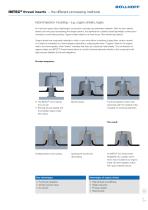
IMTEC® thread inserts – the different processing methods Hybrid injection moulding – e.g. organo sheets, tapes An important aspect about lightweight construction concepts are alternative materials. With the low material density and very good processing and design options, the significance of plastic-based lightweight construction concepts is continually growing. Organo sheets relate to the main focus “fibre-reinforced plastics”. Organo sheets are composite materials in which a non-crimp fabric consisting of glass fibre, carbon, aramid or a hybrid is embedded in a thermoplastic polyamide or polypropylene...
Open the catalog to page 9
Since the IMTEC® CO was successfully used for plastic injection moulding, the demand arose to test to expand the field of use to cast aluminium. Here we consider two manufacturing processes in which liquid or pasty aluminium is cast or forced into pre-heated steel moulds (tools or dies) under (high) pressure. There are the following challenges to thread forming in light alloys: ■ Mass melting temperature > 660 °C ■ Different casting methods: - Low-pressure casting (gravity casting, permanent mould casting ...) ■ Thermal damage to surfaces and thread inserts (effects of corrosion) 1. Low-pressure...
Open the catalog to page 10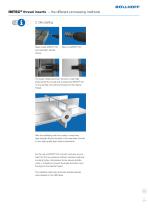
IMTEC® thread inserts – the different processing methods 2. Die casting Steel mould, IMTEC® CO and automatic spindle device. The liquid melted aluminium forced in under high pressure fills the mould and encloses the IMTEC® CO on the spindle core without flowing into the internal thread. After the solidifying melt has cooled, a wear-free, high-strength thread has also in this case been formed in your high-quality light-metal components. For the use of IMTEC® CO, smooth core pins are sufficient for the low-pressure method, whereas methods involving higher compressive forces require spindle cores...
Open the catalog to page 11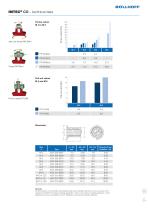
IMTEC® CO - technical data to Dry film lubrication is recommended. Using stainless steel screws potentially cold shuts can occur as a result of the material of the IMTEC® CO inserts A2 (material specification 1.4301/1.4310; option A4 material specification 1.4375). Magnetized core pins can be applied. Core pin: Modification according to the specific application.
Open the catalog to page 12All Böllhoff Verbindungstechnik GmbH catalogs and technical brochures
 TEPRO® K' in K'
16 Pages
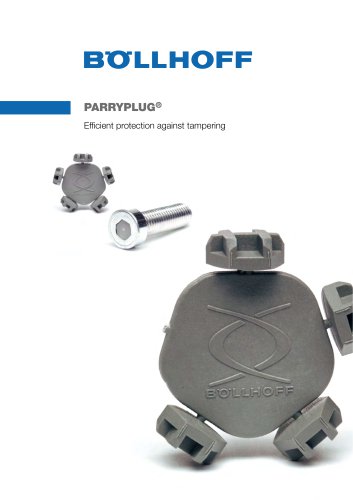 PARRYPLUG®
8 Pages
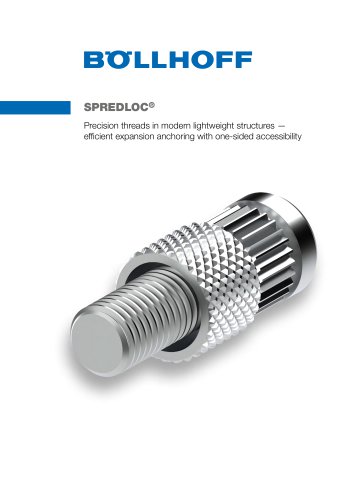 SPREDLOC®
12 Pages
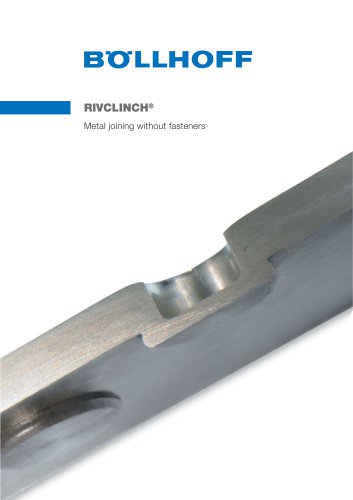 RIVCLINCH®
16 Pages
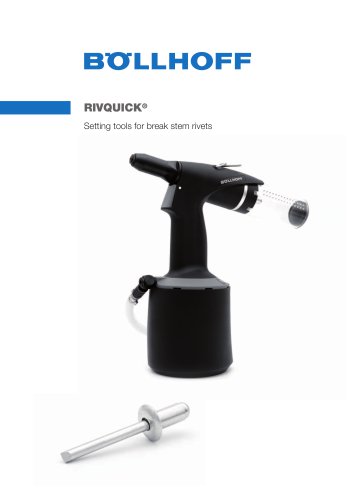 RIVQUICK®
12 Pages
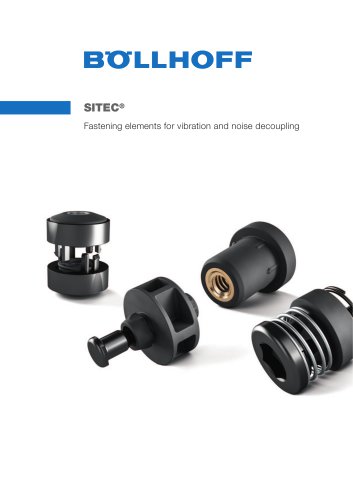 SITEC®
40 Pages
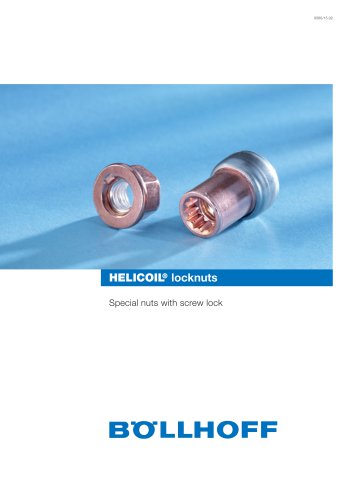 HELICOIL® locknuts
8 Pages
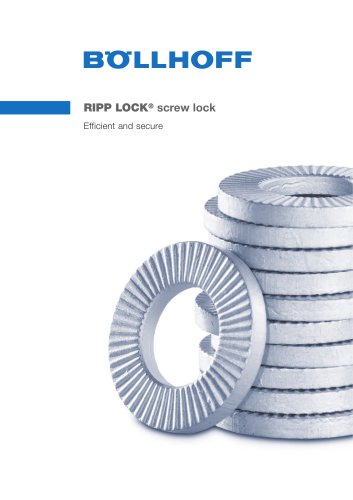 RIPP LOCK®
16 Pages
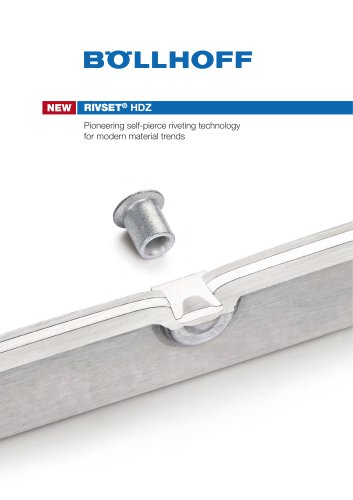 RIVSET®HDZ
4 Pages
 ONSERT®
28 Pages
 SEAL LOCK® Sealing nuts
8 Pages
 HELICOIL® Plus
82 Pages
 RIVTAC®
14 Pages
 Products and Services
40 Pages
 QUICKLOC®
20 Pages
 HELICOIL® Smart
28 Pages
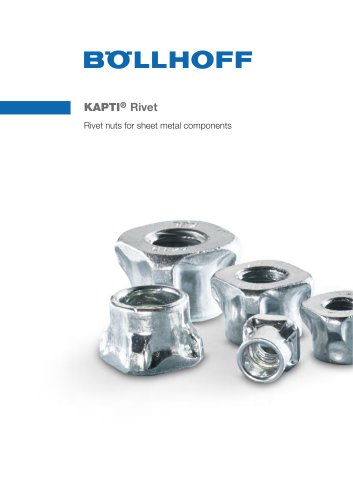 KAPTI® Rivet - Captive nuts
4 Pages
 Product Guide
20 Pages


