
- Catalogs
- Böllhoff Verbindungstechnik GmbH
- FLEXITOL® Tolerance compensation systems

FLEXITOL® Tolerance compensation systems

FLEXITOL® Tolerance compensation systems
The document outlines the FLEXITOL® systems designed for stepless tolerance compensation, emphasizing their significance in modern manufacturing, especially within the automotive sector. It highlights the necessity for efficient assembly processes to meet high production demands and quality standards.
Importance of Tolerance Compensation
Tolerance compensation is essential for ensuring high performance reliability and product quality while accommodating wider production tolerances. This approach reduces production costs and simplifies assembly by compensating for component variances.
Advantages of FLEXITOL® Systems
- Compensation for wide tolerances
- High performance reliability
- Single-side access
- Easy integration into various applications
- Quick and simple installation
FLEXITOL® Technology
The document describes both manual and automatic tolerance compensation systems. Manual systems are ideal for components positioned without auxiliaries, whereas automatic systems are suited for predefined component spacing.
Manual Tolerance Compensation System
This system involves screwing the tolerance compensation system into receiving parts to a defined position, allowing for component tolerance adjustments during installation. The FLEXITOL® K’ in K’ thread is noted for its unique profile and self-locking capabilities.
Automatic Tolerance Compensation System
Automatic systems align components and adjust spacing during screwing, fixing the aligned position. FLEXITOL® offers metal, hybrid, and plastic variants to cater to different material and application needs.
FLEXITOL® Metal
A two-component system made entirely of metal, providing high wear resistance and easy integration into existing spaces. It includes a friction element for automatic adjustment.
FLEXITOL® Hybrid
A multi-component system designed for large-scale production, combining metal and plastic components for high force transmission and modular design flexibility.
FLEXITOL® Plastic
Comprises plastic adjustment and fastening elements, available in self-tapping and bayonet variants for easy installation in plastic receiving parts.
Applications in the Automotive Industry
The document lists various automotive applications, such as fastening rear lights, roof rails, and ensuring stress-free installation of components like dashboards and seat rails.
Conclusion
FLEXITOL® systems offer efficient solutions for tolerance compensation, enhancing production efficiency and product quality across various industries, particularly in automotive manufacturing.
The rear light is installed by screwing it to the body from within the trunk using a spring-loaded unit. After installation, the gap width can be adjusted for optimal alignment, with the spring compensating for any movement. For servicing, the spring unit can be unscrewed, maintaining the original position.
Roof Rail Fastening
The fastening of roof rails utilizes FLEXITOL® manual and automatic tolerance compensation systems developed by Böllhoff. These systems ensure that high forces are transferred into supporting sheet layers, preventing damage to the thin sheet metal of the roof panel. Tolerances within the cantrail do not affect the gap width between the roof rail and roof panel. Various systems can be pre-installed on the roof rail or body.
Böllhoff International Presence
Böllhoff operates in 24 countries, including Argentina, Austria, Brazil, Canada, China, and others, supporting international customers through partnerships with agents and dealers. For local contacts, visit www.boellhoff.com or email [email protected].
Note
Technical changes are subject to occur. Reprinting is only permitted with express consent. Protective notes according to ISO 16016 should be observed.
Catalog excerpts

FLEXITOL® Systems for stepless tolerance compensation
Open the catalog to page 1
FLEXITOL® technology - manual and automatic tolerance compensation systems 07 Manual tolerance compensation system General functional principle 10 Automatic tolerance compensation system General functional principle 14 FLEXITOL® metal - a selection of standard designs, technical data and processing tools 15 FLEXITOL® hybrid - a selection of standard designs and technical data 18 FLEXITOL® plastic - a selection of standard designs and technical data 19 Proven in many industries 22 Special solutions for the automotive industry Fastening of rear lights 26 Fastening of roof rails 27
Open the catalog to page 3
Böllhoff – Professional from A to Z From A to Z we are the partner for your projects – from first concept to completion. Our dialogue with you is a thread throughout our working process. Thanks to smart innovation management and focused on realisation of your requirements, we develop tailor-made joint solutions right along your supply chain. Get to know us personally and find out about the difference cooperation with us can make!
Open the catalog to page 4
Why tolerance compensation? In today's technology-oriented industry, time is becoming ever more important. Wherever there is mass production, cycle times across the entire process chain must be kept short and thus economical. Optimised assembly processes are the key to efficient production. The automotive industry is a very good example to illustrate the growing complexity of assembly processes. Subcontractors provide pre-prepared modules and the automobile manufacturing plant then only has to carry out the final assembly. In “modular construction”, standardised parts are assembled to complete...
Open the catalog to page 5
Complex adjustment processes during assembly are time-consuming and thus generate high costs. Small tolerances require precision and, in consequence, more expensive production methods. Reject rates and quality assurance costs also increase. ■ Joining tolerances required for quick assembly ■ Individual tolerances stack up to become tolerance chains ■ Component stress is avoided ■ Allows for designs with redundant geometry ■ Easy adjustment processes produce precise gap widths The use of FLEXITOL® systems allows wider production tolerances so that production costs can be reduced. Conventional Employment...
Open the catalog to page 6
FLEXITOL® technology Today we have manual and automatic tolerance compensation systems. Use of one or other depends on the field of application. When positioning a component in an assembly without any auxiliaries, then manual solutions are considered most appropriate. For a component spacing predefined by a preceding step, then we would rather recommend automatic solutions. However, manual and automatic tolerance compensation systems may also be combined. Manual tolerance compensation The tolerance compensation system is screwed into the receiving parts to a defined position. During screwing-in,...
Open the catalog to page 7
Manual tolerance compensation system
Open the catalog to page 8
FLEXITOL® technology - manual and automatic tolerance compensation systems 07 Manual tolerance compensation system General functional principle 10 Automatic tolerance compensation system General functional principle 14 FLEXITOL® metal - a selection of standard designs, technical data and processing tools 15 FLEXITOL® hybrid - a selection of standard designs and technical data 18 FLEXITOL® plastic - a selection of standard designs and technical data 19 Proven in many industries 22 Special solutions for the automotive industry Fastening of rear lights 26 Fastening of roof rails 27
Open the catalog to page 9
Manual tolerance compensation system General functional principle The FLEXITOL® system (see figures) is supplied with a patented Böllhoff K’ in K’ thread.* This K’ in K’ thread is characterised by a unique thread profile. The different system variants are self-locking, selftapping, self-forming, adjustable and tolerance compensating and are directly screwed into a plastic component. Component tolerances can be compensated by varying the screw-in depth. After screwing-in, alignment to the second component is achieved. Prior to tightening the screw, radial tolerance compensation is also possible....
Open the catalog to page 10
FLEXITOL® K’ in K’ example of the banjo screw For “banjo screws”, the function of the K’ in K’ thread is extremely important. The K’ in K’ thread creates its mounting thread into the existing plastic bore hole. Due to a resistance effect, the banjo screw can then only be screwed further in or out with a higher torque. We can offer different variants according to your requirements. Examples of banjo screws Manual Through hole and internal drive Metal insert for M 6 thread with external and internal drive Metal insert for M 6 thread and additional adapter for adjustment later Bolt thread and seal...
Open the catalog to page 11
Automatic tolerance compensation system
Open the catalog to page 12
FLEXITOL® technology - manual and automatic tolerance compensation systems 07 Manual tolerance compensation system General functional principle 10 Automatic tolerance compensation system General functional principle 14 FLEXITOL® metal - a selection of standard designs, technical data and processing tools 15 FLEXITOL® hybrid - a selection of standard designs and technical data 18 FLEXITOL® plastic - a selection of standard designs and technical data 19 Proven in many industries 22 Special solutions for the automotive industry Fastening of rear lights 26 Fastening of roof rails 27
Open the catalog to page 13
Automatic tolerance compensation system General functional principle Installation and riveting of the basic element (RIVKLE® blind rivet nut) into the receiving part. Screwing-in of the compensating element into the adjustment thread. Alignment of the mounting part. Upon screwing-in, the compensating element screws out and compensates eliminates the gap between the components. The aligned position is thus fixed. Examples of automatic tolerance compensation systems
Open the catalog to page 14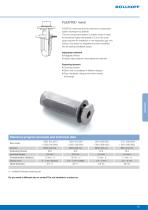
FLEXITOL® metal FLEXITOL® metal was the first tolerance compensation system developed by Bollhoff. This two-component system is entirely made of metal and therefore highly wearresistant. Due to the small space required for installation in the separation gap, this solution may easily be integrated and even retrofitted into an existing installation space. ■ Highly wear-resistant metal adjustment element ■ Blind rivet nut available in different designs ■ Easy installation using proven blind riveting technology Automatic Standard program (excerpt) and technical data 0031 910 0011 0031 910 0011 Item...
Open the catalog to page 15All Böllhoff Verbindungstechnik GmbH catalogs and technical brochures
 TEPRO® K' in K'
16 Pages
 PARRYPLUG®
8 Pages
 SPREDLOC®
12 Pages
 RIVCLINCH®
16 Pages
 RIVQUICK®
12 Pages
 SITEC®
40 Pages
 HELICOIL® locknuts
8 Pages
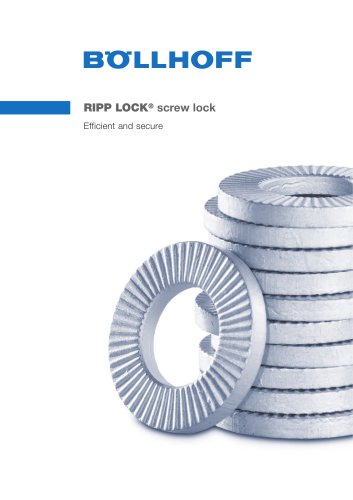 RIPP LOCK®
16 Pages
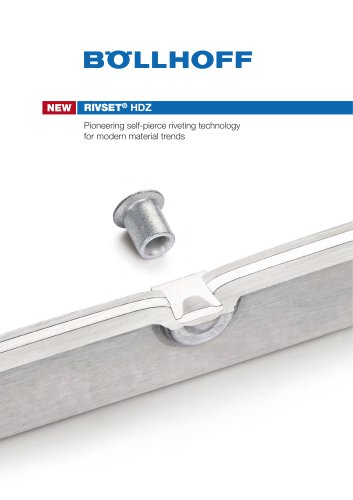 RIVSET®HDZ
4 Pages
 ONSERT®
28 Pages
 SEAL LOCK® Sealing nuts
8 Pages
 IMTEC® Moulded inserts
16 Pages
 HELICOIL® Plus
82 Pages
 RIVTAC®
14 Pages
 Products and Services
40 Pages
 QUICKLOC®
20 Pages
 HELICOIL® Smart
28 Pages
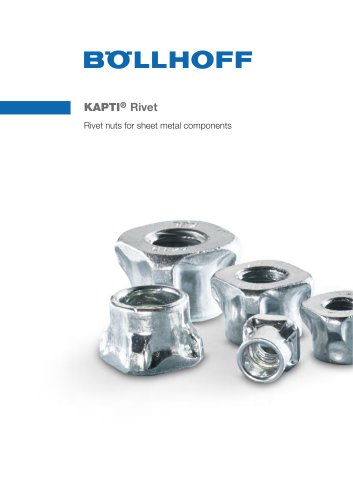 KAPTI® Rivet - Captive nuts
4 Pages
 Product Guide
20 Pages


