
- Catalogs
- Bloom Engineering
- Hot and Cold Air High Thermal Release (HTR) Direct Fired Burner Series 2100

Hot and Cold Air High Thermal Release (HTR) Direct Fired Burner Series 2100

Hot and Cold Air High Thermal Release (HTR) Direct Fired Burner Series 2100
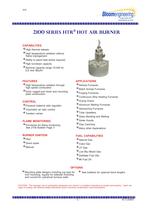
The 2100 Series HTR® Hot Air Burner offers high thermal release and high-temperature radiation without flame impingement. It allows precise heat placement and has a high turndown capacity, with a nominal capacity range from 70,000 to 3.5 million Btu/hr.
The burner features high-speed combustion for high-temperature radiation and is constructed with an extra rugged port block and mounting plate.
Control mechanisms include a pressure balance ratio regulator, volumetric air ratio control, and tandem valves.
Provisions are made for flame monitoring, with details available in the 2100 Bulletin Page 3.
Ignition options include pilot, direct spark, and manual methods.
The burner is suitable for various applications such as reheat furnaces, batch anneal furnaces, forging furnaces, continuous strip heating furnaces, drying ovens, aluminum melting furnaces, galvanizing furnaces, tube upsetters, glass bending and melting, sinter hoods, clay calcining, and many others.
The burner can operate on natural gas, coke gas, LP gas, low Btu mixed gas, distillate fuel oils, and #6 fuel oil.
Mounting plate designs include lug type for roof mounting, square for sidewall mounting, and curved for cylindrical furnace walls. Optional block lengths are available as per bulletins.
The capacity chart provides detailed specifications on air flow, atomizing air flow, and static pressure for various catalog numbers and capacity options. It also includes information on direct spark ignitor and pilot part numbers.
The burner is designed for slightly oxidizing to slightly reducing air to fuel ratios and is not intended as an excess air burner. Minimum air pressure requirement is approximately 0.3” W.C. All burners, except direct spark ignited models, have an integral machined gas distribution orifice, eliminating the need for individual gas balancing or throttle valves.
Improper use of combustion equipment can be hazardous. Users are urged to comply with National Safety Standards and/or Insurance Underwriters recommendations.
Catalog excerpts
High thermal release High temperature radiation without flame impingement Ability to place heat where required High turndown capacity Nominal capacity range 70,000 > High temperature radiation through high speed combustion Reheat Furnaces Batch Anneal Furnaces Extra rugged port block and mounting plate construction Forging Furnaces Continuous Strip Heating Furnaces > Drying Ovens Pressure balance ratio regulator Aluminum Melting Furnaces Volumetric air ratio control Galvanizing Furnaces Tandem valves Tube Upsetters Glass Bending and Melting > Sinter Hoods Provisions for flame monitoring See 2100 Bulletin Page 3 Clay Calcining Many other Applications > Pilot Natural Gas Direct spark Coke Gas Manual LP Gas Low Btu Mixed Gas Distillate Fuel Oils #6 Fuel Oil > Mounting plate designs including lug type for roof mounting, square forsidewall mounting See bulletins for optional block lengths and curved for cylindrical furnace walls > CAUTION: The improper use of combustion equipment can result in a condition hazardous to people and property. Users are urged to comply with National Safety Standards and/or Insurance Underwriters recommendations 4/05 - 1 - 4/7/2005 >
Open the catalog to page 1All Bloom Engineering catalogs and technical brochures
 LTR Brochure - Web Layout
4 Pages
 Radiant Tube Burners
6 Pages
 Radiant Tube Burners 2320
4 Pages
 Direct Fired Burners 1029
4 Pages
 Direct Fired Burners 1020
10 Pages
 1510 ULTRA5 LOW NOXTM BURNER
3 Pages


Archived catalogs
 Baffle Burner Concept
1 Page


