
- Catalogs
- Binder+Co AG
- Binder-Co BIVITEC


- Products
- Catalogs
- News & Trends
- Exhibitions
Binder-Co BIVITEC

Binder-Co BIVITEC
The BIVITEC system by Binder+Co addresses the inefficiencies of conventional vibratory screens when dealing with difficult-to-screen bulk materials. It utilizes resonance to provide dual vibratory movements, allowing flexible polyurethane mats to expand and compress, effectively separating challenging materials.
Applications
BIVITEC is versatile, suitable for both dry and wet screening, and excels in processing construction raw materials, industrial minerals, salts, ores, and materials in the coal, steel, and recycling industries. It can also serve as a low-maintenance alternative for screening unproblematic bulk materials.
Solution/Operation
The BIVITEC system employs a double vibration principle using a single drive mechanism. It features two oscillating masses that create a relative movement, stretching and relaxing screen panels to achieve high acceleration values up to 500 m/s². The system allows for adjustable parameters to optimize operation.
Screen Deck
The screen deck transmits the right amount of energy to the material, ensuring efficient screening and preventing clogging. The screwless fastening system facilitates easy assembly and dismantling of screen panels. Different colored panels are available for specific applications, such as abrasive materials or compost.
Performance
BIVITEC machines come in various models, from single to multi-deck configurations, with feed capacities up to 1000 t/h. They can handle grain sizes from 0 to 200 mm and offer adjustable screen inclination and driving power.
Banana BIVITEC
This variant combines the benefits of banana screens with BIVITEC technology, ideal for materials with high fine-grain content. It offers improved separation and higher throughput rates due to its design.
Conclusion
Binder+Co's expertise in processing raw materials is evident in its range of machinery, including the BIVITEC system, which provides economic and technological advantages for bulk material processing.
Catalog excerpts

Efficient screening of difficult-to-screen bulk materials
Open the catalog to page 1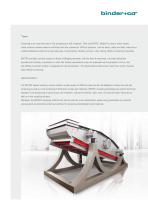
Task Screening is an important step in the processing of bulk materials. With the BIVITEC, Binder+Co starts where conventional vibratory screens become inefficient and less economical. Difficult products, such as damp, stalky and leafy materials or matted substances block the screen openings of conventional vibratory screens, thus making efficient screening impossible. BIVITEC provides a simple solution to these challenging demands: with the help of resonance, a driving mechanism provides two vibratory movements in which the flexible polyurethane mats are expanded and compressed in turns, and...
Open the catalog to page 3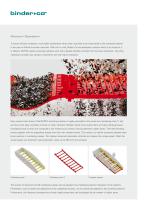
Solution/ Operation To ensure efficient screening, much higher acceleration values than usual have to be transmitted to the screening material in the case of difficult-to-screen materials. With this in mind, Binder+Co has developed a solution which is as simple as it is efficient. BIVITEC special screening machines work with a double vibration principle from one drive mechanism. One drive mechanism provides two vibratory movements with the help of resonance. Every second cross brace of the BIVITEC screening machine is rigidly connected to the screen box (oscillating mass 1) and carries out the...
Open the catalog to page 4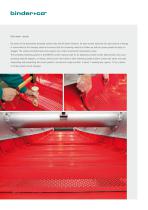
Screen deck By means of the dynamically actuated screen mats and the basic vibration, for each screen deck only the right amount of energy is transmitted to the charging material to ensure that the screening material is broken up and the screen panels are kept unclogged. The simple and well-proven drive system via e-motor ensures low maintenance costs. The screwless fastening system of the BIVITEC screen mats provide for an absolutely smooth screen deck surface, thus counteracting material deposits, or caking, which occurs more often in other fastening systems where screws and strips are used....
Open the catalog to page 6
Red BIVITEC screen panels are the standard panels and used with all common cut points. Blue BIVITEC screen panels are softer than the red standard panels and suitable for screening abrasive materials (glass cullet). Turquoise BIVITEC screen panels are of lower thickness and used for screening fines. Yellow BIVITEC screen panels are characterised by their resistance to bases and acids, and are primarily used for screening artificial fertilisers. Green BIVITEC screen panels are resistant to microbes and thus ideal for screening compost. Binder+Co precision woven mats are used for finest screening...
Open the catalog to page 7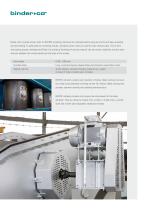
Binder+Co’s original screen mats for BIVITEC screening machines are characterised by long service life and easy assembly and dismantling. To yield optimum screening results, individual screen mats are used for each relevant task. The ox-horn side-sealing system developed by Binder+Co prevents discharge of outsize material into the screen underflow and also wear and tear between the screen panels and the sides of the screen. Hole widths Punched holes Long, round and square-shaped holes and precision woven fabric mats acidic/ alkaline, abrasive charging material (e.g. cullet), removal of finest...
Open the catalog to page 8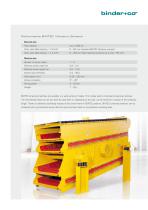
Performance BIVITEC Vibratory Screens Material data Feed capacity up to 1000 t/h Grain sizes (Bulk density > 1.5 t/m3) 0 - 80 mm (standard BIVITEC vibratory screens) Grain sizes (Bulk density < 1,5 t/m3) 0 - 200 mm (light material screening up to max. 700 mm) Machine data Number of screen decks 1 - 4 Effective screen width (m) 0.8 - 3.0 Effective screen length (m) 3.0 - 12.0 BIVITEC screening machines are available in a wide variety of models. From single deck to multi-deck screening machines. The intermediate decks...
Open the catalog to page 9
The Banana BIVITEC provides an ideal solution for the classification of difficult-to-screen materials with high fine-grain material content in the material feed and also for implementing two grain-size separations on one single screen deck. It combines the advantages of banana screens with BIVITEC screening. • The constant curvature radius prevents erratic changeovers when going from steep to flatter screening inclinations. • High material speeds on the screen deck and relatively low layer heights on the output side bring about considerably higher specific throughput rates. • Markedly lower material...
Open the catalog to page 10
Binder+Co AG’s know-how in processing primary and secondary raw materials is demonstrated in its broad range of special machinery, which is used world-wide in the bulk materials sector. Binder+Co also designs and supplies complete turnkey plants. The optimum plant concept and the right combination of machinery are indispensable in securing an economic and technological advantage for our customers. Your requirements are Binder+Co’s first priority
Open the catalog to page 11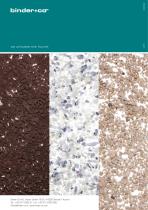
Binder+Co AG, Grazer StraBe 19-25, A-8200 Gleisdorf, Austria Tel.: +43-3112-800-0*, Fax: +43-3112-800-300 [email protected], www.binder-co.com
Open the catalog to page 12All Binder+Co AG catalogs and technical brochures
 SERIES FP
2 Pages
 system-T
2 Pages
 system-R
2 Pages
 system-F
2 Pages
 smart 2000|2800
2 Pages
 Binder+co
1 Page
 Binder+Co Fluid Bed Dryer DRYON
12 Pages
 STATEC-BINDER System R
2 Pages
 STATEC-BINDER System T
2 Pages
 STATEC-BINDER System F
2 Pages
 STATEC-BINDER Principal R
2 Pages
 STATEC-BINDER Principac
2 Pages
 STATEC-BINDER Certopac
2 Pages
 STATEC-BINDER Principal
2 Pages
 Bublon Applications
4 Pages
 Bublon_Image
14 Pages
 S_E_comec_produktblat
2 Pages
 COMPACT
8 Pages
 CLARITY
8 Pages
 DRYON
DRYON12 Pages
 Attrition machinery
2 Pages
 Binder+Co products
12 Pages
 wet processing
8 Pages
 LINEAR VIBRATORY SCREENS
8 Pages
 vlexotec
1 Page
 CANVAS
1 Page
 BIVITEC x 4
4 Pages
 BIVITEC x 3
1 Page
 BIVITEC
8 Pages
 BILOTEC
1 Page


- Crushing plant
- Automatic cleaning system
- Drying system
- Solids separator
- Screening unit
- Bagging machine
- Water cleaning system
- Bulk material screening machine
- Centrifugal classifier
- Stationary crushing plant
- Industrial cleaning system
- Automatic bagging machine
- Sorting machine
- Form fill seal bagging machine
- Vertical bagging machine
- Palletizer
- Continuous drying system
- Impact crushing and screening plant
- Process cleaning system
- Jaw crushing and screening plant