
- Catalogs
- bielomatik GmbH
- Welding from the ends

Welding from the ends

Welding from the ends
Laser transmission welding has been the predominant method for welding polymers, where a laser beam passes through a transparent part to an absorbing part, converting laser energy into heat. This method is advantageous due to low heat input and minimal vibration, making it suitable for medical and electronic applications. However, it has limitations regarding material thickness and shape.
Laser Butt Welding
Developed in the 1990s, laser butt welding is used for joining same-material, high-walled plastics. Unlike transmission welding, it involves two absorbent parts and is a two-stage process. Despite its potential, it faced challenges such as limited laser sources, high costs, and technical difficulties with deflecting mirrors.
Turn2Weld Technique
The Turn2Weld technique addresses the drawbacks of previous methods by eliminating deflecting mirrors and improving positioning accuracy. It uses servo motors to swivel machine tables, allowing for faster changeover times. This technique supports various laser sources, including diode and CO2 lasers, to accommodate different materials.
Advantages and Limitations
The Turn2Weld technique offers inline monitoring for quality control and is adaptable for "One Piece Flow" production. However, it requires more laser power for longer weld seams and is influenced by part geometry. Ongoing research aims to optimize welding parameters for specific materials and geometries.
Conclusion
The Turn2Weld technique combines the benefits of focused laser welding with conventional methods, expanding the possibilities for laser welding in polymer applications. It will be showcased at the K 2019 trade fair, highlighting its readiness for production and potential for further development.
Catalog excerpts

Joining Technology LASER TECHNOLOGY [VEHICLE ENGINEERING] [MEDICAL TECHNOLOGY] [PACKAGING] [ELECTRICAL & ELECTRONICS] [CONSTRUCTION] [CONSUMER GOODS] [LEISURE & SPORTS] [OPTICS] Welded from the Ends Advanced Laser Butt Welding for Joining High-Wall and Same-Material Parts Thanks to technical advances which have made implementation easier, laser butt welding which was invented in the 1990s is now about to make the breakthrough. Aside from high-wall parts, it can be used to weld samematerial polymers using precision laser technology. efore now, the most commonly employed laser technique for welding polymers was transmission welding. In this, a laser beam passes through one part to be joined, which is transparent to the wavelength of the laser, into a second part which absorbs the radiation and converts it into heat. This absorption is achieved, e. g., by adding carbon black particles. Heating occurs through total absorption near the surface, whereby the laser energy is transformed into thermal energy. As a result of heat conduction, the transparent part in contact with the absorbing partner softens as well. Advantages and Disadvantages of Laser Transmission Welding The advantages of laser transmission welding lie in low heat input away from the root face. The technique is also virtually vibration-free and is counted as a particle-free type of welding. The welding process does not lead to any additional impurities in the part. It is therefore widely employed in medical technology and in the electronics industry. The most common variant of transmission welding is quasi-simultaneous welding. In this, the laser beam is guided along the welding contour with the aid of scanning mirrors at a high traversing speed of up to 10 m/s. Due to the high speed of the energy source, which is essentially a point source, the mating surface can be traversed several times, being heated in its entirety and plasticized almost simultaneously [1, 2]. The disadvantage of this technique is that the manufacturing process (injection molding) for the two parts to be joined requires separate material and mold hand- Turn2Weld technique: the newly developed welding machine uses one laser per part and swivels the machine tables through 90° toward the laser scanners with the aid of servo motors ling. Furthermore, there are restrictions with regard to the shape of the transparent part and, above all, to the thickness of the polymer material. Depending on the material used, the height of the layer through which the laser beam passes may be a few millimeters only, i.e. not too high. Laser welding has several competitors, e. g. heating tool, infrared and hot gas welding, with which it is possible to weld uniformly colored parts having high-wall lids and shells. However, the disadvantage of these is that the heat radiation cannot be focused sufficiently and they can therefore influence sensitive parts both optically and functionally – usually in a relatively uncontrolled manner. Furthermore, these techniques require a part-specific heating medium (heating tool, IR emitter, hot gas heat exchanger and manifold), and that adds to the tooling costs. » Kunststoffe international 6-7/2019 www.kunststoffe-international.com © Carl Hanser Verlag, Munich. Reproductions, even in extracts, are non permitted without licensing by the publisher.
Open the catalog to page 1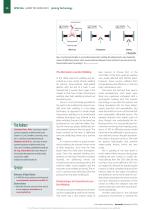
SPECIAL LASER TECHNOLOGY Joining Technology IA|lasers \ T I Joining © Kunststoffe Fig. 1. Functional principle: in conventional laser butt welding, the aligned parts were heated by means of deflecting mirrors which were positioned between them and had to be returned to the home position prior to joining [1,3] (source: bielomatik) The Authors Christian Class, M.Sc., has been a development engineer at bielomatik Leuze GmbH + Co. KG, Neuffen, Germany, since 2017; [email protected] Matthias Greif, M.Sc., has been a development engineer at bielomatik Leuze since 2017; [email protected]...
Open the catalog to page 2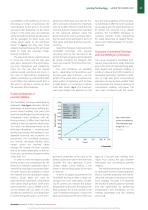
Joining Technology LASER TECHNOLOGY susceptibility of the deflecting mirrors to dirt pickup. In certain circumstances, the small distance to the parts to be joined can lead to dirt deposition on the mirror surface. In the worst case, dust particles will be burned by the laser and the mirror will be damaged. All these issues and critical points apply to the technique shown in Figure 1, but they were never properly resolved because the technique failed to make the necessary breakthrough in industry. The pneumatic drives used previously to move the mirror and the part axes were also a weak point....
Open the catalog to page 3All Bielomatik GmbH catalogs and technical brochures
 Central Lubrication System
24 Pages
 MQL 1-CHANNEL-SYSTEM H1
4 Pages
 Retrofit brochure
4 Pages
 product catalogue new english
130 Pages
 ZS Retrofit Fact Sheet
1 Page
 MMS Messkit Fact Sheet
2 Pages
 MMS Schleifen Fact Sheet
1 Page
 MMS MLU Fact Sheet
2 Pages
 MMS ECU Fact Sheet
1 Page
 MMS 2-Kanal Fact Sheet
1 Page
 MMS 1-Kanal Fact Sheet
1 Page


Archived catalogs
 Print-Finishing-on-Demand
12 Pages
 Central Lubrication Systems
26 Pages
 Vibration Welding Fact Sheet
4 Pages
 Plastic Welding Directory
24 Pages


- Automatic welding machine
- Metal welding machine
- Laser sealer
- Plastic welding machine
- Standalone welding machine
- Greasing system
- Steel welding machine
- Oil greasing system
- Integrated welding machine
- Hydraulic welding machine
- Ultrasonic sealer
- Electric greasing system
- Hot plate welding machine
- Thermoplastic welding machine
- Vertical welding machine
- Compact greasing system
- Centralized greasing system
- Horizontal welding machine
- Multi-head welding machine