


LP-31: LP-Gas

LP-31: LP-Gas
The Fisher™ Buyers Guide LP-31 for LPG and NH3 Equipment, published in 2016, showcases Emerson Process Management's dedication to providing robust and high-quality solutions for industrial challenges. The guide highlights Emerson's expertise in automation and innovation, offering a variety of technologies and services to improve operational efficiency, safety, and environmental compliance.
- Expertise and Innovation: Emerson is renowned for its extensive expertise and wide range of technologies, offering solutions for measurement, analysis, operation, management, and final control.
- Regulator Technologies: Emerson provides a comprehensive array of pressure control, flow control, and relief valve solutions for industries such as natural gas, LPG, and industrial gases.
- Quality and Reliability: Emerson maintains high-quality standards through its global brands, focusing on defect-free products and services that consistently meet customer expectations.
- Technology and Service: Emerson's innovative technologies boost productivity and efficiency, with extensive test and evaluation facilities to ensure product performance under real-world conditions.
- Historical Background: The guide offers a historical overview of Fisher Controls, detailing its evolution from its founding in 1880 to its integration into Emerson Electric in 1993.
- Natural Gas Solutions: Emerson provides conditioning, metering, and pressure regulating products for the natural gas industry, known for their reliability and durability.
- LPG Solutions: Fisher LPG regulators and valves are industry standards for reliable pressure regulation in stationary and mobile applications.
- Precision Pressure Control: TESCOM products are engineered for precise pressure control across various industries, meeting global certification requirements.
Emerson conducts rigorous testing to ensure product performance, efficiency, and safety, including flow testing, materials testing, and environmental testing to simulate real-world conditions and extend product lifecycles.
The document provides a comprehensive overview of various types of LPG regulators and valves used in propane installations, emphasizing the importance of regulators in maintaining consistent pressure despite fluctuations in tank pressure and appliance usage. It also highlights compliance with NFPA 58 standards for two-stage regulation in fixed piping systems.
- Second-Stage Regulators: Types R122H, R222H, and R622H are designed to maintain a constant outlet pressure for LPG appliances.
- Two-psi Service Regulators: Types HSRL, R222, R622, R642, and R652 are used for specific service applications.
- Integral Two-Stage Regulators: Types R622E and R652E combine two stages of regulation in one unit.
- Commercial/Industrial High-Pressure Regulators: Types R232E and R632E are suitable for high-pressure applications.
- Commercial Low-Pressure Regulators: Types 67CW, 67CH, 67CD, 67CN, 64, 64SR, 627, 630, 99, and 1098-EGR are used for low-pressure commercial applications.
- Internal Valves: Types C404-32, C407-10, C471, C477, C483, C484, and C486 are used in pressure vessels and piping systems to control LPG flow.
- Emergency Shutoff Valves: Types N551, N562, and N563 provide safety by shutting off flow in emergencies.
- Relief Valves: Types H110, H120, H123, H124, H125, H144, H148, H150, H173, H174, H185, H284, H722, H733, H5114, and 63EGLP Series are designed to release excess pressure.
- Globe and Angle Valves: Types N301, N310, N310F, N350, N401, N410, N410F, and N450 are used for controlling flow direction and pressure.
The document mentions that Fisher™ brand products comply with standards developed by the National Fire Protection Association and other agencies. These products are listed by Underwriters Laboratories (UL®) and may assist in meeting guidelines established by the Department of Transportation and ASME.
Emerson Process Management Regulator Technologies Inc. offers a wide range of LPG regulators and valves, providing solutions for various applications in the propane industry. The document serves as a guide for selecting the appropriate equipment based on specific requirements and standards.
Two-stage LPG systems offer several advantages over single-stage systems, including the ability to use larger orifices to prevent ice blockages and improved heat transfer through dual regulators. These systems allow for smaller piping due to higher pressure between stages, making them more economical to install. They also provide a constant appliance pressure, reducing service calls and improving appliance performance.
Two-stage systems maintain downstream pressure below 2 psig (0.14 bar) as per UL 144 standards. They are recommended under conditions such as compliance with regulation codes, presence of moisture in LPG, wide fluctuations in gas demand, and significant temperature variations between seasons.
Types R122H, R222H, and R622H are UL-listed first-stage regulators designed for two-stage systems. They reduce tank pressure to a lower level for second-stage regulators, with a maximum inlet pressure of 250 psig (17.2 bar). These regulators are corrosion-resistant, have a 20-year recommended replacement life, and feature large diaphragms for precise regulation.
Types R222, R622, R642, R652, and HSRL are designed to reduce outlet pressure from first-stage regulators to 11 in. w.c. (27 mbar) for domestic installations. They feature stainless steel inlet screens and have a 20-year recommended replacement life. The Type R622, for example, is adjustable and provides high-performance relief valve features.
These regulators combine first and second-stage regulation into one unit, suitable for short piping distances. Types R632A and R232A are UL-listed and provide a 20-year replacement life. They feature high capacity relief valves and large vents to prevent overpressure situations.
These combine a first-stage regulator and a two-psi regulator into a compact unit, recommended for short piping installations. They offer the benefits of two-stage regulation and are designed for domestic applications supplying 2 psig LPG to line regulators inside buildings.
The document provides detailed specifications for various types of pressure regulators and relief valves, including models 1805-18P, 1805-51P, 1808A-61, 289H-42, and 289H-2. Key parameters include body size, relief start-to-discharge spring range, pressure buildup over set pressure, and capacity in SCFH and nm3/h. It notes that some regulators may require more than one relief valve and advises consulting a Fisher™ LPG Distributor for proper sizing.
Vent assemblies are designed to prevent moisture buildup and improve stability. The document lists various types of vent assemblies and their specifications, including size and stabilizer presence. It also covers small portable appliance regulators, highlighting the Type 912 series with specific pressure ranges and capacities.
Fisher™ brand internal valves are used as primary shutoff valves, excess flow valves, and back check valves. They are suitable for LPG and Anhydrous Ammonia (NH3) service. Features include rapid equalization bleed area, unique serviceability features, durable design, excess flow closure, and back check feature. The document explains the principle of operation with a schematic and describes different valve positions.
Emerson™ offers a variety of threaded internal valves for use in bobtail and transport trucks, stationary storage tanks, and in-line installations. The document details the C407, C477, C471, and C486 series, including their connection types, body styles, and flow capacities. It also covers special service threaded internal valves in the C800 series, highlighting their material and elastomer options.
The document includes warnings about the use of excess flow valves and advises against using them to satisfy passive shutdown requirements under specific regulations. It emphasizes the importance of following these guidelines to prevent serious injury or property damage.
Types N310 and N410 are heavy-duty ductile iron valves designed for LPG or Anhydrous Ammonia (NH3) service, available in sizes from 1/2 to 3 inches. They feature spring-loaded PTFE chevron packing for leak prevention and ball bearing valve disc construction for sizes 1-1/4 inches and larger to protect against back-flow.
Types N350 and N450 are economy globe and angle valves for LPG service, available in sizes 1/2 and 3/4 inches, also featuring PTFE spring-loaded packing for effective sealing.
Back Check Valves
The G100 Series back check valves are used mainly in tank inlet connections and offer metal-to-metal or soft seat construction. They are rated at 250 psi and have a temperature range of -20 to 160°F. The G200 Series is designed for heavy-duty in-line service with a high flow capacity and is suitable for LPG or NH3 service.
Hose End, Filler, and Liquid Transfer Valves
Type N480 hose end valves are designed for quick operation during LPG or NH3 deliveries, featuring a 45° angle body for ease of handling. Type N456 liquid transfer valves attach to withdrawal valves for transferring liquid between tanks.
Bypass and Backpressure Valves
The N100 Series bypass valves are used for large pumps, allowing surplus pump discharge to return to the tank. The N110 Series is for smaller pumps, featuring an internal sensing orifice. The N120 Series backpressure valves maintain differential backpressure on liquid meters to prevent vapor formation.
Rotary Gauges and Liquid Level Indicators
Fisher™ rotary gauges indicate the amount of LPG or NH3 in tanks and are used for filling to the correct liquid level. Type J-31 gauges minimize vibration effects and have a temperature rating of -20 to 160°F.
Adaptor Caps and O-rings
Adaptor caps are available in various sizes, with O-rings providing a tighter seal than conventional washers. The Type M390 POL filler coupling is a brass construction with available replacement O-rings.
- Material: The regulators are primarily made of ductile iron or WCC (wrought carbon steel).
- Port Sizes: Available in 3/8 inch, 1/2 inch, and 1/4 inch FNPT (Female National Pipe Thread).
- Pressure Ranges: Regulators are designed to handle pressures from as low as 3 psi (0.21 bar) to as high as 500 psi (34.5 bar).
- Standard High-Pressure Regulators: These are available in various pressure ranges and port sizes, suitable for general high-pressure applications.
- Monitor Regulators: Designed for monitoring and controlling pressure in systems, available in similar configurations as standard regulators.
- Regulators with Relief: These include a relief feature to manage excess pressure, ensuring system safety.
- Liquid Regulators: Specifically designed for liquid applications, available in similar pressure and port configurations.
- UL Listed Options: Some models are UL listed, indicating compliance with safety standards.
- Special Trims: Certain models include special trims such as Fluorocarbon (FKM) for enhanced chemical resistance.
- Disc Materials: Options with Nylon (PA) discs are available for specific applications.
Catalog excerpts

Fisher™ Buyers Guide LP-31 The Industry Leader for Durability and Quality Process Management
Open the catalog to page 1
Emerson Process Management Solving Your Toughest Challenges Industries are under constant pressure to cut costs, increase output, reduce energy use and improve safety and emissions. That is why companies around the world turn to Emerson Process Management for technologies, services and expertise to solve problems and deliver proven results. Expertise and Innovation To Deliver Proven Results Emerson Process Management is the automation innovator with the depth of expertise and breadth of technologies to take on our customers’ toughest challenges and bring predictable success anytime, anywhere....
Open the catalog to page 2
Regulator Technologies Emerson Process Management Regulator Technologies: Control Your System with Certainty Emerson Process Management Regulator Technologies Inc. (Emerson™) brings together technology and engineering to provide an expanding array of innovative manufacturing and processing solutions for industrial, commercial and consumer markets. We offer the world’s largest collection of pressure control, flow control and relief valve solutions for process and specialty gases, liquids, steam, natural gas and liquid propane industries. Our regulators are renowned for setting industry standards...
Open the catalog to page 3
Emerson Process Management At Emerson, we are committed to continually raising the bar in our efforts to develop still higher quality, more advanced systems that operate safely and reliably well into the future. Emerson™ ensures the highest quality and safety standards through our global brands – Fisher™, Francel™, Tartarini™, TESCOM™ and our Asian-specific brand Jeon. For more than a century we have worked side-by-side with customers to understand their challenges and help implement effective solutions. Our systems, processes and employees are committed to providing defect-free products, information...
Open the catalog to page 4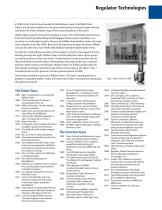
Regulator Technologies In 1880, Fisher Controls was founded in Marshalltown, Iowa, by William Fisher. Fisher Controls grew steadily over the years,evolving into an industry leader offering customers the most complete range of flow control products in the world. William Fisher came to America from England as a boy of 14. As his family ventured west in the new land, they settled along the Mississippi in Clinton, Iowa. It was there, as a mechanic in a small engine shop for 10 years, that William learned about steam, the major source of power in the late 1800s. Because of his experience in water...
Open the catalog to page 5
You Demand High Performance. We Ensure It. Real-World Simulation Flow Testing • Simulates real-world operating conditions using pipelines up to NPS 32 / DN 800 with compressible and incompressible fluids up to 30,000 psig / 2068 bar • Ensures product performance, efficiency, environmental compliance, life span and safety Materials Testing • Develops and tests materials to improve regulator performance and reliability • Ensures materials meet customer requirements, national standards, and our own, still higher, brand standards • Analyzes and troubleshoots field installations for contamination...
Open the catalog to page 6
Table of Contents REGULATOR APPLICATION MAP. . . . . . . . . . . . . . . . . . . . . . . . . . 2 REGULATOR SELECTION GUIDE . . . . . . . . . . . . . . . . . . . . . . . . 9 . . VALVE SELECTION GUIDE. . . . . . . . . . . . . . . . . . . . . . . . . . . . . . 14 Accessories SELECTION GUIDE . . . . . . . . . . . . . . . . . . . . . 19 . . REGULATORS . . TWO-STAGE SYSTEMS . . . . . . . . . . . . . . . . . . . . . . . . . . . . . . . 24 FIRST-STAGE REGULATORS. . . . . . . . . . . . . . . . . . . . . . . . . . . . 25 Types R122H, R222H and R622H SECOND-STAGE REGULATORS . . . . . . . . . . . . . . ....
Open the catalog to page 7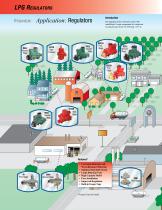
Application: Regulators The regulator truly is the heart of an LPG installation. It must compensate for variations in tank pressure from 8 to 250 psig / 0.55 to • Corrosion-Resistant and Wear-Resistant Materials • Stainless Steel Inlet Screen • Large Drip-Lip Vent • High Capacity Relief • Easy Installation • Improved Regulation • Built-in Gauge Taps *Features Vary By Model.
Open the catalog to page 8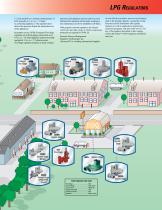
LPG Regulators 17.2 bar and deliver a constant outlet pressure of LPG typically at 11 in. w.c. / 27 mbar to consuming appliances. The regulator must deliver this pressure despite the intermittent use of the appliances. In propane service, NFPA 58 requires Two-Stage regulation on all fixed piping systems that serve 14 in. w.c. / 35 mbar appliance systems (normally operated at 11 in. w.c. / 27 mbar pressure). Two-Stage regulation produces a nearly constant pressure to the appliance and can result in a more efficient LPG operation for the dealer resulting in less maintenance and fewer installation...
Open the catalog to page 9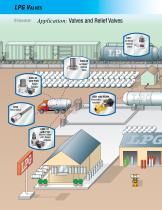
LPG Valves Application: Valves and Relief Valves C477 Jet Bleed ™ Internal Valve C484-24 Jet Bleed™ Internal Valve C483-24 with P723 Rotary Actuator N551 with P539A Pneumatic Actuator H722 Relief Valve C407-10 with P731 Internal Valve with Rotary Actuator
Open the catalog to page 10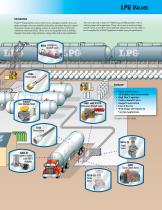
LPG Valves Introduction Fisher™ brand internal valves, relief valves, emergency shutoff valves and globe and angle valves are installed in the inlets and outlets (liquid or vapor) of pressure vessels and in piping systems to control the flow of LPG and Anhydrous Ammonia (NH3). These valves are frequently used on bobtails, transport truck tanks, large stationary storage tanks and in-line installations. The valves provide a means of withdrawing and filling product with or without pumps and compressors. These valves may be used as primary shutoff valves, excess flow valves and back check valves....
Open the catalog to page 11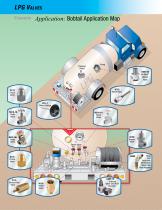
LPG Valves Application: Bobtail Application Map Pressure Relief J Jet Bleed™ Internal Valve J31L-1 Rotary Gauge N310-16 Globe Valve N401-06 Angle Valve Spray Vapor Fill Line F131 Excess Flow Valve C407-10 Internal Valve with P731 Actuator Hose End Valve with M570 Back Check Filler Hose Adaptor
Open the catalog to page 12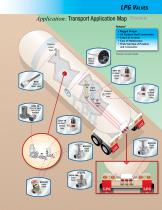
LPG Valves Application: Transport Application Map Features* Features* • • • • • Pressure Pressure Relief Relief Valve Valve Rugged Designs • Rugged Designs All•Stainless SteelSteel Construction All Stainless Construction Long Life Life Sealants • Long Sealants EaseEase of Maintenance • of Maintenance Wide Selection of Products • Wide Selection of Products and Accessories and Accessories *Features Vary By Model. *Features Vary By Model. J31L-1 J31L-1 Rotary Rotary Gauge Gauge C471-24 C471-24 Jet Bleed™ Jet Bleed™ Internal Internal Valve Valve H733 H733 Internal Internal Relief Relief Valve Valve...
Open the catalog to page 13All BETTIS catalogs and technical brochures
 RPE-Serie
4 Pages
 CBB-series
6 Pages
 CBA-300
6 Pages
 Q series
4 Pages
 Pressurematic
6 Pages
 Gas/Hydraulic
6 Pages
 G-series
6 Pages
Archived catalogs
 GVO-series
20 Pages
 RGS Q-Series
31 Pages
 RGS F-Series
34 Pages
 CW Series
2 Pages
 TEC2
TEC217 Pages
 AT Series
2 Pages
 HD-series
6 Pages
 Complete TorqPlus brochure
35 Pages
 CBA-Series Pneumatic Actuators
16 Pages
 Multiport Flow Selector
12 Pages


- Valve actuator
- Rotary valve actuator
- Compressed air dryer
- Electric valve actuator
- Desiccant compressed air dryer
- Pneumatic valve actuator
- Double-acting valve actuator
- Compact valve actuator
- Piston actuator pressure regulator
- Linear valve actuator
- Aluminum valve actuator
- Modulating valve actuator
- 90° valve actuator
- ISO valve actuator
- Butterfly valve valve actuator
- Manual valve actuator
- Valve actuator with spring return
- Valve actuator with handwheel
- ATEX valve actuator