
- Catalogs
- Beta Utensili
- Load and Tightening

Load and Tightening

Load and Tightening
Torque Wrenches and Bars Specifications
The document provides detailed torque specifications for various torque wrenches and bars, identified by model numbers such as 590, 603/5, 666N/2, 599DGT/6, 606/10, 667N/20, 677/50, and others. Each model is associated with torque ranges expressed in Newton-meters (Nm), kilogram-force meters (Kgfm), and pound-force feet (lbf.ft). For example, models like 606/10X have torque values up to 100 Nm, while heavy-duty models like 677C/150 reach up to 1500 Nm.
Torque Ranges and Units
- Torque values range from as low as 0.3 Nm to as high as 2000 Nm depending on the tool model.
- Conversion factors are provided: 1 Nm = 0.10197 Kgfm = 0.7375 lbf.ft.
- Torque scales are presented in multiple units to accommodate different measurement preferences.
Fields of Use
The document categorizes torque wrenches and bars by their fields of use, indicating appropriate torque ranges for each tool type. This helps users select the correct tool based on the required torque application.
Torque Calculation Methodology
A formula is provided to calculate the effective torque when using accessories of different lengths than the standard. The formula accounts for the lever arm length differences between the standard accessory (LS), the bar length (LB), and the accessory length (LA):
C = M × (LB + LS) / (LB + LA)
Where:
- C = torque to set
- M = required torque
- LB = bar length
- LS = standard accessory length
- LA = accessory length
This ensures accurate torque application despite variations in accessory sizes.
Tensile Load and Tightening Torque Tables
The document includes tables detailing tensile loads and tightening torques for bolts with coarse and fine pitches. These tables specify:
- Resistant section dimensions
- Friction coefficients
- Tensile load values
- Recommended tightening torques
The data supports proper bolt selection and tightening procedures to ensure mechanical integrity and safety.
Key Recommendations and Best Practices
- Use the correct torque wrench or bar model according to the torque range required.
- Apply the torque calculation formula when using non-standard accessories to maintain accuracy.
- Refer to tensile load and tightening torque tables to select appropriate bolt classes and tightening parameters.
- Always consider friction coefficients and resistant section dimensions for precise torque application.
Overall, the document serves as a comprehensive technical reference for selecting, calculating, and applying torque using various tools and accessories, ensuring mechanical reliability and safety.
Catalog excerpts
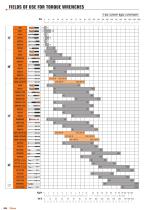
I I I I I I I I I I I I I I I I I I I I I I I I I I I I lllllllllllll I I I I I I I I I I I I I I I I I I I I I I I lllllllllllll Ibf.ft 0 10 20 30 40 50 60 70 100 200 300 400 500 600 700 1100 1500
Open the catalog to page 1
I I I I I I I I I I I I I I I I I I I I I I I I I I I I lllllllllllll I I I I I I I I I I I I I I I I I I I I I I I lllllllllllll Ibf.ft 0 10 20 30 40 50 60 70 100 200 300 400 500 600 7001100 1500 Torque calculation The lever arm changes for accessories differing from standard in length (LA ^LS). To calculate the torque, use the following formula: C = torque to set M = required torque La = accessory length (see accessory specifications table) Lb = bar length (see torque bar specifications table) Ls = standard accessory length (see torque bar specifications table)
Open the catalog to page 2All Beta Utensili catalogs and technical brochures
 Modular Workbenches New range
24 Pages
 RSC50 2.0 Promotion
44 Pages
 C45PRO 2.0 Promotion
36 Pages
 General Catalogue 2025
772 Pages
 Beta Action 2025
116 Pages
Archived catalogs
 Beta Action 2024
116 Pages
 RSC24AXLP/7
1 Page
 Beta Worker 2024
32 Pages
 ROBUR Catalogue 2024
60 Pages
 General Catalogue 2024
772 Pages
 Beta Inox
16 Pages
 Height-Safe
24 Pages
 NEW ITEMS 2020
40 Pages
 beta work automn 2020
16 Pages
 LET’S BIKE TOGETHER
2 Pages
 Beta RSC 55
108 Pages
 RSC55_EN
28 Pages
 Stainless steel
12 Pages
 RSC55 Modular System
32 Pages
 Beta Action 2018
100 Pages
 Action 2020
108 Pages
 Special Motorbike Catalogue
64 Pages
 color my work
2 Pages
 ENGINE TIMING TOOLS
28 Pages
 Beta_Inox
2 Pages
 pneumatic tools
48 Pages
 action euro 2017
100 Pages
 General programme 2015
436 Pages
 /Action EURO EXP 2014
72 Pages
 catalogue 2016
28 Pages
 Action EURO EXP 2013
64 Pages
 RSC55
RSC5528 Pages
 Pneumatic tools
32 Pages
 New Pliers and Nippers range
16 Pages
 BetamaX screwdrivers
12 Pages
 Spark-proof tools catalogue
16 Pages

- Industrial vacuum cleaner
- Mobile vacuum cleaner
- Metal cart
- Drilling tool
- Transport trolley
- Solid drill bit
- Storage cabinet
- Floor-mounted cabinet
- Sanding machine
- Metal cabinet
- Portable grinder
- Hydraulic parking jack
- Shelf trolley
- Multi-purpose drilling tool
- Impact wrench
- Tungsten carbide drill bit
- Micrometer
- Air-operated portable grinder
- Pneumatic impact wrench
- Liquids vacuum cleaner