
- Catalogs
- Berthold Technologies Process Control
- Radiometric gauges in the potash industry


Radiometric gauges in the potash industry

Radiometric gauges in the potash industry
Dr. Madeleine Stoll from Berthold Technologies provides an overview of the use of radiometric gauges in the potash industry, focusing on potassium detection, density, and bulk flow measurement. Potassium is a crucial macronutrient for plants, and its extraction from evaporite deposits is essential for producing potassium-based fertilizers.
These analyzers are designed to measure potassium concentration by detecting the radioisotope K-40, which is present in a fixed ratio with stable potassium isotopes. The detection system requires sensitivity and stability to suppress background radiation, using detector shields for protection. The setup can be adapted to factory conditions, and potassium mass flow can be measured in combination with bulk flow measurement.
These gauges measure density and bulk flow using a radioactive source and detector. The principle is based on radiation attenuation, which varies with the media's density and material. The system is maintenance-free and does not require recalibration, as it operates non-intrusively.
Radiometric detectors use low radioactive source activities for safety and cost efficiency. Sources like Caesium-137 and Cobalt-60 are encapsulated and shielded to ensure safety during transport and operation.
Point and rod detectors are available, using NaI(Tl) crystals or polymers as scintillator materials. These materials are temperature stable, and water-cooling jackets are used for protection at higher temperatures.
A measuring frame with a point detector and rod source is used to measure bulk flow on conveyor systems. The system is maintenance-free and unaffected by environmental factors like dirt and wind.
These measurements are conducted using a point detector and source, unaffected by pressure, temperature, or abrasive conditions. Pipes must be fully filled to avoid measurement errors.
Radiometric gauges are used in various stages of potash processing, including flotation, hot dissolution, and electrostatic separation. These methods optimize the yield and purity of potassium salts.
Radiometric gauges are essential in potash fertilizer production, providing real-time monitoring and optimization of processes. They offer reliable results in harsh conditions without requiring maintenance or recalibration.
Catalog excerpts
ACHIEVING RADIOMETRIC
Open the catalog to page 1
RESULTS WITH GAUGES Dr Madeleine Stoll, Berthold Technologies GmbH & Co. KG, Germany, provides an overview of radiometric gauges in the potash industry, from potassium detection to density and bulk flow measurement. longside nitrogen and phosphorus, potassium is one of the three main macronutrients for plants. Long-term agricultural cultivation inevitably leads to a reduction of those nutrients in the soil, for which reason the use of potassium-based fertilizers is indispensable. In order to obtain the raw material, potassium-bearing salts are extracted from evaporite deposits, which are over...
Open the catalog to page 2
Radiometric potassium analysers To measure the potassium concentration online, radiometric potassium analysers are specifically designed and manufactured for the potash industry. In nature, the element potassium is both stable – potassium isotopes K-39 and K-41 – and radioactive – represented by the radioisotope K-40. Stable potassium and K-40 are always present in a fixed ratio. K-40 makes up only about 0.01% of the total potassium. With the help of radiometric gauges, it is possible to make use of this constant ratio. By measuring the concentration of K-40, the total concentration of potassium...
Open the catalog to page 3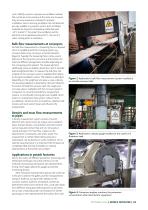
with a NaI(Tl)-crystal or a polymer as scintillator material. NaI crystals are more sensitive at the same size, however, they are more expensive compared to polymer scintillators. Due to the long scintillator rod, rod detectors are only available in a polymer version. Both scintillator materials are long-term temperature stable between −20˚C and 60˚C. To protect the scintillator and the electronics at temperatures above 60˚C, the use of a water-cooling jacket is mandatory. Bulk flow measurements at conveyors For bulk flow measurements, a measuring frame is required, which is installed around...
Open the catalog to page 4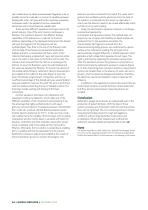
salt is milled down to obtain monomineralic fragments as far as possible. Since the crude salt is a mixture of valuable potassium bearing salts, other salt types and further impurities, separation techniques need to be applied to remove undesirable admixtures and to concentrate the valuable salts. There are three different separation techniques used in the potash industry. One of the most common techniques is flotation. This method is based on the different binding capabilities of the substances in crude salt to chemical additives. Depending on the deployed chemical and the desired salt type,...
Open the catalog to page 5All Berthold Technologies Process Control catalogs and technical brochures
 Density measurement
5 Pages
 Continuous level measurement
5 Pages
 Retrofit
3 Pages
 Article "Made to measure"
3 Pages
 Moisture in pasta production
3 Pages
 Glass level measurement
3 Pages
 Mould level measurement
4 Pages
 LB 475 Fracturing system
3 Pages
 Multiphase level measurement
7 Pages
 Produkt InlineSENS
4 Pages
 Industry Sugar
9 Pages
 LB472 Bulk Flow Meter
12 Pages
 MEVIS
MEVIS4 Pages
 NUMo - LB 134 UMo II
2 Pages
 Radiation Protection Instruments
12 Pages
 Micro-Polar
16 Pages
 DuoSeries Detectors LB 4700
2 Pages
 Rod Source Shielding
4 Pages
 Safety Source Capsule SSC
2 Pages
 Level Switch LB 471
6 Pages


- Flowmeter
- Measuring device
- Concentration analyzer
- Liquids analyzer
- Level limit switch
- Liquid level detector
- Level probe
- Solids analyser
- Liquid level sensor
- Industrial flow monitor
- Process analyzer
- Precision flow meter
- Analog level sensor
- Real-time analyzer
- Integration analyzer
- Mass flow monitor
- Flow meter with display
- Level transmitter
- Liquid level transmitter
- Digital output level sensor