
- Catalogs
- Berthold Technologies Process Control
- Multiphase level measurement


Multiphase level measurement

Multiphase level measurement
Refineries are intricate systems that convert crude oil into refined products. To enhance operating margins, refiners aim for maximum throughput, necessitating precise process control. Effective measurement is vital for improvement, particularly in the desalting process, which removes salts and minerals to prevent corrosion and other refinery issues.
Optimizing Desalters
Optimizing desalters involves maximizing grid efficiency and vessel volume to increase residence time and improve desalting effectiveness. Controlling the interface level between crude oil and water/brine is crucial, though sampling for this purpose poses safety and environmental risks.
Measurement Technologies
Various technologies measure water levels in desalters, including differential pressure (DP), RF absorption probes, and nuclear density profile systems. These technologies are categorized into direct and indirect measurements, with nuclear density profile systems being indirect. Each has its pros and cons, especially when dealing with undefined interfaces and density variations.
Differential Pressure (DP)
DP is a cost-effective method that uses Pascal's law to relate level, pressure, and fluid density. However, it can be inaccurate for interface levels, particularly with emulsions, as it measures average density across the span.
RF Absorption Probes
RF absorption probes measure RF energy absorption based on fluid dielectric constants. They require calibration with oil and water, which can lead to errors if the crude slate changes. These probes measure localized areas and may miss changes in emulsion layers.
Nuclear Density Profiling Systems
Nuclear density profiling systems provide a fluid density profile using radioactive sources and detectors. They offer reliable measurements regardless of crude type and are popular among refiners for providing real-time transition zone data.
Different Arrangements
Nuclear density profiling systems can be arranged with internal or external sources and detectors. Each configuration has its advantages and disadvantages but operates on the same basic principle.
Introduction to Radiometric Systems
This section discusses the EmulsionSENS system by Berthold Technologies, focusing on its technical specifications, operational procedures, and benefits in refining processes.
Specifications and Design
The document outlines different configurations of radiometric measurement systems, emphasizing the use of materials like Titanium for accurate gamma radiation measurements. The systems are designed to minimize measurement inaccuracies due to buildup.
Operational Procedures
Operators with basic radiation safety training can safely handle the systems. Advanced algorithms calculate density profiles, crucial for process control, and can integrate with existing control systems for automatic adjustments.
Benefits and Recommendations
Nuclear density profiling systems reduce operational upsets in desalters, improving process stability and reducing chemical usage. A cost analysis shows potential savings from reduced chemical usage and increased equipment reliability.
Technological Features
Berthold's detectors are noted for their stability, resistance to temperature changes, and protection against X-ray interference. The systems operate with minimal source activity, enhancing safety and reducing costs, and are certified for SIL2 and SIL3 applications.
Conclusion
Berthold Technologies provides advanced radiometric measurement solutions that enhance process control and efficiency across industries, offering significant operational benefits and cost savings.
Catalog excerpts

Improving level control in desalters to aid in use of opportunity crudes MULTIPHASE LEVEL MEASUREMENT
Open the catalog to page 1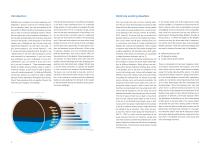
Introduction Refineries are a complex set of various operating units designed to process crude oil into refined products such as gasoline, diesel, jet fuels and feedstocks for thousands of different products that people use every day. In order to maximize operating margins, refiners rely on pushing the units to maximum throughput. To do this safely and effectively, they must have very good control of the process. Some processes in the refinery industry are a challenge for even the best and most experienced engineers. As Lord Kelvin once said, “If you cannot measure it, you cannot improve it.”...
Open the catalog to page 2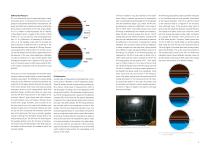
Differential Pressure DP is an economical way of measuring levels in tanks and vessels and it is the second most common use of pressure measurement behind flow measurements. DP levels use Pascal law to determine level by relating the level, pressure and density of the fluid, simply stated, P = ρ * h, where P = pressure (pascals, Pa), ρ = density of fluid (kg/m³) and h = height of the column of fluid (meters, m). You can solve for h by rearranging Pascal law, h = P / ρ (Meribout, Al Naamany & Al Busaidi, 2011, p. 2). For example, a tank with 2 m of water will exert a pressure of 2000 mmH2O or...
Open the catalog to page 3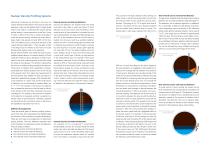
Nuclear Density Profiling Systems Operating companies are starting to rely more on nuclear density profile systems since they can give the operators a view into the desalter itself. A larger global refiner once stated “I understand the nuclear density profiler system is more expensive to install but I know it works a 100% of the time no matter what type of crude we are processing, whereas the other technologies might only operate correctly 85% of the time. This 15% difference cost us more than the price of the nuclear density profile system.” There has been a trend in the large major oil refiners...
Open the catalog to page 4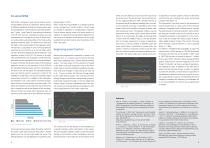
EmulsionSENS Berthold’s multiphase level measurement system EmulsionSENS consists of radiometric density devices at different elevations through the measurement span (see arrangement “internal sources and external detectors” Figure 1 and Figure 6) and optional evaluation units LB 478. Such an arrangement allows accurate measurement of the density at each of these positions and provides a density profile of the fluids as they separate inside the vessel. This difference in density of the fluids is the main principle of the separation vessel. The density is calculated in each individual detector...
Open the catalog to page 5
COMMITTED TO TECHNOLOGICAL LEADERSHIP Outstanding long-term stability A reliable measurement is vital for the operation of a process and is therefore, our highest priority. Berthold’s detectors operate consitantly irrespective of changes in ambient temperature. Even drastic temperature shifts, e.g. from winter to summer don’t influence the measurement drift. Due to various patented technologies for detector stabilization and the use of cosmic radiation as an external reference source, the detectors output has an accuracy of under 0.001% per °C temperature change. Apart from employing these cutting-edge...
Open the catalog to page 6
Berthold Technologies stands for excellent know-how, high quality and reliability. The customer is always the focus of our solution. We know our business! Using our varied product portfolio, our enormous specialized knowledge and extensive experience, we develop suitable solutions together with our customers for new, individual measurement tasks in a wide variety of industries and applications. Berthold Technologies is specialised in radiometric process measurements for 70 years. This is our core competence with state-of-the-art and cutting edge products and solutions covering a vast range of...
Open the catalog to page 7All Berthold Technologies Process Control catalogs and technical brochures
 Density measurement
5 Pages
 Continuous level measurement
5 Pages
 Retrofit
3 Pages
 Article "Made to measure"
3 Pages
 Moisture in pasta production
3 Pages
 Glass level measurement
3 Pages
 Mould level measurement
4 Pages
 LB 475 Fracturing system
3 Pages
 Produkt InlineSENS
4 Pages
 Industry Sugar
9 Pages
 LB472 Bulk Flow Meter
12 Pages
 MEVIS
MEVIS4 Pages
 NUMo - LB 134 UMo II
2 Pages
 Radiation Protection Instruments
12 Pages
 Micro-Polar
16 Pages
 DuoSeries Detectors LB 4700
2 Pages
 Rod Source Shielding
4 Pages
 Safety Source Capsule SSC
2 Pages
 Level Switch LB 471
6 Pages


Archived catalogs

- Flowmeter
- Measuring device
- Concentration analyzer
- Liquids analyzer
- Level limit switch
- Liquid level detector
- Level probe
- Solids analyser
- Liquid level sensor
- Industrial flow monitor
- Process analyzer
- Precision flow meter
- Analog level sensor
- Real-time analyzer
- Integration analyzer
- Mass flow monitor
- Flow meter with display
- Level transmitter
- Liquid level transmitter
- Digital output level sensor