
- Catalogs
- Berthold Technologies Process Control
- Moisture measurement of gypsum


Moisture measurement of gypsum

Moisture measurement of gypsum
Radiometric measurements are essential in industrial processes for measuring level, density, and flow, particularly in extreme conditions where traditional methods are ineffective. These measurements are non-contact and non-intrusive, making them suitable for challenging environments.
These measurements work on the principle of attenuation using a gamma radiation source, a vessel with process material, and a detector. Isotopes like Cesium-137 and Cobalt-60 are commonly used. The material in the path of radiation attenuates its intensity, which the detector measures to calculate process values.
There are point and rod sources, each suited for specific applications. Point sources are used for density and level measurements, while rod sources provide linear calibration over a range. Detectors can also be point or rod types, with scintillators converting gamma radiation into light, then into electrical pulses.
Errors can be systematic or statistical. Systematic errors include sensitivity changes due to temperature, background radiation variations, and interference from external sources. Statistical errors arise from random fluctuations and follow a Gaussian distribution.
Advanced algorithms and compensation methods can reduce systematic errors. Automatic gain control can adjust for temperature variations. Background radiation changes, especially from Radon-222, are challenging but manageable with proper shielding and detector design.
Calibration is crucial for accuracy. A point source's correlation with count rate and filling level is non-linear, leading to systematic errors if not properly calibrated. Multi-point calibration can linearize the curve, reducing errors. High reproducibility is often prioritized over absolute accuracy.
Systematic errors can be managed with good workmanship, but application-related errors, such as media deposits and crosstalk, require user attention. These errors can significantly affect measurement accuracy.
Sensitivity is crucial but must be balanced with the signal-to-noise ratio. Increasing sensitivity without managing background noise does not improve system performance. A holistic approach is necessary to enhance measurement quality.
Level Switches: Require careful management of systematic and statistical errors. Proper setup and switching limits are essential.
Continuous Level Measurements: Utilize rod detectors sensitive to background noise. Focus should be on improving the signal-to-noise ratio.
Density Measurements: Require careful calibration and management of systematic errors. High count rates and long time constants help manage statistical errors.
Radiometric measurements require a comprehensive approach to ensure accuracy and reliability. Berthold Technologies offers expertise and advanced solutions to address these challenges, emphasizing customer-focused, high-quality measurement technology.
Catalog excerpts

Accuracy, repeatability and errors RADIOMETRIC MEASUREMENTS
Open the catalog to page 1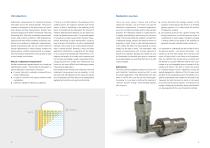
Radiation sources Radiometric measurements for industrial processes have been around for several decades. They are an important component in the performance of critical level, density and flow measurements. Nuclear measurement gauges work where conventional measuring technology fails. They offer outstanding measurement results under extreme conditions. High temperatures, pressures and other difficult ambient and process conditions are no problem for radiometric measurements. Typical measurement tasks are non-contact level and density measurements in various vessels, bunkers and piping systems,...
Open the catalog to page 2
Point sources Point sources are widely used in literally any measurement task, whether it is density, level or the use as limit switch. They usually comprise an inner source capsule, which securely encapsulates the radioactive material and a shield with a shutter mechanism to block the radiation in a controlled way. Fig.4 shows schematically how a detector works. When the emitted gamma quants hit the crystal, after having passed through the walls of the vessel, pipe and the measured product itself, each gamma photon in the beam might generate a light flash, resulting in thousands of subsequent...
Open the catalog to page 3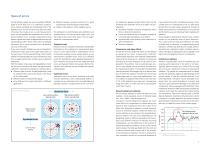
Types of errors On the following pages we want to elucidate different types of errors that occur in a radiometric measurement. Clearly, everybody will immediately think of the statistical error, but we will show that there are other influences that create errors as well. Measurement errors can be classified into systematic errors and statistical (random) errors. A proper measurement setup delivers a good result with an appropriate accuracy and reproducibility. Often, by all means within acceptable tolerances, this is more important than the absolute accuracy of the value. If you want to watch...
Open the catalog to page 4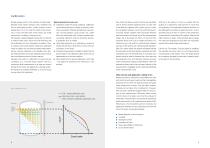
Calibration Nuclear gauges work on the principal of attenuation. Basically, every matter interacts with ɣ-radiation and has an attenuating effect. Under process control perspective, this is not only the media to be measured, it is also the steel walls of the vessel, any inside construction, insulation, framework, etc. For example, a typical Delayed Coking Unit in a refinery is made of steel with a 20-50 mm wall thickness and has a diameter of 5-9 m, all packed in insulation. Thus, it is obvious that a level system needs to be calibrated onsite to reflect the non-process related attenuation. Hence,...
Open the catalog to page 5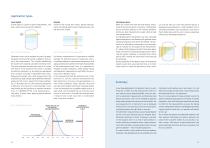
Application types Level switch A level switch is a point-to-point measurement, utilizing a point source and a point detector. Density Similar to the nuclear limit switch, density measurements are typically point-to-point measurements, with the same error modes. Fig.9 Level switch schematic Fig.10 Schematic of a density measurement Systematic errors can be reduced very well, by applying good workmanship during installation and setup of the measurement. This includes establishing the system with properly calculated switching limits. The most important and dominant error of a nuclear limit switch,...
Open the catalog to page 6
Berthold Technologies stands for excellent know-how, high quality and reliability. The customer is always the focus of our solution. We know our business! Using our varied product portfolio, our enormous specialized knowledge and extensive experience, we develop suitable solutions together with our customers for new, individual measurement tasks in a wide variety of industries and applications. Berthold Technologies is specialised in radiometric process measurements for 70 years. This is our core competence with state-of-the-art and cutting edge products and solutions covering a vast range of...
Open the catalog to page 7All Berthold Technologies Process Control catalogs and technical brochures
 Density measurement
5 Pages
 Continuous level measurement
5 Pages
 Retrofit
3 Pages
 Article "Made to measure"
3 Pages
 Moisture in pasta production
3 Pages
 Glass level measurement
3 Pages
 Mould level measurement
4 Pages
 LB 475 Fracturing system
3 Pages
 Multiphase level measurement
7 Pages
 Produkt InlineSENS
4 Pages
 Industry Sugar
9 Pages
 LB472 Bulk Flow Meter
12 Pages
 MEVIS
MEVIS4 Pages
 NUMo - LB 134 UMo II
2 Pages
 Radiation Protection Instruments
12 Pages
 Micro-Polar
16 Pages
 DuoSeries Detectors LB 4700
2 Pages
 Rod Source Shielding
4 Pages
 Safety Source Capsule SSC
2 Pages
 Level Switch LB 471
6 Pages


Archived catalogs

- Flowmeter
- Measuring device
- Concentration analyzer
- Liquids analyzer
- Liquid level detector
- Level probe
- Solids analyser
- Liquid level sensor
- Industrial flow monitor
- Process analyzer
- Precision flow meter
- Analog level sensor
- Real-time analyzer
- Integration analyzer
- Mass flow monitor
- Flow meter with display
- Level transmitter
- Liquid level transmitter
- Digital output level sensor