
- Catalogs
- Bentley Systems Europe B.V.
- RISE Structural Design Uses Innovative Technology for Methanol Plant’s Pipe Stress and Structural Analysis


- Products
- Catalogs
- News & Trends
- Exhibitions
RISE Structural Design Uses Innovative Technology for Methanol Plant’s Pipe Stress and Structural Analysis

RISE Structural Design Uses Innovative Technology for Methanol Plant’s Pipe Stress and Structural Analysis
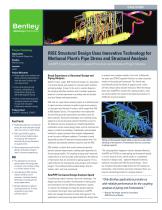
Overview: RISE Structural Design, Inc., based in Tokyo, Japan, specializes in structural design and analysis for plant, building, and piping projects. The company is recognized for its expertise in seismic diagnosis and safe, durable structural designs. RISE undertook a pipe stress analysis project at a methanol plant in Japan, focusing on pipes near the furnace with temperatures ranging from 300 to 900 degrees Celsius.
Challenges and Solutions: The project required accurate assessments and cost reduction for steel materials. A key challenge was ensuring the piping system's flexibility to withstand extreme temperatures, which involved installing spring supports. Effective coordination across design teams was crucial to avoid delays. Traditionally, independent analyses by different disciplines increased analysis time and complexity. RISE needed a solution to integrate piping and framework models for a more accurate understanding of framework behavior connected to piping supports.
Technological Integration: RISE used Bentley's AutoPIPE and STAAD software to overcome productivity barriers. AutoPIPE managed thousands of nodes and segments, allowing the design team to analyze complex models quickly. The pipelink function in STAAD facilitated the creation of conjoined piping and framework models, automatically joining beams at support points, which also helped reduce carbon dioxide emissions. This integration significantly reduced design costs and improved analysis efficiency.
Benefits and Outcomes: The integration of Bentley's solutions eliminated inefficient work processes, such as checking design policy differences between departments. The use of Bentley applications reduced coupling analysis time by tenfold compared to other software. This approach led to a decrease in design costs and improved project delivery efficiency. RISE plans to continue using Bentley applications for coupling analysis to maintain quality designs and make this method a standard in plant engineering and construction.
Conclusion: RISE Structural Design successfully utilized innovative technology to enhance productivity and maintain project schedules for the methanol plant's pipe stress and structural analysis. The integration of AutoPIPE and STAAD provided reliable performance and substantial cost reductions, setting a new standard for coupling analysis in the industry.
Catalog excerpts
CASE STUDY Bentley Advancing Infrastructure Project Summary Organization RISE Structural Design, Inc. Solution Manufacturing Location Japan Project Objectives • Perform pipe stress analysis and deliver accurate assessments to meet the owner's safety and cost requirements • Ensure that piping around furnaces could perform in temperatures ranging from 300 to 900 degrees Celsius • Deliver synchronized structural and piping analysis and design through multi-discipline collaboration and data sharing Products Used AutoPIPE® Advanced, STAAD® RISE Structural Design Uses Innovative Technology for Methanol Plant's Pipe Stress and Structural Analysis AutoPIPE-STAAD Integration Increased Productivity and Maintained Project Schedule Fast Facts • Establishing effective coordination among the multi-discipline design team was critical to avoid delays. • RISE used STAAD's pipelink format to create linked models of the piping and framework, automatically joining the beams at support points. • Spring supports ensured that the piping was flexible enough to react to extreme temperatures. ROI • The application's processing speed enables the design team to analyze more complex models in a shorter amount of time. • Using Bentley's ISM solutions reduced inefficient work processes, including checking differences in design policies among departments. • Bentley applications reduced coupling analyses by 10 times, compared to using other software options. Broad Experience in Structural Design and Piping Analysis Based in Tokyo, Japan, RISE Structural Design, Inc. specializes in structural design and analysis for overseas plant, building, and piping design. Known for its work in seismic diagnosis, the company identifies situations and formulates proposals based on its broad experience in providing safe and durable structural design and piping analysis. RISE took on a pipe stress analysis project at a methanol plant in Japan and was contracted to perform pipe stress analysis on the pipes near the plant's furnace, which ranged from 300 to 900 degrees Celsius. The organization was responsible for delivering accurate assessments and reduce costs for steel materials. Among the challenges was installing spring supports to ensure the piping system's flexibility to react to the furnaces extreme temperatures. Establishing effective coordination across various design teams, such as structural and piping, is critical to avoid delays. Traditionally, each discipline involved in a project conducts their analyses independently as well as uses in different conditions. This makes it nearly impossible to create 3D data and increases analysis time. The traditional, disconnected workflow would not work for RISE. RISE needed a solution that would remove productivity barriers between departments, enabling each department to link the piping models. The coupling of piping and framework models allows a more accurate understanding of the behavior of frameworks that are connected to piping supports. This is highly effective for selecting the spring hangers and constant hangers. The combined effects enable designs that are simpler, safer, and more economical. AutoPIPE Increases Design Analysis Speed Consolidating models, however, came with challenges. The design team had to consider the thousands of intersections and connections from the different departments' models. To resolve this challenge and keep the design's progress on schedule, the project team used Bentley's AutoPIPE, which can manage thousands of nodes and segments. The application's quick processing speed enabled the design team to analyze more complex models in less time. Additionally, the team used STAAD's pipelink function to create conjoined models of the piping and framework. This format also automatically joined the beams at support points, which will help reduce carbon dioxide emissions. While the design team uses AutoPIPE to conduct the coupling analysis, users can easily transfer the results of the piping load analysis to STAAD for structural analysis. Piping and framework models allow a more accurate understanding of the behavior of frameworks that are connected to piping supports. "We used pipelink's integration function between Bentley's AutoPIPE and STAAD to create piping and framework models in a short amount of time, which results in a substantial reduction in design costs," explained Nobuaki Koremoto, technical consultant with RISE Structural Design. "Since our company had analysis departments for both piping and frameworks, with extremely low barriers between them, we have an outstanding process for coupling analysis." "Only Bentley applications provide us with reliable performance for the coupling analysis of piping and frameworks." — Nobuaki Koremoto, technical consultant, RISE Structural Design
Open the catalog to page 1
"We used pipelines integration function between Bentley's AutoPIPE and STAAD to create piping and framework models in a short amount of time, which results in a substantial reduction in design costs. Since our company had analysis departments for both piping and frameworks, with extremely low barriers between them, we have outstanding process for coupling analysis. " - Nobuaki Koremoto, Technical Consultant, RISE Structural Design, Inc. Bentley Solutions Eliminate Inefficient Work Processes Using Bentleys integrated structural modeling (ISM) solutions for coupling analysis, RISE reduced inefficient...
Open the catalog to page 2All Bentley Systems Europe B.V. catalogs and technical brochures
 Digital Airport Project Showcase
18 Pages
 Water_Hazelwood_Coal_Mine
2 Pages
 Water_Simtejo_case_study
2 Pages
 Wimbledon Stadium_Case Study
2 Pages
 WSP-Shard_Case_Study
3 Pages
 Bentley’s Water Project Showcase
92 Pages
 Mine Water Software Solution
4 Pages
 AutoPLANT Equipment V8i
2 Pages
 AutoPLANT Piping V8i
2 Pages
 ConstructSim
2 Pages
 promis•e
2 Pages
 Bentley Datasheets
2 Pages
 Making PDS Interoperable
17 Pages
 Bentley OpenPlant PowerPID
2 Pages
 STAAD.Pro
2 Pages


Archived catalogs
 Water modelling
24 Pages
 Bentley Water V8 XM
2 Pages
 Bentley Cadastre Specsheet
2 Pages
 STAAD Foundation
2 Pages
 RAM CADStudio
2 Pages
 Bentley MAP
2 Pages
 Bentley Structural Brochure
2 Pages
 Bentley Project Yearbook 2006
82 Pages
 Bentley SewerCAD
2 Pages
 Bentley WaterCAD
2 Pages
 Bentley WaterGEMS
2 Pages
 Bentley HAMMER
2 Pages
 Bentley StormCAD
2 Pages
 Bentley SewerGEMS
2 Pages
 Bentley AutoPlant P&ID
2 Pages
 Bentley Microstation
2 Pages
 Bentley Architecture
2 Pages
 Bentley ProjectWise brochure
2 Pages
 Bentley CivilStorm
2 Pages
 Bentley ProjectWise
4 Pages
 Bentley PowerDraft
2 Pages
 Bentley AutoPipe Specsheet
2 Pages


- Automation software solution
- Management software solution
- Analysis software solution
- Process software
- Real-time software
- Windows software
- Computer-aided design software
- Cloud-based software
- Control software
- Design software solution
- Industrial software
- 3D software solution
- Interface software
- Visualization software solution
- Quality software
- Simulation software solution
- Programming software solution
- Automated software
- Development software
- Network software