
- Catalogs
- Bentley Systems Europe B.V.
- Guangdong Hydropower Planning & Design Institute Optimizes Design of Underground Waterway System


- Products
- Catalogs
- News & Trends
- Exhibitions
Guangdong Hydropower Planning & Design Institute Optimizes Design of Underground Waterway System

Guangdong Hydropower Planning & Design Institute Optimizes Design of Underground Waterway System
Catalog excerpts

Advancing Infrastructure Project Summary Organization: Guangdong Hydropower Planning & Design Institute Solution: Reality Modeling Location: Foshan, Guangzhou, Dongguan, Shenzhen, Guangdong Province, China Project Objective: • Construct 114.9 kilometers of water delivery lines from the Xijiang River, branching into four nearby regions. • Implement BIM advancements for a collaborative design process. • Limit the impact on the surrounding community and environment with 3D reality modeling. Products used: Bentley Map® , AECOsim Building Designer, Bentley Raceway and Cable Management, ContextCapture, Descartes, LumenRT, MicroStation®, Navigator, OpenRoads, OpenRoads Navigator, Bentley Substation, ProjectWise® Fast Facts • Guangdong Hydropower planned and designed a CNY 34.7 billion water delivery line system in the Pearl River Delta. • The project team used reality modeling applications to design 114.9 kilometers of delivery lines. • When completed, the delivery lines will increase flow to these areas, counteracting the effects of rapid urbanization. ROI • AECOsim Building Designer reduced the design period by 1,500 resource hours. • ProjectWises collaborative design platform helped finish the design 23 days ahead of schedule. • The team saved CNY 250,000 using Navigator for early clash detection in delivery system lines. Guangdong Hydropower Planning & Design Institute Optimizes Design of Underground Waterway System Bentley Applications Helped Deliver the Project 23 Days Ahead of Schedule Rapid Urbanization in Guangdong Province The Pearl River Delta is located in the Guangdong Province in South China, north of Hong Kong and Macau. The river flows directly into the South China Sea. The area is known for its farming and is regarded as one of the most productive and sustainable ecosystems in the world because of its integrated dike-rice paddy-fish agricultural system. Guangdong province, particularly the Pearl River Delta area, saw a sharp rise in population in 2005, when it reached 110 million people for the first time. The population has continued to grow, leading to rapid urbanization in the area. Water shortage is one of the consequences of this population boom. The State Council approved the Pearl River Delta Water Resources Allocation Project to address this concern by erecting a far-reaching modernized water network. Some lines will also run under civil houses, which will require house reinforcement or demolition. Additionally, the team also planned to have a working well every three kilometers alongside the shield tunnels. The section of the network from water intake to the Gaoxinsha Reservoir utilized two shield tunnels with 6-meter outer diameters and one shield tunnel with an 8.5-meter outer diameter was used for the portion of the system transporting water from Gaoxinsha Reservoir to Luotian Reservoir. Constructing the underground lines with incredibly long shield tunnels was a challenge for GDPI as these tunnels are extremely complicated to build. Increased Water Distribution Guangdong Hydropower Planning & Design Institute (GPDI), an engineering design consultancy, was retained by the Ministry of Water Resources to plan and design a solution to the water shortage crisis surrounding the Pearl River Delta area. Since its establishment in 1956, GPDI has won many awards and is well recognized in China for its design projects. The GDPI project team set out to create 114.9 kilometers of water delivery lines, drawing water from the nearby Xijiang River and sending it to the Foshan, Guangzhou, Dongguan, and Shenzhen regions. The team decided to use building information modeling (BIM) technology and a collaborative design process across many participants to formulate the water network design. This complex, CNY 34.7 billion project needed to be built with a minimal impact on the surrounding environment and community. The delivery line system will include one main line with two branches, one regulating reservoir, and three pump stations. The lines are arranged alongside municipal roads and designed to be as far underground as possible to reduce land requisition and demolition. A few of these lines will run deep beneath farmland so they do not affect the land or the crops. LumenRT was used to render high quality virtual reality meshes and visualizations, which helped stakeholders make more informed decisions. 3D Models GPDI turned to reality modeling to help create a design that minimally affects the Pearl River Delta region. Models of the planning areas were essential for the team to visualize where the new delivery lines should be located. To begin, GPDI created 3D reality meshes of the planning areas. The team took pictures of the communities and environment and used ContextCapture to create the 3D model. This model was visible by all project participants and updated in real-time, improving communication between all contributors during the planning and design stages.
Open the catalog to page 1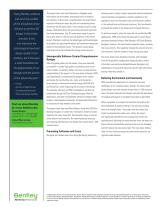
"Using Bentley software and services enables all the disciplines of our institute to perform 3D design in the whole process. It not only improves the technological level and design quality of our institute, but it also lays a solid foundation for the appreciation of our designs and the launch of the whole lifecycle." — Yi Yang, Director ofDigital Center, Guangdong Hydropower Planning & Design Institute Find out about Bentley at: www.bentley.com Contact Bentley 1-800-BENTLEY (1-800-236-8539) Outside the US +1 610-458-5000 Global Office Listings www.bentley.com/contact The project team also used...
Open the catalog to page 2All Bentley Systems Europe B.V. catalogs and technical brochures
 Digital Airport Project Showcase
18 Pages
 Water_Hazelwood_Coal_Mine
2 Pages
 Water_Simtejo_case_study
2 Pages
 Wimbledon Stadium_Case Study
2 Pages
 WSP-Shard_Case_Study
3 Pages
 Bentley’s Water Project Showcase
92 Pages
 Mine Water Software Solution
4 Pages
 AutoPLANT Equipment V8i
2 Pages
 AutoPLANT Piping V8i
2 Pages
 ConstructSim
2 Pages
 promis•e
2 Pages
 Bentley Datasheets
2 Pages
 Making PDS Interoperable
17 Pages
 Bentley OpenPlant PowerPID
2 Pages
 STAAD.Pro
2 Pages


Archived catalogs
 Water modelling
24 Pages
 Bentley Water V8 XM
2 Pages
 Bentley Cadastre Specsheet
2 Pages
 STAAD Foundation
2 Pages
 RAM CADStudio
2 Pages
 Bentley MAP
2 Pages
 Bentley Structural Brochure
2 Pages
 Bentley Project Yearbook 2006
82 Pages
 Bentley SewerCAD
2 Pages
 Bentley WaterCAD
2 Pages
 Bentley WaterGEMS
2 Pages
 Bentley HAMMER
2 Pages
 Bentley StormCAD
2 Pages
 Bentley SewerGEMS
2 Pages
 Bentley AutoPlant P&ID
2 Pages
 Bentley Microstation
2 Pages
 Bentley Architecture
2 Pages
 Bentley ProjectWise brochure
2 Pages
 Bentley CivilStorm
2 Pages
 Bentley ProjectWise
4 Pages
 Bentley PowerDraft
2 Pages
 Bentley AutoPipe Specsheet
2 Pages


- Automation software solution
- Management software solution
- Analysis software solution
- Process software
- Real-time software
- Windows software
- Computer-aided design software
- Cloud-based software
- Control software
- Design software solution
- Industrial software
- 3D software solution
- Interface software
- Visualization software solution
- Quality software
- Simulation software solution
- Programming software solution
- Automated software
- Development software
- Network software