
- Catalogs
- Bentham Instruments Ltd
- Solar Cell Characterisation

Solar Cell Characterisation

Solar Cell Characterisation
- Speed and Accuracy: Utilizes a monochromatic probe and NMI traceable calibrated reference diodes for quick and accurate solar cell characterization.
- Device Compatibility: Supports a wide range of photovoltaic devices including c:Si, mc:Si, a:Si, µ:Si, CdTe, CIGS, CIS, CZTS, Ge, dye-sensitized, organic/polymer, multi-junction, quantum well, quantum dot, chalcogenides, and perovskites.
- Electrical Interface: Offers a full range of detection electronics for various device requirements, including AC or DC modes.
- Spectral Range: Standard range of 300-1100nm, extendable to 1800nm and beyond.
- Ease of Use: Fully automated via USB and controlled by Benwin+ software, providing direct measurement results.
- Flexibility: Includes options for different mounts, integrating sphere accessory, and motorized XY stage for device mapping.
- Constant Current Power Supply: Ensures stable lamp output for xenon, quartz halogen, and solar simulator light sources.
- Monochromatic Probe: Dual Xenon/quartz halogen source with a 300mm focal length monochromator for optimal illumination.
- Detection Electronics: Includes various amplifiers and controllers for precise measurement.
- DTR6 Integrating Sphere: Measures total reflectance and transmittance.
- Reference Detectors: Calibrated photodiodes for accurate system calibration.
- BenWin+ Control Software: Automates system calibration and device measurements, with data export capabilities.
- Measurement Modes: Single point or device mapping with motorized XY stage.
- Spectral Range Options: Various configurations for different wavelength ranges.
- Sample Mount Options: Temperature-controlled vacuum mount and PV_SS6 for different contact devices.
- Probe Modes: AC, AC/DC, and DC chopped modes available.
- Detection Electronics: Specific configurations for different cell types.
- Reflectance/Transmittance Measurement: DTR6 integrating sphere inclusion.
- Multiple Light Bias Sources: Required for multi-junction devices.
- Voltage Biasing: Important for multiple junction cells and thin film devices.
- Custom Electrical Probe: Custom probing schemes available.
- High Irradiance Monochromatic Bias Source: Provides a tunable source for multiple junction cells.
- Temperature Sensor: Non-contact infrared sensor for accurate temperature measurement.
- Programmable Bias Source: Includes a solenoid-based shutter and motorized slit for irradiance variation.
- Monochromatic Probe: Features a 75W Xenon and 100W Quartz halogen light source with adjustable bandwidth and resolution.
- Temperature-Controlled Vacuum Mount: Peltier-based heat pump with a temperature range of 15-65°C.
- Solar Simulator: Quartz halogen/Xenon source with uniform illumination.
- Reference Diodes: Silicon and Germanium diodes with PTB traceability.
- XY Stage: 300mm travel with 0.1mm resolution.
- DTR6 Integrating Sphere: Features Ba2SO4 coating and various detector options.
Catalog excerpts

PVE300 Photovoltaic Device Spectral Response EQE (IPCE), IQE
Open the catalog to page 1
The PVE300 is a turnkey solution for the determination of solar cell spectral response/ EQE (IPCE) and IQE. The ability to characterise both photovoltaic devices and materials renders the PVE300 a key component in research and production-line quality processes. Key features include: • Speed and Accuracy Using a monochromatic probe and NMI traceable calibrated reference diodes, the PVE300 allows the quick and accurate determination of solar cell characteristics. • Measurement of all Device Types Compatible with all types of photovoltaic devices and architectures: c:Si, mc:Si, a:Si, g:Si,...
Open the catalog to page 2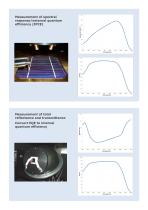
Measurement of spectral response/external quantum efficiency (IPCE) Measurement of total reflectance and transmittance Convert EQE to internal quantum efficiency
Open the catalog to page 3
A dual Xenon/ quartz halogen source and TMc300, 300mm focal length monochromator ensures optimum illumination from the UV to the NIR. Operation in AC or DC mode. The DTR6 integrating sphere is mounted on an optical rail to the upper of the PVE300 chamber to allow the measurement of total reflectance and total transmittance Constant Current Power Supply A 610 constant current supply is required for each light source (xenon, quartz halogen and solar simulator). The excellent stability of the 610 ensures constant lamp output. Detection Electronics The 417 unit houses the detection electronics of...
Open the catalog to page 4
BenWin+ Control Software Fully automating the PVE300 over the USB interface, Benwin+ allows quick and easy system calibration and device measurements. Data may be analysed directly or exported to another platform as required. Relay Optic A reflective optic relays an image of the monochromator exit port onto the sample plane, providing a probe of any shape up to 6x6mm. Solar Simulator A variable intensity quartz halogen-based solar simulator with computer controlled shutter is mounted to the wall of the PVE300. Light is transported via six-branch fibre to ensure uniform illumination in the sample...
Open the catalog to page 5
The following options are required for the configuration of the PVE300. Single point measurement or device mapping • PVE300: Single point sample measurement • PVE300_XY: Includes motorised X-Y stage allowing the determination of device uniformity and IPCE . Spectral range • Monochromatic probe 300-1100nm, Si reference diode • Monochromatic probe 300-1800nm, Si and Ge reference diodes • Maximum range 250-3000nm: Please enquire Sample Mount • Temperature controlled vacuum mount: Measurement of front/ front and front/ rear contact devices with sample temperature control • PV_SS6: Measurement...
Open the catalog to page 6
Optional Extras The PVE300 has been designed to be compatible with all types of photovoltaic device and architectures. The following extras are included to meet with specific device requirements. Multiple Light Bias Sources In the measurement of multi-junction devices, multiple solar simulators are required, one to bias the subcell under test at one sun, the other filtered simulator to ensure that the non–tested subcells are sufficiently illuminated that they do not current limit the tested subcell response. Voltage Biasing In the case of multiple junction cells and some thin film devices, testing...
Open the catalog to page 7
Probe light source: Monochromator configuration: Bandwidth: 75W Xenon and 100W Quartz halogen Triple grating, symmetric, single Czerny -Turner, 300mm focal length Adjustable fixed slit, 1-10nm typical Software control: BenWin+ Windows application Wavelength Range: Wavelength accuracy: ± 0.4nm (600g/mm) Relay Optic: Mirror-based, 1.2x magnification Probe size: Up to 6x6mm Interface: USB Reference Diodes Diode & Range Traceability Voltage Bias (Keithley 2400) Voltage Range: -20 to 20V Silicon 300-1100nm; Germanium 800-1800nm PTB, Germany Temperature control: 4x70W Peltier-based heat...
Open the catalog to page 8All Bentham Instruments Ltd catalogs and technical brochures
 Collimators
1 Page
 DTR6 Integrating Sphere
1 Page
 706 Power Supply
2 Pages
 IL6/7/8 Light Sources
3 Pages
 M300 Monochromator
4 Pages
 TMS305 Monochromator
4 Pages
 DTMS300 Monochromator
4 Pages
 TMS300 Monochromator
4 Pages
 DH00 (Te) Detector
2 Pages
 IL1 Light Source
2 Pages
 TMc150 Monochromator
4 Pages


