

Dual Plate Check Valves

Dual Plate Check Valves
- Available in sizes DN 40 to 300, with two types: 177 for DN 40 to 65 and 105 for DN 80 to 300.
- Maximum working pressure is PN 16.
- Operational temperature range is +1°C to +50°C.
- Compatible with flange drillings such as ISO PN 6, PN 10, PN 16, ANSI 150, BS Table E/D, JIS 5K/10K.
- Face-to-face dimensions conform to EN 558-1 series 16 and ISO 5752 series 16.
- Internal coating is elastomer, with cassette type internal parts for easy replacement.
- For vertical pipe installations, ensure fluid flows from bottom to top for proper valve function.
- Maintain minimum distances between the valve and any disturbing elements like elbows, pumps, or other valves to ensure optimal performance.
- For horizontal pipe configurations, the valve should be installed with the axis of rotation in a vertical position.
- Place the double check valve at 6 DN downstream of any disturbing element, and observe at least 2 DN minimum for elements downstream of the valve.
- Body: Ductile iron/EN-GJS-400-15 for T177 and Fonte GL/EN-GJL-250 with blue epoxy coating for T105.
- Liner: NBR for both types.
- Plates: Stainless Steel 316.
- Shaft: Stainless Steel 304.
- Springs: Stainless Steel 302.
| DN | Type | B (mm) | C (mm) | E (mm) | G (mm) | Weight (kg) |
|---|---|---|---|---|---|---|
| 40 | 177 | 33 | 43 | 8 | 15 | 1.2 |
| 50 | 177 | 43 | 49 | 10 | 21 | 1.8 |
| 65 | 177 | 46 | 64 | 14 | 22 | 2.5 |
| 80 | 105 | 64 | 70 | 11 | 30 | 3.8 |
| 100 | 105 | 64 | 91 | 21 | 30 | 4.9 |
| 125 | 105 | 70 | 125 | 38 | 32 | 7.9 |
| 150 | 105 | 76 | 148 | 47 | 32 | 10.2 |
| 200 | 105 | 89 | 200 | 64 | 35 | 18.6 |
| 250 | 105 | 114 | 240 | 78 | 48 | 32.0 |
| 300 | 105 | 114 | 300 | 103 | 50 | 38.0 |
Catalog excerpts

Dual plate check valve with centering lugs Series B6 25 Characteristics • DN 40 to 65 : 177 type. • DN 80 to 300 : 105 type. • PN 16 maximum working pressure. • Temperature: +1°C to +50°C. • Centering lugs valid for installation between flanges drillings such as ISO PN 6, PN 10, PN 16, ANSI 150, BS Table E/D, JIS 5K/ 10K. • Face-to-face dimension: • Internal coating elastomer. • Cassette type internal parts, allowing easy replacement (plates, shaft and springs). Mounting In case of a mounting on vertical pipe, the correct functioning of the valve will be ensured only if the fluid circulates from bottom to top (for fluid circulation from top to bottom, please consult us). Recommendation The minimum distances to be observed between the position of the check valve and any disturbing element (elbow, divergent, pump, valve, ...). Depending on the configuration of the circuit, certain minimum distances must be observed between the position of the valve and the one of a disturbing element such as elbow, divergent, pump, valve, etc. The mountings on the left represent horizontal pipe configurations (top view) with the check installed with axis of rotation in vertical position. The double check valve must be placed at 6 DN downstream of any disturbing element. For any disturbing element placed downstream of the valve, be sure to observe the particular instructions of the element and/or at l
Open the catalog to page 1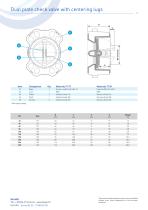
Dual plate check valve with centering lugs Body Liner Plates Ductile iron/EN-GJS-400-15 NBR Stainless Steel 316 Fonte GL/EN-GJL-250* NBR Stainless Steel 316 * Blue epoxy coating The technical data and performance can be modified without prior notice depending on the technical evolution.
Open the catalog to page 2All Belgicast catalogs and technical brochures
 Series 1400
1 Page
 EBCO
EBCO2 Pages
 ATPLAS
2 Pages
 Product Catalogue
162 Pages
 FS-20
FS-203 Pages
 Ductile Iron Repair Clamps
8 Pages
 SERIES 3200
2 Pages
 2200 LIBERTY
2 Pages
 MAJOR
MAJOR2 Pages
 EUROCOUP
4 Pages
 3100
31002 Pages
 1500 LIBERTY
2 Pages
 1200 LIBERTY
2 Pages
 DISCOBLOC BA
4 Pages
 NOREPOL EA
4 Pages
 F3 30
F3 302 Pages
 F1 10
F1 102 Pages
 non slam nozzle check valve
6 Pages
 B6 40
B6 402 Pages
 B6 50
B6 504 Pages
 ERHARD DVF
4 Pages
 SERIES K1
11 Pages
 RKV Needle Valve
8 Pages
 ERHARD butterfly valves
23 Pages
 EVOLUTION
12 Pages
 ERHARD TWIN-AIR
7 Pages
 Single orifice air valve
2 Pages
 Swing check valve
2 Pages
 ERHARD ball valve
11 Pages
 INFINITY
28 Pages
 MONECA SMART
8 Pages
 RAF Irrigation Catalog
88 Pages
 Fire Protection CATALOGUE
184 Pages
 PRODUCT CATALOGUE 2020
482 Pages
 ULTRAF IRRIGATION CATALOGUE
46 Pages
 Dismantling Joints
12 Pages
 Belgicast Flow Control Valves
18 Pages
 Belgicast Air Relief Valves
16 Pages
 Belgicast Butterfly Valves
24 Pages
 BELGICAST Check Valves brochure
20 Pages


