
- Catalogs
- Beijing Holtop Artificial Environment Technology Co., Ltd.
- Liquid Circulation Heat Exchangers


Liquid Circulation Heat Exchangers

Liquid Circulation Heat Exchangers
Liquid circulation heat exchangers are designed to transfer heat between liquid and air. They are installed on both the fresh air and exhaust air sides. A pump circulates the liquid between the two heat exchangers, allowing the liquid to preheat or precool the fresh air. Typically, water is used as the liquid, but ethylene glycol is added to lower the freezing point.
- Heat exchange occurs through separate liquid pipes, preventing cross-contamination, making it suitable for hospitals, germ-free labs, and industries handling harmful gases.
- Offers stable and reliable operation with a long service life.
- Flexible connections between exchangers facilitate easy installation, ideal for upgrading existing air handling units (AHUs).
- Uses conventional accessories like water pumps and heat exchangers, ensuring low maintenance costs.
- Applicable in various configurations, such as one-to-one, one-to-many, or many-to-many connections.
- The heat exchanger is a sensible type with an efficiency of 55% to 60%.
- Recommended to use 6 or 8 rows, with a face velocity not exceeding 2.8 m/s.
- The choice of circulating pump should consider the pressure drop in both fresh and exhaust air, as well as the water flow pressure drop.
- Airflow direction significantly affects heat recovery efficiency, with an influence rate of up to 20%.
- The freezing point of the ethylene glycol-water mixture should be 4 to 6 degrees Celsius lower than the local minimum winter temperature. A table provides the necessary percentages for different freezing points.
For more details, visit the product link: Holtop Liquid Circulation Heat Exchangers.
Catalog excerpts
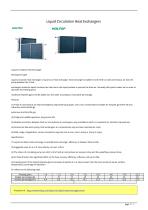
Liquid Circulation Heat Exchangers Liquid Circulation Heat Exchanger Working Principle Liquid circulation heat exchanger is liquid to air heat exchanger, heat exchangers installed in both fresh air side and exhaust air side, the pump between the 2 heat exchangers make the liquid circulate then the heat in the liquid preheat or precool the fresh air. Normally the liquid is water but in order to decrease the freezing point, moderate ethylene glycol will be added into the water according to reasonable percentage. Features (1) Fresh air and exhaust air heat exchanged by separated liquid pipes, zero cross contamination.Suitable for hospital, germfree lab and industries which discharge poisonous and harmful gas. (2) Stable and reliable operation, long service life (3) Flexible connection between fresh air and exhaust air exchangers, easy installation which is convenient for old AHU improvement. (4) Accessories like water pump, heat exchangers are conventional, easy and low maintanence costs. (5) Wide range of application, various connection ways like one to one, one to many or many to many. Specifications (1) Liquid circulation heat exchanger is sensible heat exchanger, efficiency is between 55% to 60%. (2) Suggested rows are 6 or 8, face velocity not over 2.8m/s (3) The choice of circulating pump can refer to the fresh air and exhuast air pressure drop and the waterflow pressure drop. (4) Air flow direction has significant effect on the heat recovery efficiency, influence rate up to 20%. (5) Freezing point of the hybrid ethylene glycol and water should be 4 to 6 celsius lower than the local minimum winter outdoor temperature, percentage of hybridcan be refered to the following table. Freezing point Weight percentage (%) Volume percentage (% ) Product link:https://www.holtop.com/liquid-circulation-heat-exchangers.html page 1 / 1 Powered by TCPDF (www.tcpdf.org)
Open the catalog to page 1All Beijing Holtop Artificial Environment Technology Co., Ltd. catalogs and technical brochures
 Black Cool Intelligent
3 Pages
 Fresh Air Sterilization Box
4 Pages
 Heat Pipe Heat Exchangers
2 Pages
 Enthalpy Wheels
1 Page
 Heat Wheels
1 Page
 Total Heat Exchanger
1 Page








- Chiller
- Liquid recirculation chiller
- Air chiller
- Filtration unit
- Water recirculation chiller
- Industrial cooling system
- Air dehumidifier
- Plate heat exchanger
- Disinfection unit
- Air-cooled blast chiller
- Filtration system
- Gas/liquid heat exchanger
- Industrial heat exchanger
- UV disinfection unit
- Refrigerant dehumidifier
- Absorption filtration unit
- Gas filtration unit
- Gas/gas heat exchanger