


- Company
- Products
- Catalogs
- News & Trends
- Exhibitions
White paper - Calibration in hazardous areas

White paper - Calibration in hazardous areas
This white paper by Beamex discusses calibration in hazardous areas, covering definitions, industry types, zone classifications, regulations, equipment classification, and practical calibration issues.
Hazardous areas contain or may contain flammable substances like liquids, gases, vapors, or dust, posing explosion or fire risks if the "Explosion Triangle" conditions are met.
Flammable liquids have a flashpoint below 100°F, while combustible liquids have a flashpoint above this temperature. Flashpoint and autoignition temperatures are critical for determining flammability.
The concept originated in coal mines with flammable substances, leading to standards for intrinsically safe electrical equipment.
Industries like chemical, petrochemical, oil and gas, pharmaceuticals, food and beverage, energy production, and mining often have hazardous areas marked with the Ex logo.
Techniques like increased safety (Exe), intrinsically safe (Exi), and flameproof (Exd) are used to prevent explosions by eliminating ignition sources.
Standards include International IEC standards, the ATEX directive for Europe, and North American legislation, specifying hazardous areas and equipment classification.
Zones are classified by the likelihood of flammable substance presence: Zone 0 (continuous), Zone 1 (occasional), and Zone 2 (rare).
Equipment is categorized by safety levels: Category 1/EPL a (very high), Category 2/EPL b (high), and Category 3/EPL c (normal), depending on zone classification.
Electrical equipment is grouped for specific atmospheres: Group I (mines), Group II (gas), and Group III (dust), with subdivisions for specific gases or dust types.
Temperature class indicates maximum equipment surface temperature, which must match the flammable gases in the area.
Equipment temperature classes range from T1 (842 °F/450 °C) to T6 (185 °F/85 °C), selected based on flammable substances present.
North America uses divisions (1 and 2), while IEC uses zones (0, 1, and 2). Division 1 covers Zones 0 and 1, Division 2 covers Zone 2.
North America has an additional explosion group compared to IEC. The most dangerous group is A in North America and IIC in IEC, with comparisons for gases like acetylene, hydrogen, ethylene, and propane.
IEC/ATEX and North American temperature classes are compared, noting more intermediate classes in North America.
Equipment must suit environmental conditions, considering operating temperature and protection ratings (IP or NEMA). Non-static materials prevent static electricity, and label sizes are restricted based on classification.
The Beamex MC5-IS is an intrinsically safe process calibrator with Ex marking, indicating suitability for hazardous areas, detailing equipment group, product category, gas group, temperature class, and safe operating temperature.
Catalog excerpts

Calibration White Paper hazardous areas WORLD-CLASS CALIBRATION SOLUTIONS
Open the catalog to page 1
BEAMEX Calibration White Paper Calibration in hazardous areas This article discusses calibration in hazardous areas and what everyone needs to be aware of before entering into a hazardous area with calibration equipment. Other topics covered are flammable and combustible liquids, definition of a hazardous area, the types of industries where hazardous areas are found, the different levels of hazardous zones, regulations, equipment classification and various other practical and related issues. source of ignition (or heat) and oxygen (air). The situation is often presented as a triangle; hence the...
Open the catalog to page 2
BEAMEX Calibration White Paper Brief history Some of the first hazardous areas were discovered in the early coal mines. Being flammable substances, both the coal dust and the methane absorbed created a hazardous area. The lighting in early mines was produced by candles and torches, generating a source of ignition. This led to many accidents. Later, when miners began to use electrical equipment (lighting, tools), many accidents occurred due to sparking or heating. Eventually, design standards were developed to guide the design process to prevent the sparking and heating of electrical equipment....
Open the catalog to page 3
BEAMEX Calibration White Paper environmental conditions to make a burnable mixture with air. Combustible liquids have a flashpoint way above normal environmental conditions, and therefore they have to be heated before they will ignite. Some examples of flashpoint and autoignition temperatures: Substance Autoignition temperature Diethyl ether Various protective techniques As mentioned earlier, in order to prevent an explosion, one of the three elements of the Explosion Triangle should be eliminated. In practice, eliminating the source of ignition would be the most sensible. There are various techniques...
Open the catalog to page 4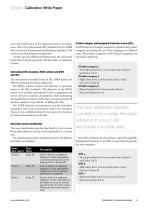
BEAMEX Calibration White Paper areas and classification of the equipment used in hazardous areas. One is the International IEC standard and the ATEX directive used in International and European legislation. The second is the North American legislation. As there are some differences between these two, this article looks, first, at the two separately and then makes a comparison of them. International IEC standards, IECEx scheme and ATEX directive The international standard family of IEC 60079 defines the different standards for related regulations. The IECEx scheme involves international co-operation...
Open the catalog to page 5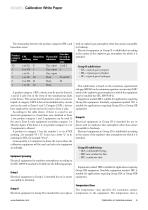
BEAMEX Calibration White Paper The relationship between the product categories/EPLs and hazardous zones: Can also Product EPL Hazardous Flammable be used in category marking zone substance hazardous label zone with an explosive gas atmosphere other than mines susceptible to firedamp. Electrical equipment in Group II is subdivided according to the nature of the explosive gas atmosphere for which it is intended. A product category 1/EPL a device (can be used in Zones 0, 1 and 2) is safe even in the event of two simultaneous faults in the device. This means that all protective safety circuits are...
Open the catalog to page 6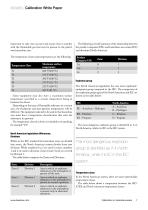
BEAMEX Calibration White Paper important to take into account and assure that it matches with the flammable gas that may be present in the plant’s own hazardous area. The temperature classes and temperatures are the following: Temperature Class Maximum surface temperature Some equipment may also have a maximum surface temperature specified as a certain temperature being in between the classes. Depending on the type of flammable substance in a certain area, the flashpoint and auto-ignition temperatures will be different. The equipment selected to be used in that hazardous area must have a temperature...
Open the catalog to page 7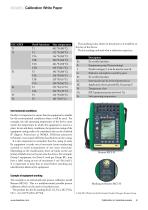
BEAMEX Calibration White Paper North American That marking is also shown in the picture as it would be on the face of the device. The Ex marking code and what it indicates in practice: Ex-certified product Equipment group II (non-mining) Product category 1 (can be used in zone 0) Explosive atmosphere caused by gases Ex-certified product Intrinsically safe (i), level of protection ia Application above ground (II), Gas group C Temperature class EPL Equipment protection level Ga Safe operating temperature Environmental conditions Finally, it is important to ensure that the equipment is suitable...
Open the catalog to page 8All Beamex catalogs and technical brochures
 Brochure - Software and services
44 Pages
 MC6-Ex
16 Pages
 Beamex smart reference p
2 Pages
 Beamex MC2-IS
12 Pages
 MCS200
18 Pages
 Calibration World spring 2016
36 Pages
 Brochure - Workshop Equipment
54 Pages
 Brochure - Field Equipment
116 Pages
 Brochure - Calibration Solutions
36 Pages





Archived catalogs
 Calibration World 2-2007
24 Pages
 Calibration World Issue 1-2007
24 Pages
 Calibration World Issue 1-2006
24 Pages


- Temperature probe
- Management software solution
- Resistance temperature sensor
- Analysis software solution
- Test stand
- Process software
- Cloud-based software
- Measurement software
- Pt100 temperature transducer
- Automated test bench
- Visualization software solution
- Stainless steel temperature transducer
- Portable calibrator
- Reporting software
- Temperature calibration system
- Creation software
- Industrial test bench
- Precision calibration equipment
- Precision temperature transducer