


- Company
- Products
- Catalogs
- News & Trends
- Exhibitions
Magazine - Calibration World Autumn 2014

Magazine - Calibration World Autumn 2014
The CEO of Beamex, Raimo Ahola, addresses the increasing demands on process instruments and control systems due to modern quality systems like ISO9000 and ISO14000. He highlights challenges such as the retirement of experienced calibration specialists and the need for modern calibration techniques to maintain productivity and quality. The global nature of Beamex's business helps balance sales despite challenges in Europe.
This section emphasizes the evolution of calibration practices, highlighting the need for advanced techniques due to improvements in measurement technology. It discusses the use of sophisticated equipment like the Beamex MC6 and CMX software to manage complex instrumentation and documentation requirements. Loop testing is suggested as an efficient method to ensure accurate control without individual instrument testing, minimizing downtime and maximizing efficiency.
This section focuses on the importance of accurate switch calibration for reliable plant operations. It discusses challenges and solutions in calibrating different types of switches and the role of advanced tools in simplifying these processes.
The article covers intelligent commissioning, which involves using advanced tools and techniques to streamline the commissioning process of instrumentation systems, improving system reliability and performance.
- British Sugar, UK: Enhanced calibration processes with the Beamex Integrated Calibration Solution.
- L-Tech Engineering, India: Achieved leadership in fieldbus calibration using Beamex solutions.
- Monsanto, US: Simplified calibration procedures with the right tools.
Updates on Beamex's activities include significant donations to ISA and the release of Beamex CMX version 2.8.
An overview of Beamex's products and services, highlighting their commitment to innovation in calibration solutions.
The document discusses advanced methods for calibrating instrumentation loops in process plants, emphasizing accurate measurements for optimal control, safety, and efficiency. It highlights multivariable loop testing, switch calibration, and intelligent commissioning in improving plant operations.
Flow measurements, particularly for natural gas or steam, require precise calibration due to their impact on billing and management scrutiny. The document describes using multivariable flow meters that integrate differential pressure, temperature, and static pressure measurements for accurate flow calculations. A loop test is recommended to verify measurement accuracy, using tools like the Beamex MC6.
The document outlines a non-linear test setup for multivariable loops, emphasizing loop testing over individual transmitter checks for comprehensive calibration and improved maintenance efficiency.
Switch calibration is crucial for safety and regulatory compliance. The document lists reasons for calibrating switches, such as regulatory requirements, safety hazards, and material wastage, advocating for precise calibration methods.
Commissioning of process instruments is vital for plant performance. The document suggests using automated, paperless procedures to enhance efficiency and reduce errors, providing an example of a chemical facility's commissioning process.
The document concludes with a case study of British Sugar's Wissington factory, showcasing efficient operations and sustainable practices, integrating energy efficiency and sustainability in industrial operations.
The document advocates for evolving calibration methods to keep pace with advancements in instrumentation and automation, emphasizing the benefits of loop testing and intelligent commissioning for better control, safety, and reliability in process plants.
Field calibration traditionally required multiple devices for different tasks, which was cumbersome and time-consuming. The introduction of Beamex MC5 and MC6 multifunction calibrators reduced the equipment needed, allowing technicians to perform multiple calibrations with a single tool.
Beamex CMX professional calibration management software complements the multifunction calibrators by automating work orders, storing calibration data, and generating reports, ensuring compliance with regulatory and audit requirements.
The adoption of Beamex solutions has led to significant time savings, improved documentation, and extended calibration intervals based on historical data analysis.
Beamex has donated calibration equipment to the International Society of Automation (ISA) to support hands-on training for automation professionals.
Beamex offers a range of products, including portable calibrators, workstations, calibration accessories, and software solutions. Their professional services include re-calibration, installation, training, and software support.
Beamex's integrated calibration solutions have revolutionized the field calibration process, making it more efficient, automated, and reliable.
Beamex provides a wide range of products and services in the field of instrumentation and calibration, accessible in over 80 countries through their partner network.
For brochures, product demonstrations, and quotations, contact [email protected] or visit their online request form. Software support is available at [email protected], and re-calibration and service inquiries can be directed to [email protected].
The Beamex MC6 is an advanced field calibrator and communicator featuring a 5.7-inch color touch-screen with a user-friendly interface. It supports five operational modes and integrates with calibration software for efficient, paperless calibration management.
Catalog excerpts

New methods for calibrating loops Calibrating switches Intelligent commissioning Customer success stories British Sugar, UK L-Tech Engineering, India Monsanto, US
Open the catalog to page 1
Calibration World • AUTUMN 2014 oday’s modern process plants, production processes and quality systems place new and tough demands on the accuracy of process instruments and control. Quality systems, such as the ISO9000 and ISO14000, call for systematic and welldocumented calibrations with regard to accuracy, repeatability, uncertainty and confidence levels. At the same time, many of the dedicated and experienced calibration specialists are retiring, and the new specialists replacing them are also typically given other duties and responsibilities, leaving less time to become deeply familiar with...
Open the catalog to page 2
CEO’s Letter 2 New methods for calibrating loops 4 Calibrating switches 12 Intelligent commissioning 14 Customer success stories British Sugar introduces the Beamex Integrated Calibration Solution 16 L-Tech Engineering number one in fieldbus calibration in India 18 Calibration with the right tools simplifies procedures at Monsanto 20 Calibration Insights – Beamex newsletter series Beamex makes significant equipment and software donation to ISA Beamex in brief 27 Beamex products and services 27 CALIBRATION WORLD – Beamex corporate magazine Published by Beamex Oy Ab, Ristisuonraitti 10,...
Open the catalog to page 3
New methods for calibrating loops New methods for calibrating loo Instrument technicians are following practices that were set up many years ago and it is not uncommon to hear, “this is the way we have always done it.” Measurement technology continues to improve and is becoming more accurate. CALIBRATION WORLD AUTUMN 2014 www.beamex.com/calibrationworld
Open the catalog to page 4
www.beamex.com/calibrationworld CALIBRATION WORLD AUTUMN 2014
Open the catalog to page 5
New methods for calibrating loops he typical approach to calibration has been to regularly test instrumentation that influences effective control, safe operation, quality or other relevant criteria. In most cases, scheduling is conservative and methods at a particular site have slowly evolved over time. Instrument technicians are following practices that were set up many years ago and it is not uncommon to hear, “this is the way we have always done it.” Measurement technology continues to improve and is becoming more accurate. It is also becoming more complex – why test a fieldbus transmitter...
Open the catalog to page 6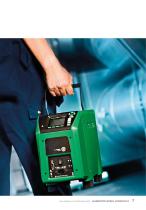
www.beamex.com/calibrationworld CALIBRATION WORLD AUTUMN 2014
Open the catalog to page 7
New methods for calibrating loops One good way to look at error is to think in terms of the loop’s input engineering units. loop should be checked and corrected one by one in order to bring the final measurement back into good operation. In some cases, it is not possible to make a closed loop test. In the example loop, it may be extremely difficult or expensive to remove the probe from the process or the probe cannot be inserted into a temperature block/bath. If this is the situation, then an open loop test can be performed where the temperature element is disconnected from the transmitter and...
Open the catalog to page 8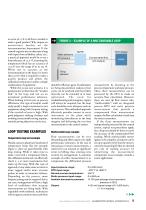
an error of ±5 ºF is all that is needed to make a good product? Why impose an unnecessa r y burden on t he instrumentation department? If the control engineer has no objection (along with input from reliability, safety, etc.), a practical approach would be to set a loop tolerance of ±2.0 ºF, assuming the temperature block has an accuracy of ±0.5 ºF over the range of 50 to 250 ºF. While not as accurate as the instrumentation in the loop, it is better than 2:1 for what is required to make a quality product and allows the calibration technician to utilize a simple combination of equipment. While...
Open the catalog to page 9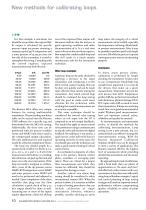
New methods for calibrating loops For this example, a non-linear test should be set up where the expected lbs/ hr output is calculated for specific pressure input test points assuming a constant, typical 450 ºF temperature and a static pressure of 14.735 psi since the low side of the transmitter is vented to atmosphere for testing. Consulting with the control engineer, expected measurements may look like this: inH²O mA Lbs/Hr 0.00 4.0000 0.0 30.00 7.6250 339.8 60.00 9.2202 489.4 90.00 10.4787 607.4 120.00 11.5717 709.8 150.00 12.5634 802.8 180.00 13.4872 889.4 200.00 14.0738 944.4 225.00 14.7845...
Open the catalog to page 10
www.beamex.com/calibrationworld CALIBRATION WORLD AUTUMN 2014
Open the catalog to page 11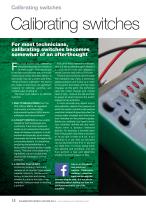
Calibrating switches Calibrating switches For most technicians, calibrating switches becomes somewhat of an afterthought or most technicians, calibrating switches becomes somewhat of an afterthought. This may be due to the fact that switches are commonly viewed as an overly simplistic device. A technician may see a switch and think, “What is there to calibrate?” The fact of the matter is that there are significant reasons to calibrate switches and multiple ways of doing so. The three main reasons to calibrate switches: 1. ue to regulations from the D FDA, EPA or EMEA, all regulated instruments,...
Open the catalog to page 12
www.beamex.com/calibrationworld CALIBRATION WORLD AUTUMN 2014
Open the catalog to page 13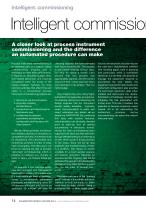
Intelligent commissioning Intelligent commission A closer look at process instrument commissioning and the difference an automated procedure can make Process instrument commissioning is an essential part of a plant’s overall commissioning program and is necessary for ideal plant performance. It requires an allocated budget, time, and trained personnel, and must be considered within the scope of the overall program. Typically, the most common activities that affect time and costs in a conventional process instrument commissioning program are: 1. learning to use the field device, 2. hysically installing...
Open the catalog to page 14
www.beamex.com/calibrationworld CALIBRATION WORLD AUTUMN 2014
Open the catalog to page 15
Customer success story British Sugar, UK British Sugar introduces the Beamex Integrated Calibration Solution ritish Sugar at Wissington, built in 1925, is the largest beet sugar factory in the world and the most efficient in Europe – operational 355 days per year. The operation runs with 267 permanent employees peaking at 500 including non-permanent staff during campaign periods when the sugar beet is being brought into the factory. During this campaign period over 3 million tons of beets are processed with 1,000 trucks visiting the site every day. That’s a truck every 45 seconds. In total 420,000...
Open the catalog to page 16All Beamex catalogs and technical brochures
 Brochure - Software and services
44 Pages
 MC6-Ex
16 Pages
 Beamex smart reference p
2 Pages
 Beamex MC2-IS
12 Pages
 MCS200
18 Pages
 Calibration World spring 2016
36 Pages
 Brochure - Workshop Equipment
54 Pages
 Brochure - Field Equipment
116 Pages
 Brochure - Calibration Solutions
36 Pages






Archived catalogs
 Calibration World 2-2007
24 Pages
 Calibration World Issue 1-2007
24 Pages
 Calibration World Issue 1-2006
24 Pages


- Temperature probe
- Resistance temperature sensor
- Analysis software solution
- Test stand
- Process software
- Cloud-based software
- Measurement software
- Pt100 temperature transducer
- Automated test bench
- Visualization software solution
- Stainless steel temperature transducer
- Reporting software
- Temperature calibration system
- Creation software
- Industrial test bench
- Precision calibration equipment
- Precision temperature transducer