


- Company
- Products
- Catalogs
- News & Trends
- Exhibitions
Improving power plant performance with a modern calibration process

Improving power plant performance with a modern calibration process
Introduction
Calibration is essential in power plants for maintaining efficiency, ensuring safety, and meeting regulatory standards. This document highlights the significance of modern calibration processes, the challenges of outdated methods, and the advantages of advanced calibration techniques.
Common Reasons for Calibration
Power Plant Efficiency: Accurate measurements are crucial for optimizing energy production and profitability. Proper calibration minimizes asset strain and maintenance costs, with high-quality equipment and software being vital for accuracy and resource management.
Plant Safety: Safety relies on precise pressure and temperature measurements. Regular calibration of safety circuits is necessary for regulatory compliance, accident prevention, and avoiding fines.
Typical Challenges in Power Plants
Lack of Dedicated Metrology Resources: The absence of skilled metrology experts in many plants necessitates automated calibration solutions to enhance efficiency and accuracy.
Legacy Calibration Process: Outdated manual processes can cause errors and inefficiencies. Modern solutions automate documentation and calculations, reducing labor and improving accuracy.
Outage Support: Outsourcing calibration requires well-planned processes for compliance and efficiency. Automated systems minimize manual errors and enhance data traceability.
Modern Calibration Processes
Modern processes utilize automated management and scheduling through calibration software, integrating with maintenance systems for a paperless workflow. Intelligent calibrators perform automatic calculations, boosting efficiency and data quality.
Implementation of a New Calibration Process
Adopting a modern process enhances efficiency, reduces costs, and ensures regulatory compliance. A structured project framework with expert support is recommended for successful implementation.
Conclusion
A modern calibration process improves plant performance, safety, emissions control, and invoicing accuracy while reducing costs and enhancing compliance. The Central Nuclear de Almaraz case study illustrates significant production improvements with high-accuracy calibrators.
Catalog excerpts

Calibration White Paper Improving power plant performance calibration process WORLD-CLASS CALIBRATION SOLUTIONS
Open the catalog to page 1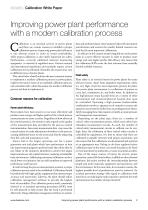
BEAMEX Calibration White Paper Improving power plant performance with a modern calibration process alibration is an essential activity in power plants and there are various reasons to establish a proper calibration process. Improving power plant efficiency is one obvious reason in order to ensure profitability, while proper calibration is also vitally important for safety. Furthermore, correctly calibrated emission monitoring equipment is essential in regulated areas. Various national and international regulations and standards require certain calibrations to be performed. Naturally, the reasons...
Open the catalog to page 2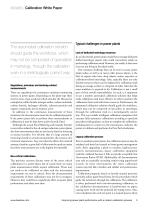
BEAMEX Calibration White Paper The automated calibration solution should guide the workforce, which may not be composed of specialists in metrology, through the calibration work in a metrologically correct way. Regulations, emissions and invoicing-related measurements There are regulations for continuous emissions monitoring systems in power plants. Depending on the plant type there may be series of gas analyzers which monitor the flue gas for example for; sulfur dioxide, nitrogen oxides, carbon monoxide, carbon dioxide, hydrogen chloride, airborne particles and organic compounds, just to mention...
Open the catalog to page 3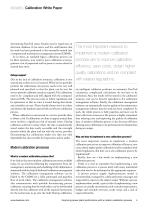
BEAMEX Calibration White Paper determining Pass/Fail status. Results may be typed into an electronic database, if one exists, and the confirmation that the work has been performed is also manually entered into a computerized maintenance management system (CMMS). So in short, an outdated legacy calibration process can be labor intensive, may result is poor calibration accuracy, generate a lot of paperwork and be prone to errors related to manual data entry. implement a modern calibration process are to improve calibration efficiency, save costs, obtain higher quality calibrations and be compliant...
Open the catalog to page 4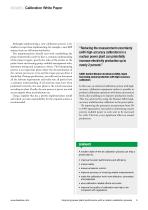
BEAMEX Calibration White Paper Although implementing a new calibration process is far smaller in scope than implementing, for example, a new ERP system, there are still many similarities. The implementation should start with establishing the project framework in order to have a common understanding of the project targets, specify the roles of the parties in the project team and steering group, establish management rules, determine testing and acceptance criteria. This blueprinting process is an important phase where the documentation of the current process (as it is) and the target process (how...
Open the catalog to page 5All Beamex catalogs and technical brochures
 Brochure - Software and services
44 Pages
 MC6-Ex
16 Pages
 Beamex smart reference p
2 Pages
 Beamex MC2-IS
12 Pages
 MCS200
18 Pages
 Calibration World spring 2016
36 Pages
 Brochure - Workshop Equipment
54 Pages
 Brochure - Field Equipment
116 Pages
 Brochure - Calibration Solutions
36 Pages






Archived catalogs
 Calibration World 2-2007
24 Pages
 Calibration World Issue 1-2007
24 Pages
 Calibration World Issue 1-2006
24 Pages


- Temperature probe
- Management software solution
- Resistance temperature sensor
- Analysis software solution
- Test stand
- Process software
- Cloud-based software
- Measurement software
- Pt100 temperature transducer
- Automated test bench
- Visualization software solution
- Stainless steel temperature transducer
- Portable calibrator
- Reporting software
- Temperature calibration system
- Creation software
- Industrial test bench
- Precision calibration equipment
- Precision temperature transducer