


- Company
- Products
- Catalogs
- News & Trends
- Exhibitions
Calibration World 3-2007 28 pages

Calibration World 3-2007 28 pages
Modern process plants require high accuracy in instruments and control systems. Calibration is essential for maintaining this accuracy, ensuring efficiency and productivity.
Calibration involves comparing an instrument's output to a known reference to maintain accuracy, credibility, and compliance with safety and environmental regulations.
Calibrations must be traceable to national standards, with regulations like ISO9001 and FDA requiring systematic processes and record-keeping.
Key terms include Calibration, Resolution, Accuracy, and Uncertainty, with methods for evaluating uncertainty being Type A (statistical) and Type B (systematic).
Uncertainty in calibration is evaluated using scientific judgment and experience, with Type B evaluations being as reliable as Type A.
Calibration labs must state expanded uncertainty using a coverage factor for a 95% confidence level.
Effective management involves using professional tools and software for record-keeping, automating processes, and reducing errors.
Automated systems like Beamex® enhance efficiency and accuracy, supporting documentation and analysis, especially in critical industries like power and energy.
Proper calibration in power plants ensures safety, meets standards, and impacts profitability by reducing measurement uncertainty.
Calibration enhances safety and productivity by adhering to standards, preventing operational parameter exceedance, and reducing paperwork.
Trend analysis helps optimize calibration intervals, ensuring instruments perform within tolerances and preventing downtime.
Calibration frequency varies by industry, with pharmaceuticals calibrating more due to regulatory demands.
Trend analysis optimizes intervals, verifies performance, and compares sensor quality, saving time and ensuring specifications are met.
Organizations must calibrate devices against traceable standards and maintain records, with software validated for its application.
Plant Yates maintains instrumentation through regular calibration, supporting operations under strict standards.
Beamex offers calibration accessories, software, and professional services, providing solutions globally through a partner network.
Beamex provides a multimedia CD-ROM with resources like videos, demos, and guides, available through registration on their website.
Catalog excerpts
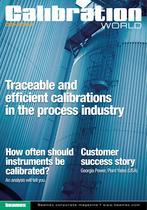
03• 2007 WORLD B e a m e x c o r p o r a t e m a g a z i n e • w w w. b e a m e x . c o m Traceable and efficient calibrations in the process industry How often should instruments be calibrated? An analysis will tell you. Customer success story Georgia Power, Plant Yates (USA)
Open the catalog to page 1
Dear Calibration Professional, the main articles in this issue of CALIBRATION WORLD deal with traceable and efficient calibrations in the process industry, optimum frequency of calibrations, and improving power plant performance through calibration. The primary reason for calibration is based on the fact that even the best ‘digital’ measuring instruments lack in absolute stability, they drift and lose their ability to give accurate measurements. However, there is a wide range of different ways to plan, manage and complete the needed calibration tasks, starting from the most inefficient and prone...
Open the catalog to page 2
Calibration World 03/2007 MD’s letter Traceable and efficient calibrations in the process industry 4 Improving power plant performance through calibration 12 How often should instruments be calibrated? 16 Customer Success Story: Georgia Power, USA 20 Beamex News 22 Using the Beamex® MC5 fieldbus calibrator with Emerson’s AMS Suite Free demo for Beamex® CMX Light Calibration Software The Beamex® MC5-IS gets updated certification John Adeimy appointed as president of Beamex, Inc. Beamex provides a corporate-wide calibration system for Scottish and Southern Energy Beamex provides a calibration solution...
Open the catalog to page 3
Traceable and effi in the process ind 4 CALIBRATION WORLD 03 • 2007 www.beamex.com/calibrationworld
Open the catalog to page 4
cient calibrations ind ustry www.beamex.com/calibrationworld CALIBRATION WORLD 03 • 2007 5
Open the catalog to page 5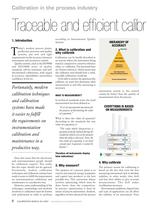
1. Introduction Today’s modern process plants, production processes and quality systems, put new and tight requirements on the accuracy of process instruments and on process control. Quality systems, such as the ISO9000 and ISO14000 series of quality standards, call for systematic and welldocumented calibrations, with regard to accuracy, repeatability, uncertainty, confidence levels etc. Does this mean that the electricians and instrumentation people should be calibration experts? Not really, but this topic should not be ignored. Fortunately, modern calibration techniques and calibration systems...
Open the catalog to page 6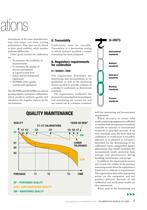
instruments of the same manufacturer, type and range, can show varying performance. One unit can be found to have good stability, while another performs differently. Other good reasons for calibration are: • To maintain the credibility of measurements • To maintain the quality of process instruments at a good-as-new level • Safety and environmental regulations • ISO9000, other quality systems and regulations The ISO9000 and ISO14000 can assist in guiding regular, systematic calibrations, which produces uniform quality and minimizes the negative impacts on the environment. 5. Traceability Calibrations...
Open the catalog to page 7
measurement of specified requirements, the ability of computer software to satisfy the intended application is confirmed. This is done prior to initial use and reconfirmed as necessary. NOTE: See ISO 10012 for further information. 6.2 PHARMACEUTICAL (FDA, U.S. Food and Drug Administration) Any pharmaceutical company that sells their products in the USA must comply with FDA regulations regardless where the products are manufactured. • Calibration records must be maintained. • Calibrations must be done according to written, approved procedures. • Each instrument should have a master history record....
Open the catalog to page 8
able to comply with these regulations. In such a system, the Electronic Signature is considered equivalent to a hand-written signature. Users must understand their responsibilities once they give an electronic signature. The Audit Trail is required for change management. It must be a tool that records all modifications, which add, edit, or delete data from an electronic record. 7. Definitions of metrological terms Some metrological terms in association with the concept of calibration are described in this section. Quite a few of the following terms are also used on specification sheets for calibrators....
Open the catalog to page 9
calculation. Standard deviation is used as a measure of the dispersion of values. Type B uncertainty Type B evaluation of uncertainty involves the use of other means to calculate uncertainty, rather than applying statistical analysis of a series of measurements. It involves the evaluation of uncertainty using scientific judgement based on all available information concerning the possible variables. Values belonging to this category may be derived from: • Experience with or general knowledge of the behavior and properties of relevant materials and instruments • Ambient temperature • Humidity •...
Open the catalog to page 10
without producing any papers. If paper copies of certificates are preferred, printing them must, of course, be possible. When all calibration related data is located in a single database the software is obviously able to create calibration related reports and documents. Today’s documenting calibrators are capable of calibrating many process signals. It is not very uncommon to have a calibrator that calibrates pressure, temperature and electrical signals including frequency and pulses. In addition to the conventional mA output of a transmitter, modern calibrators can also read HART, Foundation...
Open the catalog to page 11
Calibration helps a power plant in maintaining or even improving safety, as well as in meeting national and international standards. However, calibration is also a matter of profitability. By using high-accuracy calibration equipment, the accuracy of vital measurements can be maintained at required levels and plants can increase their annual power production capability. Power and Energy Operations Electric, natural gas, oil, and other energy meters directly inf luence revenue. Because of rising energy costs, power and energy operations carefully scrutinize these devices to ensure that they accurately...
Open the catalog to page 12All Beamex catalogs and technical brochures
 Brochure - Software and services
44 Pages
 MC6-Ex
16 Pages
 Beamex smart reference p
2 Pages
 Beamex MC2-IS
12 Pages
 MCS200
18 Pages
 Calibration World spring 2016
36 Pages
 Brochure - Workshop Equipment
54 Pages
 Brochure - Field Equipment
116 Pages
 Brochure - Calibration Solutions
36 Pages






Archived catalogs
 Calibration World 2-2007
24 Pages
 Calibration World Issue 1-2007
24 Pages
 Calibration World Issue 1-2006
24 Pages


- Temperature probe
- Management software solution
- Resistance temperature sensor
- Analysis software solution
- Test stand
- Process software
- Cloud-based software
- Measurement software
- Pt100 temperature transducer
- Automated test bench
- Visualization software solution
- Stainless steel temperature transducer
- Portable calibrator
- Reporting software
- Temperature calibration system
- Creation software
- Industrial test bench
- Precision calibration equipment
- Precision temperature transducer