
- Catalogs
- BDC ELECTRONIC S.r.l.
- CYLINDRICAL INDUCTIVE ATEX SENSORS IN METAL HOUSING

CYLINDRICAL INDUCTIVE ATEX SENSORS IN METAL HOUSING

CYLINDRICAL INDUCTIVE ATEX SENSORS IN METAL HOUSING
Catalog excerpts
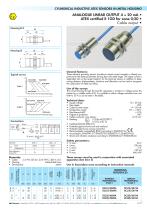
CYLINDRICAL INDUCTIVE ATEX SENSORS IN METAL HOUSING ANALOGUE LINEAR OUTPUT 4 ÷ 20 mA • ATEX certified II 1GD for zone 0;20 • Cable output • Housing B-2 General features: These inductive proximity sensors provide an output current inversely or directly proportional to the distance between sensing face and metal target. The output current is dependent also on the target material. So the proximity sensors in addition to determining distance, displacements, vibrations and distortions can be used to recognize the composition of metal and alloys. The current flowing through the load RL, generates a variation in voltage across the resistor for a suitable value of RL, it is possible to obtain voltage variations from one tenth to 20 V as can be seen in the tables. Technical data: Connections brown Safety parameters: Measurement range Cable diameter Use in hazardous area according to instruction manuals Max switching frequency ( f ) These sensors must be used in conjunction with associated apparatus (See Sect. E) No- load supply current Maximum linearity error Flush mounting Non flush mounting • Cable: 2 m PVC CEI 20 - 22 II; 90°C; 300 V; O.R. • Housing: nickel plated brass • Sensing face: plastic Supply voltage: 10 ÷ 30 Vdc Max ripple: 20% Output current range: 4 ÷ 20 mA Temperature range: - 10° ÷ + 60°C Max thermal drift: < 10% Degree of protection: IP67 Cable conductor cross section: 0,75 mm2 Marking: II 1D Ex iaD 20 T80° C II 1G Ex ia IIC T6 Certified IMQ 08 ATEX 010 Protected against short-circuit and overload Protected against any wrong connection Electromagnetic compatibility (EMC) according to EN60947-5-2 According to: EN60947-5-7/EN60079-0/EN60079-11/EN60079-26 Shock and vibration resistance according to EN60068-2-27/EN60068-2-6 ORDERING REFERENCES INVERSELY PROPORTIONAL Graph 1 DIRECTLY PROPORTIONAL Graph 2 BDC Electronic - Viale Lidice, 37/39 - 10095 Grugliasco (To) - Italy -Tel. (+39)011.31.49.021/022 Fax (+39) 011.3
Open the catalog to page 1All BDC ELECTRONIC S.r.l. catalogs and technical brochures
 NAMUR SERIES
1 Page
 Connector output M8x1
1 Page
 SPEED SENSORS
2 Pages
 CONNECTORS CABLED ON SENSORS
33 Pages
 CAPACITIVE SENSORS
12 Pages
 INDUCTIVE SENSORS
92 Pages
 ATEX SENSORS CATALOGUE
97 Pages
 DF.../...A series
1 Page
 DCX.../...A series
1 Page
 DCZ.../...A series
1 Page
 General Catalogue
213 Pages


Archived catalogs

- Connector
- Data connector
- Metal connector
- Screw-in connector
- Socket electrical connector
- Industrial connector
- IP67 connector
- Cylindrical proximity sensor
- Male connector
- Inductive proximity sensor
- Current connector
- Signal amplifying integrated circuit
- Cable connector
- IP67 proximity sensor
- Straight connector
- Tilt sensor
- RF connector
- DIN connector
- DC proximity sensor