- Catalogs
- BDC ELECTRONIC S.r.l.
- ATEX SENSORS CATALOGUE

ATEX SENSORS CATALOGUE

ATEX SENSORS CATALOGUE
BDC Electronic offers a catalogue for ATEX sensors designed for explosive atmospheres, compliant with the 94/9/EC directive and certified by IMQ. Installation instructions are available online.
The document categorizes explosive atmospheres into zones:
- Zone 0/20: Continuous danger with long-term presence of explosive gases or dust.
- Zone 1/21: Potential danger during normal operation.
- Zone 2/22: Minimal danger, with short-lived presence of explosive gases or dust.
Guidance is provided on interpreting ordering references for various sensor types, including specifications for housing, cable output, and protection modes.
Technical data for NAMUR series sensors include:
- Supply voltage: 7.7 to 9 Vdc
- Temperature range: -20°C to +60°C
- Protection degree: IP67
- Certified standards: EN60947-5-2, EN60079-0, EN60079-11, EN60079-26
Sensors are made with stainless steel or nickel-plated brass housing and plastic sensing faces, designed to withstand shock and vibration.
Sensors must be used with associated apparatus in hazardous areas, following provided manuals. They feature protection against incorrect connections and LED indicators for switch status.
- Cable conductor cross-section varies by diameter.
- Marking: II 1D Ex iaD 20 T80°C, II 1G Ex ia IIC T6.
- Certification: IMQ 08 ATEX 010.
- Protection against short-circuit, overload, and wrong connections.
- EMC: EN60947-5-2 compliant.
- Standards: EN60947-5-6, EN60079-0, EN60079-11, EN60079-26.
- Shock and vibration resistance: EN60068-2-27, EN60068-2-6.
- Vi max: 13.5 V
- Ii max: 60 mA
- Ci max: 100 nF
- Li max: 100 μH
- Pi max: 200 mW
Sensors are suitable for hazardous areas and must be used with associated apparatus as per manuals.
- Supply Voltage: 7.7 ÷ 9 Vdc (NAMUR standard)
- Max Ripple: 10%
- Temperature Range: -20° ÷ +60°C
- Degree of Protection: IP67
- Switch Status Indicator: Yellow LED
- Housing: Stainless steel or nickel-plated brass
- Sensing Face: Plastic
Various models are available with different body diameters and configurations, suitable for flush and non-flush mounting.
- ATEX certified for various zones.
- EMC: EN60947-5-2 compliant.
- Compliance with EN60079-0, EN60079-18, EN60079-26, EN60079-15, EN60079-31.
- Shock and vibration resistance: EN60068-2-27, EN60068-2-6.
- Protected against short-circuit and overload.
- Protected against incorrect connections.
- Suppression of initial false impulse.
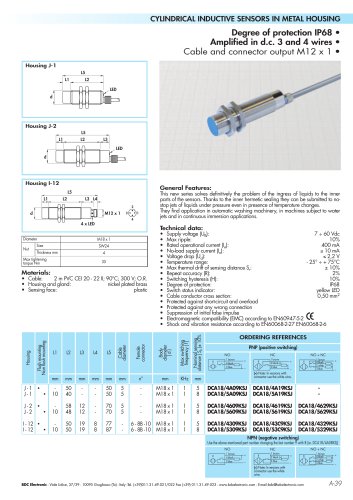
- Cable: 2 m PVC, rated for 90°C and 300 V.
- Housing: Nickel-plated brass or stainless steel.
- Sensing face: Plastic.
Part numbers are provided for various configurations, with instructions for ordering NPN versions by altering the part number.
- Supply Voltage (UB): Refer to ordering references.
- Max Ripple: 10%
- No-load Supply Current (Io): ≤ 10 mA
- Voltage Drop (Ud): ≤ 1.5 V
- Temperature Range: -25°C to +60°C
- Max Thermal Drift of Sensing Distance (Sr): ±10%
- Repeat Accuracy (R): 2% or 4% depending on model
- Switching Hysteresis Max (H): 10%
- Degree of Protection: IP67
- Switch Status Indicator: Yellow LED
- Marking: II 3D Ex tc IIIC T80°C IP67 X, II 3G Ex nAc IIC T6 X
- Protection: Short-circuit, overload, and wrong connection protection
- Initial False Impulse Suppression: Yes
- EMC: EN60947-5-2 compliant
- Standards Compliance: EN60079-0, EN60079-15, EN60079-31
- Shock and Vibration Resistance: EN60068-2-27, EN60068-2-6 compliant
- Housing Diameter 8 mm: Stainless Steel
- Housing Diameters 12-30 mm: Nickel Plated Brass
- Sensing Face: Plastic
- Cable: 2 m PVC CEI 20-22 II; 90°C; 300 V; O.R.
- Flush and Non-flush Mounting: Options available
- Connector Output: M12 x 1
- Female Connector: Refer to page G-1
- Various models available with different specifications, refer to the catalog for detailed part numbers and configurations.
- Designed for use in hazardous areas as per instruction manuals.
- Protection: IP67, ATEX certified for zones 2 and 22.
- Switch status indicator: Yellow LED.
- Cable conductor cross section varies by version and diameter.
- Marking: II 3D Ex tc IIIC T120°C IP67 X, II 3G Ex nAc IIC T4 X.
- Temperature range: -20°C to +100°C.
- Materials: Nickel plated brass housing, plastic sensing face.
- Supply voltage: 10 ÷ 30 Vdc.
- Max ripple: 10%.
- Rated operational current: ≤ 50 mA.
- No-load supply current: ≤ 10 mA.
- Voltage drop: < 1.5 V.
- Temperature range: -25°C to +100°C.
- Max thermal drift of sensing distance: ± 10%.
- Repeat accuracy: 2%.
- Switching hysteresis max: 10%.
- EMC: EN60947-5-2 compliant.
- Compliance with EN60079-0, EN60079-15, EN60079-31.
- Shock and vibration resistance: EN60068-2-27, EN60068-2-6.
- Protected against short-circuit and overload.
- Protected against any wrong connection.
- Suppression of initial false impulse.
- Use in hazardous areas according to instruction manuals.
- Recommended to use with ATEX certified connectors.
- Inductive proximity sensors with output current proportional to distance and target material.
- Can replace mechanical microswitches in many applications.
- Various models available with different specifications for body diameter, sensing distance, and switching frequency.
The document provides detailed technical specifications and features of various ATEX certified sensors, including inductive and capacitive types, designed for use in hazardous areas. These sensors are manufactured by BDC Electronic and are suitable for detecting metal and other materials in industrial environments.
- Supply Voltage: Ranges from 5 to 60 Vdc depending on the sensor type, with a maximum ripple of 10%.
- Temperature Range: -25°C to +60°C for most models.
- Protection Degree: IP67 for most sensors, ensuring dust-tight and water-resistant capabilities.
- Marking and Certification: ATEX certified for various zones, with markings such as II 1D Ex iaD 20 T80°C and II 3G Ex nAc IIC T6 X.
- Safety Parameters: Include maximum voltage (Vi max 13.5 V), current (Ii max 60 mA), capacitance (Ci max 100 nF), and inductance (Li max 100 μH).
- Special housing materials allow use without additional electrostatic protection.
- LED indicators for switch status visibility.
- Protection against short-circuit, overload, and incorrect connections.
- EMC: EN60947-5-2 standards compliant.
These sensors are suitable for detecting metal blades, level control in storage bins, and other industrial applications where hazardous conditions may exist.
Sensors must be used with associated apparatus as per instruction manuals, and specific mounting precautions are provided in the BDC General Catalogue.
The document provides technical specifications and features of ATEX certified sensors, including capacitive and magnetic sensors, designed for use in hazardous environments. These sensors are suitable for detecting various materials and are used in applications such as level control and position detection.
- General Features: Capable of detecting any material, including through plastic or glass walls. Applications include level control in storage bins and tanks.
- Technical Data: Supply voltage of 7.7 to 9 Vdc, temperature range of -20°C to +60°C, and IP67 protection. Certified for use in hazardous areas with specific safety parameters.
- Materials: Nickel-plated brass housing and plastic sensing face.
- Reduction Factor: Sensing distance varies with target material, with steel having a factor of 1 and materials like cloth and paper having lower factors.
- General Features: Activated by external magnetic fields, independent of polarity. Suitable for use in difficult conditions with high pressures.
- Technical Data: Working voltage of 5 to 30 Vdc, normally open output logic, and IP67 protection. Certified for use in hazardous areas with specific safety parameters.
- Materials: Stainless steel housing and PVC cable.
- Various models and housing types are available, with specific ordering references provided.
- Installation requires adherence to safety standards and use in conjunction with associated apparatus as per instruction manuals.
- Compliance with standards such as EN60947-5-2, EN60079-0, and others for electromagnetic compatibility and safety.
- Certified by IMQ for ATEX standards, ensuring safe operation in explosive atmospheres.
The document provides detailed technical specifications and operational guidelines for various ATEX certified sensors and related equipment, including magnetic sensors, speed sensors, and amplifiers/repeaters. These devices are designed for use in hazardous areas and comply with specific safety standards.
- These sensors are activated by an external magnetic field and are independent of the field's polarity.
- They comply with the NAMUR standard for output impedance, allowing for connection diagnostics.
- Technical specifications include a working voltage of 7.7 to 9 Vdc, normally open output logic, and a temperature range of -20 to +60°C.
- They are certified under various EN standards and have a degree of protection rated at IP67.
- Used as actuators for magnetic sensors, suitable for applications up to 70°C.
- Available in different housings, including stainless steel and plastic, with varying detection distances.
- These sensors control the rotation of a toothed wheel or reference marks with high precision.
- They are available in both DC and AC versions, with integrated control functions.
- DC sensors operate at 10 to 30 Vdc, while AC sensors operate at 90 to 240 Vac.
- Both types are protected against wrong connections, overvoltages, and short circuits.
- They feature a self-teaching threshold procedure for setting speed thresholds.
- These devices are used to control safe area loads via switches or proximity detectors located in hazardous areas.
- The D1030 series includes single and dual-channel models with configurable input and output modes.
- Fault detection for contact or proximity sensors is configurable via DIP switches.
- All devices are ATEX certified for use in hazardous zones and comply with relevant EN standards for safety and electromagnetic compatibility.
- They are designed to withstand shock and vibration as per EN60068 standards.
The document describes various models of Switch/Proximity Detector Repeaters designed for use in hazardous areas. These devices are DIN Rail units that can be configured for contact or proximity detectors, with options for Normally Open (NO) or Normally Closed (NC) configurations. They provide 3-port isolation (input/output/supply) and are equipped with signaling LEDs for power supply indication, output status, and line fault detection.
The repeaters operate on a supply voltage of 24 Vdc, with reverse polarity protection and ripple limits. They offer isolation test voltages of 1.5 KV between input/output/supply. The input switching current levels are specified, along with fault current levels for open and short faults. The output is a voltage-free SPDT relay contact with specified ratings and life expectancy.
The devices allow for field configurability of NO/NC input for contact/proximity sensors, NE/ND relay operation, and fault detection enable/disable. Actuation modes can be configured via DIP switches, allowing for flexibility in operation.
The operating temperature range is -20 to +60°C, with storage limits from -45 to +80°C. The devices are designed for mounting on T35 DIN Rails and have a degree of protection rated at IP 20.
The repeaters conform to various international standards and directives, including ATEX and IECEx certifications, making them suitable for use in hazardous areas. They are compatible with CE mark requirements and meet EMC directives.
These devices are suitable for controlling Safe Area loads via switches or proximity detectors located in Hazardous Areas. They are designed for use in Zone 0 (Zone 20) installations and are compliant with various safety and performance standards for hazardous locations.
This document provides technical specifications and guidelines for amplifiers and repeaters used in ATEX sensor applications, focusing on intrinsic safety and compliance with international standards.
- Supply Voltage: Up to 250 Vrms for intrinsic safety applications.
- Isolation: Test voltage of 2.5 KV across various input/output and supply configurations.
- Input Switching: ON at ≥ 2.1 mA, OFF at ≤ 1.2 mA, with a switch current of approximately 1.65 mA ± 0.2 mA hysteresis.
- Fault Current Levels: Open fault ≤ 0.2 mA, short fault ≥ 6.8 mA.
- Output: Voltage-free SPDT relay contact with a contact rating of 2A 250 Vac or 2A 250 Vdc.
- Environmental Conditions: Operating temperature from -20 to +60°C, storage temperature from -45 to +80°C, and up to 90% relative humidity non-condensing.
- Mounting: T35 DIN Rail according to EN50022.
- Protection: IP 20 degree of protection.
- CE mark compliant, conforms to 94/9/EC ATEX Directive and 2004/108/CE EMC Directive.
- EMC compatibility to EN61000-6-2, EN61000-6-4.
- Various international approvals including DMT, IECEx, UL, C-UL, FM, and others for hazardous locations.
- II (1) G [Ex ia] IIC, II (1) D [Ex iaD], I (M2) [Ex ia] I, II 3G Ex nA IIC T4.
- Uo/Voc = 10.7 V, Io/Isc = 15 mA, Po/Po = 39 mW at specific terminals.
- Models D1130S and D1130D for single and dual channel configurations respectively.
- Current consumption and power consumption details provided for different voltage scenarios.
- Preassembled male connectors for sensors with specific cable lengths available upon request.
- Various connector types and configurations detailed for different applications.
The document provides technical specifications and ordering information for BDC Electronic's ATEX certified connectors and cables, suitable for use with proximity sensors in hazardous environments. It includes details on female and male connectors, their compatibility with NAMUR sensors, and specific technical data.
- Operating Voltage: Maximum 50 Vac/75 Vdc
- Maximum Current: 4 A
- Contact Resistance: ≤ 5 mΩ
- Contacts Material: CuZn, brass pre-nickeled and gold plated (0.8 μm)
- Locking Nut: Self-locking in CuZn, nickel plated brass
- Temperature Range: -25°C to +90°C for PUR and PVC versions; -40°C to +120°C for HT versions
- Degree of Protection: IP68 with plug in fully locked position
- Connector 10A: Suitable for NAMUR sensors, usable in zone 0 or 20 without additional protection against electrostatic charges.
- Connector 8A: Usable in zone 1 or 21, with similar specifications to Connector 10A.
- Connector 9A and 9C: Designed for heavy applications, usable in zone 2 or 22.
The document provides a detailed ordering reference system based on the number of conductors, connector type, cable length, and material. Examples include:
- 2-Wire: C10/0022PVA for PVC material, 2 meters length
- 3-Wire: C9/0032PV3GD for PVC material, 2 meters length
- 4-Wire: C9B/0042PV3GD for PVC material, 2 meters length
All products comply with ATEX standards 94/9/CE, EN60079-0, and EN60947-5-2, ensuring safety in explosive atmospheres.
The document emphasizes the importance of following the instruction manual when using these products in hazardous areas. It also notes that the physical appearance of devices may differ from illustrations and that specifications are subject to change without notice.
Catalog excerpts

AT E X SENSORS CATALOGUE BDC ELECTRONICproduce proximityinsensors, S.r.l.was formed 1970. Being the first in Italy to it has gained in its business a lot of experience, thanks to its abilities to develop products to fulfil the market requirements. The extremely flexible company organization is able to satisfy customer's needs, assuring a high quality and reliable production, appreciated all over the world. Research and development is continuously working in order to offer solution to all kinds of problems and to find new applications. All the products are engineered to perform even in the arduous and most difficult conditions. The use of a quality system, certified according to standard ISO 9001:2008, affords the best care and precision in the fulfillment of all the realization stages: from the engineering to the production, through a manufacturing process with high levels of automation together with rigorous testings on each product.
Open the catalog to page 1
THE INTERNATIONAL CERTIFICATION NETWORK hereby certify that the organization VIALE UDfCE 37/39 - 1009S GRUGUASCO (TO) Design mid prodiKti^ni of pm*imj'fy smtefMs. iVtducifie magmlic and capuofrvf Svt&Qr. system of irt^iffiertton snrf canmdars far industrial usa WK«/ fci <M*r, mamas' for *tw>» erf «M*WHWIIL «J 'SO »W I ?0M i»jgi»«*nij Quality Management System w/jjc/? fMf/fc ifte requfrmwnts of the fatfoKwg sfandani Registration Number: Presiiieni >,} IQNET FmtulenS .,/CiSQ ■VfN<»« Spam 41 NOR lauluwwi rVuy«£ AJB-Vi ntoW Invnuttuna! /JWei<™ W'l. Afeun. Alt f it ftirfupJCCC Cl?™' OigU CCCCWi COWC«mi...
Open the catalog to page 2
has obtained the ATEX notification of the production quality system and the ATEX certification according potentially explosive atmosphere
Open the catalog to page 3
TOTAL QUALITY FOR TOTAL PRECISION INTERNAL TEST LABORATORY SURFACE MOUNTING TECHNOLOGY (SMT) All the BDC ELECTRONIC products are tested with the most sophisticated high technology equipment to ensure conformity with the relevant of all the standards. The production process is based on the use of high technology machinery which allows the highest control levels for the quality of the finished product. All stages are built with the maximum accuracy to make the finished product attain the highest standards of functional reliability. Completely automated processes for every stage ensure the creation...
Open the catalog to page 4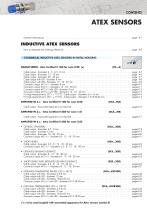
ATEX SENSORS General informations . . . . . . . . . . . . . . . . . . . . . . . . . . . . . . . . . . . . . . . . . . . . . . . . . . . . . . . . . . . . . . . page A-1 INDUCTIVE ATEX SENSORS How to interprete the ordering references . . . . . . . . . . . . . . . . . . . . . . . . . . . . . . . . . . . . . . . . . . . . . . . . . page A-3 CYLINDRICAL INDUCTIVE ATEX SENSORS IN METAL HOUSING NAMUR SERIES - Atex Certified II 1GD for zone 0;20 ( ) Cable output - diameters 4 - 5 - 6,5 - 8 mm . . . . . . . . . . . . . . . . . . . . . . . . . . . . . Cable output - diameters 12 - 18 mm . . . . . . ....
Open the catalog to page 5
CYLINDRICAL INDUCTIVE ATEX SENSORS IN METAL HOUSING AMPLIFIED IN d.c. + a.c. - Atex Certified II 3GD for zone 2;22 Cable output - diameters 12-18-30 mm . . . . . . . . . . . . . . . . . . . . . . . . . . . . . . . . . . . . . . . . . . . . . . . . . . . pageA-36 ANALOGUE LINEAR OUTPUT - Atex Certified II 1GD for zone 0;20 ( ) Cable output - diameters 18-30 mm . . . . . . . . . . . . . . . . . . . . . . . . . . . . . . . . . . . . . . . . . . . . . . . . . . . . . pageA-37 Connector output M12 x1 - diameters 18-30 mm . . . . . . . . . . . . . . . . . . . . . . . . . . . . . . . . . . . . . . ....
Open the catalog to page 6
ATEX CAPACITIVE SENSORS General informations . . . . . . . . . . . . . . . . . . . . . . . . . . . . . . . . . . . . . . . . . . . . . . . . . . . . . . . . . . . . . . . page B-1 How to interprete the ordering references . . . . . . . . . . . . . . . . . . . . . . . . . . . . . . . . . . . . . . . . . . . . . . . . . page B-1 CYLINDRICAL CAPACITIVE ATEX SENSORS IN METAL HOUSING NAMUR SERIES - Atex Certified II 1GD for zone 0;20 ( ) Cable output - diameters 18-30 mm . . . . . . . . . . . . . . . . . . . . . . . . . . . . . . . . . . . . . . . . . . . . . . . . . . . . . page B-3 Connector output...
Open the catalog to page 7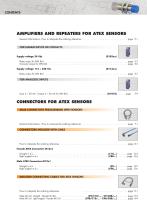
AMPLIFIERS AND REPEATERS FOR ATEX SENSORS General informations - How to interprete the ordering references . . . . . . . . . . . . . . . . . . . . . . . . . . . . . . . . . page E-1 FOR NAMUR INPUTS OR CONTACTS Supply voltage 24 Vdc Relay output for DIN Rail . . . . . . . . . . . . . . . . . . . . . . . . . . . . . . . . . . . . . . . . . . . . . . . . . . . . . . . . . . . . . page E-3 Transistor output for DIN Rail . . . . . . . . . . . . . . . . . . . . . . . . . . . . . . . . . . . . . . . . . . . . . . . . . . . . . . . . . . page E-5 Supply voltage 115 ÷ 230 Vac Relay output for DIN Rail...
Open the catalog to page 8
GENERAL INFORMATIONS ATEX SENSORS This catalogue is complementary to the BDC General Catalogue. Please refer to General informations, installation and storage instructions on section "General information" of the General Catalogue. ATEX installation instructions are available on website www.bdcelectronic.com. The ATEX sensors meet the requirements of 94/9/EC directive and are certified by IMQ for use in potentially explosive atmospheres. The applied harmonized standards are listed on the product pages. It's very important to choose the category of the device according to the classification of...
Open the catalog to page 9
HOW TO INTERPRETE THE ORDERING REFERENCES INDUCTIVE ATEX SENSORS = cylindrical amplified a.c. + d.c. 2-wire 10 ÷ 50 V = cylindrical NOT amplified d.c. NAMUR series = cylindrical amplified d.c. = cylindrical extended sensing distance d.c. series = cylindrical analogue linear output = slot sensors NOT amplified d.c. NAMUR series = cylindrical amplified d.c. SHORT series = cylindrical amplified extended sensing distance d.c. SHORT series Diameter of cylindrical sensor or slot width for slot types. For other types, change the number with the following: 80 P R T X Y Z P = plastic housing sensor =...
Open the catalog to page 10All BDC ELECTRONIC S.r.l. catalogs and technical brochures
 NAMUR SERIES
1 Page
 Connector output M8x1
1 Page
 SPEED SENSORS
2 Pages
 CONNECTORS CABLED ON SENSORS
33 Pages
 CAPACITIVE SENSORS
12 Pages
 INDUCTIVE SENSORS
92 Pages
 DF.../...A series
1 Page
 DCX.../...A series
1 Page
 DCZ.../...A series
1 Page
 General Catalogue
213 Pages