
- Catalogs
- BBH Products GmbH
- Installation Manual for SMX 100 series SMX Modular

- Products
- Catalogs
- News & Trends
- Exhibitions
Installation Manual for SMX 100 series SMX Modular
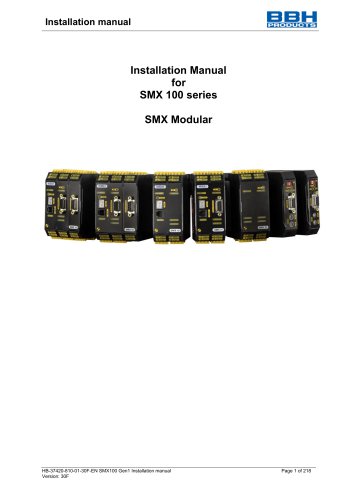
Installation Manual for SMX 100 series SMX Modular
This installation manual provides comprehensive guidance for the installation of the SMX100 series, including base devices and expansion modules. It covers models such as SMX100-1, SMX100-2, and SMX100-4, along with expansion modules like SMX121 and SMX131R. The manual is valid from firmware release 2.0.2.46 and is subject to updates.
This section includes definitions, co-valid documents, and abbreviations used throughout the manual. It emphasizes the importance of referring to the latest version of the document for accurate information. Target groups include project engineers, maintenance electricians, service technicians, and commissioning technicians.
Details the intended use of the devices, safety regulations, and operational guidelines. It includes specific instructions for use in regions with UL/CSA requirements and general safety measures for operation, service, transport, and storage.
Provides an overview of the module types, characteristic data, and identification methods. It includes information on basic modules, central expansion modules, and optional communication interfaces.
Discusses the design and architecture of safety-related features, including data and wiring for connected sensors and outputs. It covers digital, speed, position, and analog sensors, as well as output characteristics and diagnostics.
Offers detailed instructions on the installation and assembly of SMX100 modules, including backplane bus systems and terminal assignments. It also covers external voltage supply connections and configuration of inputs and sensors.
Describes various sensor types such as absolute encoders, incremental encoders, SinusCosinus encoders, and proximity switches. It includes details on HTL sensors and resolvers.
Explains the response times of the SMX in standard operation, including FAST_CHANNEL and fault distance monitoring. It also covers reaction times for inputs and outputs at expansion modules.
Outlines the start-up procedure, including switch-on sequences, reset behavior, LED display, parameterization, function tests, and validation.
Details the examination process to ensure safety compliance.
Covers modification, handling changes, and module exchange procedures to maintain device functionality.
The document provides an overview of the SMX100 Gen1 system modules, detailing their specifications and capabilities. The modules are designed for safe digital and analog input/output operations, with various configurations available for different application needs.
The modules are designed to meet high safety standards, including PL e according to EN ISO 13849-1 and SIL 3 according to IEC 61508. They feature a robust design with a 24 VDC power supply and are capable of operating in a wide temperature range.
This module includes 14 digital inputs, 2 pulse outputs, and 2 relay outputs. It supports logic processing up to PL e and SIL 3, with extensive diagnostic capabilities and optional communication interfaces for integration with higher-level systems.
Similar to the SMX100-1, this module offers additional digital I/O capabilities, with 20 configurable safe I/O ports. It maintains the same safety and diagnostic features, with enhanced power consumption specifications.
This module provides the highest number of digital I/O ports (40), making it suitable for complex applications requiring extensive input/output operations.
The SMX121 expansion module is designed for sensor interfacing, with 12 digital inputs and alternative counting inputs. It supports high-level safety processing and integrates seamlessly with the base modules.
The SMX100 Gen1 series offers a versatile and robust solution for industrial automation, with a focus on safety, expandability, and communication. The modules are designed to meet stringent safety standards and provide comprehensive diagnostic and monitoring capabilities.
The document outlines the diagnostic functions and procedures for the SMX100 modules, focusing on digital sensors and inputs. It describes the single-channel input element and dual-channel processing, emphasizing the importance of cyclic testing and fault exclusions for achieving desired safety levels (PI/SIL).
The SMX100 modules provide extensive diagnostic functions, either permanently active or optional. These include cross-comparison of input signals, dynamic testing of switching thresholds, and switchability tests.
Operational and organizational tests can be conducted within applications to assess diagnostic coverage (DC). These tests are crucial for combining hardware and functional inputs, although exclusive use of functional inputs is not recommended.
The document specifies achievable performance levels (PL) for digital inputs, depending on the configuration and testing frequency.
Several connection examples for digital sensors are provided, including single-channel and dual-channel configurations with and without cross-shorting tests.
Safety notes throughout the document stress the importance of using positively opening contacts, regular testing, and adhering to applicable regulations, such as the EC machine directive 2006/42/EC, to ensure safety and compliance.
Standard encoders can be used in the SMX-series due to its monitoring functions. However, a safety-related assessment of the overall arrangement is necessary, using data from the encoder manufacturer and diagnostic measures.
The SMX100 module detects faults such as short-circuits, interruptions, and stuck signals in encoder systems. Diagnostic measures have tolerances that must be considered in safety assessments.
The SMX12A modules have two analog inputs with dual-channel processing. Diagnostic measures include cross-comparison of input signals. Safety assessments must use manufacturer data and consider fault exclusions.
SMX modules have various safe outputs. Wiring must consider the characteristics described. Diagnostic functions include cross-wise readback of outputs and testing cutout ability.
The module should be installed in control cabinets with at least IP54 protection. It provides guidelines for mounting on top hat rails and ensuring adequate ventilation.
Instructions for assembling modules on C-standard rails and backplane buses are provided. The process involves snapping modules onto rails and ensuring proper connection to the backplane bus system.
Detailed terminal assignments for the SMX100-1 module are provided, including descriptions of voltage supply, digital inputs, clock outputs, and safe relay outputs.
The SMX100 module supports various encoder voltages (5V, 8V, 10V, 12V, 24V) with internal monitoring. The document outlines the need for a supply voltage connection and protection with a fuse.
The SMX100 systems have multiple safe digital inputs suitable for single or two-channel signals. The document specifies the required signal levels and includes a diagnostic function for fault detection.
For SMX122A and SMX122-2A, up to two analog signals can be processed safely. The document specifies the voltage range for these inputs and notes the presence of a fixed load resistor.
Throughout the document, safety notes emphasize the importance of proper grounding, fusing, and compliance with local regulations and standards like EN61000-4-11 and DIN VDE 0551.
This document is an installation manual for the SMX100 Gen1, focusing on the connection and configuration of position and speed sensors. It provides detailed instructions on connecting various types of encoders and sensors to the SMX100 module, ensuring proper installation and operation.
The SMX100 module supports different encoder types, including incremental, SIN/COS, absolute SSI encoders, and proximity switches.
Different terminals (X31/X32, X33/X34) are used for connecting encoders, with specific configurations for SMX121, SMX122, SMX121-2, and SMX122-2 modules.
The manual details various connection methods for different encoder types, including absolute encoders, incremental encoders, SIN/COS encoders, and resolvers.
The document outlines the configuration of encoder systems for monitoring functions, emphasizing dual-channel generation for safe position, speed, and acceleration measurements.
The manual describes different sensor types, including absolute encoders, incremental encoders, SIN/COS encoders, and proximity switches, with detailed specifications for each type.
The document provides diagnostic parameters and fault thresholds for each sensor type, ensuring proper monitoring and maintenance of the system.
The extended monitoring system identifies faults such as supply voltage failure, output signal failure, high signal proximity switch malfunction, signal path interruption, and mechanical de-adjustment of the proximity switch.
The HTL sensor operates with a signal level of 24V/0V and a push/pull physical layer. It features a measuring signal A/B track with a 90° phase difference and a maximum counting pulse frequency of 200 kHz.
The resolver uses a SIN/COS measuring signal with a 90° phase difference and a maximum counting pulse frequency of 2 kHz/pole.
Response times are critical for safety and must be validated against nominal behavior. The cycle time of the SMX system is selectable at 16, 24, or 32 ms.
Calculations for worst-case conditions involve system speed, acceleration, and deceleration parameters.
Start-up should be conducted by qualified personnel, following safety regulations.
The document outlines the configuration of the SMX100 Gen1 with slave modules, highlighting potential bus errors.
Reset functions are categorized into General Reset and Internal Reset, triggered by voltage recovery or a reset button/input.
LED indicators provide system status: green for system OK, yellow for unvalidated configuration, and red for alarms or fatal faults.
Parameterization is conducted via SafePLC SMX100, requiring a programming adapter.
Maintenance should be performed by qualified personnel, with module replacements following specific steps to ensure safety.
The document specifies environmental conditions, safety characteristics, and system structure, including protection class IP 20, ambient temperature range, and safety class ratings.
SMX100 modules switch to a safe state upon errors, indicated by LED codes.
This document is an installation manual for the SMX100 Gen1, detailing the specifications, procedures, and safety standards necessary for its implementation and operation.
The manual provides detailed logic diagrams and truth tables for various switch configurations, such as eSwitch_1s1o, eSwitch_2o, and eTwoHand_2o.
The document outlines procedures for risk assessment, emphasizing the importance of reducing risks to an acceptable minimum.
The manual stresses compliance with EU machine directive 2006/42/EU and other relevant standards for safety.
The manual describes the V-model approach for designing and testing safety-related functions.
The safety requirements for the system must be analyzed individually based on applicable standards, such as product standards.
The document describes an automatic handling machine designed to pick up truck cabins of varying heights.
Potential dangers include crushing by falling cabins, impacts from moving parts, and risks from fast lowering of cabins.
The system must ensure safe operation even during power failures, using safety valves and reduced speed controls.
Each safety function must specify the risk covered, describe the function, list involved sensors and control units, and define the shut-down circuit.
The performance level required for each safety function is determined based on risk assessment.
The software specification should align with the safety functions, detailing the designation, description, parameters, triggering events, and responses.
The hardware specification outlines the system design and components used, focusing on achieving the desired safety level.
An example is provided for safely reduced speed with door open, detailing the architecture, mean time to failure, and diagnostic coverage for each component involved in the safety function.
Measures against systematic failures are discussed, such as handling power drops during operation.
The document outlines potential systematic failures such as manufacturing faults, development errors, and environmental influences.
Performance targets from hardware and software specifications must be implemented and documented.
The hardware design must be tested for compliance with safety specifications using methods described in standards like EN ISO 13849-1.
Verification involves checking the Function Block Diagram (FUP) against specifications and validating it against the AWL-listing in the validation report.
A complete list of functions to be tested must be prepared, including safety functions and fault tests.
The appendix classifies switch types according to standards like EN ISO 13849-1 and IEC 61508, detailing their safety performance levels (PL) and safety integrity levels (SIL).
The document is an installation manual for the SMX100 Gen1, a modular and programmable safety PLC designed for monitoring drive systems.
The manual details various switch types and their classifications, including door monitoring, two-hand buttons, light curtains, mode selector switches, sensors, and start/reset elements.
The document outlines the installation and operational procedures, emphasizing the importance of adhering to safety, installation, and operating instructions as described in the product manual.
The product complies with several harmonized standards, including EN ISO 13849-1, EN 62061, EN 50178, EN 60204-1, EN ISO 13850, EN ISO 13851, IEC 61508, EN 81-20, EN 81-50, EN 61000-6-2, and EN 61000-6-4.
An annex provides a detailed list of product types, descriptions, and versions, including various configurations of the SMX100 series and axis extension modules.
The manual includes critical safety notes, such as ensuring the SafePLC program deactivates module outPorts when changing switch statuses, in compliance with Standard 60204-Part1-Paragraph 9.2.3.
Users are advised to follow all instructions, warnings, and safety information provided in the product manual to ensure proper installation and operation.
Catalog excerpts

Installation manual Installation Manual for SMX 100 series SMX Modular
Open the catalog to page 1
Installation manual Installation manual for base devices of SMX100 series - SMX100-1 (/4x, /5x) - SMX100-2 (/4x, /5x) - SMX100-4 (/4x, /5x) and the expansion modules - SMX121 - SMX121-2 Options: /5x - Standard field bus /4x - Standard field bus and safety protocol A - Safe, analog inputs
Open the catalog to page 2
Installation manual Note: The German version if the original version of the installation manual Status: 07/2022 Valid from FW release 2.0.2.46 Subject to change without prior notification The contents of this documentation has been collated with greatest care and corresponds with our present status of information. However, we would like to point out, that this document cannot always be updated at the same time as the technical further development of the products. Information and specifications can be changed at any time. Please keep yourself informed about the current version under www.bbh-products.de....
Open the catalog to page 3
Installation manual 1 Important notes Definition of individual target groups Project engineers for safe drive systems: Engineers and technicians Assembly, electric installation, maintenance and replacement of devices: Maintenance electricians and service technicians Commissioning, operation and configuration: Technicians and engineers 1.1 Definitions The designation SMX100 is used as generic term for all derivatives from the SMX100 product range. Wherever this description refers to a certain derivative, the complete designation is used. The term "safe" used in the following text in any case refers...
Open the catalog to page 7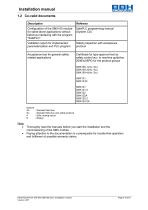
Installation manual1.2 Co-valid documents Description Options: /5x - Standard field bus /4x - Standard field bus and safety protocol A - Safe, analog inputs Note: • Thoroughly read the manuals before you start the installation and the commissioning of the SMX module. • Paying attention to the documentation is a prerequisite for trouble-free operation and fulfilment of possible warranty claims.
Open the catalog to page 8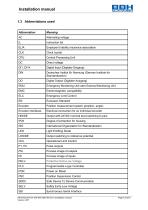
Installation manual1.3 Abbreviations used Abbreviation
Open the catalog to page 9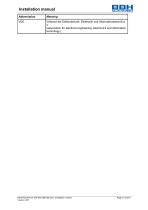
Installation manual Abbreviation
Open the catalog to page 10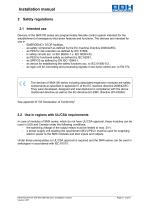
Installation manual 2 Safety regulations 2.1 Intended use Devices of the SMX100 series are programmable fail-safe control system intended for the establishment of emergency shut-down features and functions. The devices are intended for use in - EMERGENCY STOP facilities, - as safety component as defined by the EC machine directive 2006/42/EG, - as PES for risk reduction as defined by IEC 61508, - in safety circuits acc. to IEC 60204-1 u. IEC 60204-32, - as PES for functional safety as defined by IEC 62061, - as SRP/CS as defined by EN ISO 13849-1, - as device for establishing the safety functions...
Open the catalog to page 11
Installation manual 2.3 General safety regulations Safety note: • In order to avoid damage to persons and property only qualified personnel is entitled to work on the device. The term qualified personnel refers to persons who have successfully completed electrotechnical training and are fully familiar with the applicable rules and standards of electrical engineering. The qualified person must become familiar with the operating instructions (see IEC 364, DIN VDE 0100). The qualified person must have profound knowledge of the national accident prevention regulations The use of the device must be...
Open the catalog to page 12
Installation manual WARNING: Using our devices contrary to the rules and conditions specified hereunder can lead to injuries or fatalities as well as damage to connected devices and machines! This will also cause the loss of all warranty and compensation claims against BBH. 2.4 Operation and service The module must always be de-energized before installation and removal, or before disconnecting signal lines. For this purpose, all live supply lines to the device must be checked for safe isolation from supply. When installing or removing the module appropriate measures must be applied to prevent...
Open the catalog to page 13
Installation manual 3 Device types The series SMX100 consists of - base devices SMX100-1, SMX100-2, SMX100-4 optionally with o integrated communication modules ▪ Standard field bus SMX100-x(/5x) or ▪ Safe field bus SMX100-x(/4x) - central I/O expansion modules SMX131, SMX131R - central axis expansion modules SMX121, SMX121-2, SMX122 or SMX122A, and SMX122-2 or SMX122-2A Basic devices SMX100-x series is a modular safety controller. The device is open programmable for safe processing of EMERGENCY OFF buttons, two-handed controls, light barriers, operating mode selection switches etc. as well as...
Open the catalog to page 14
Installation manual • Safety note: The 24V DC supply terminals of the SMX module must be fused with an external back-up fuse of 2A (24VDC). Recommended fuse type: 2A circuit breaker (Class B) or fuse (fast-blow). Depending on the current requirement, fusing can be done in total or per I/O group.
Open the catalog to page 15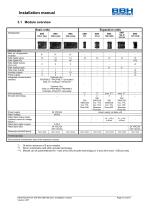
Installation manual3.1 Module overview
Open the catalog to page 16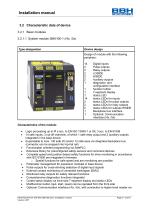
Installation manual 3.2 Characteristic data of device 3.2.1 Basic modules 3.2.1.1 System module SMX100-1 (/4x, /5x) Type designation Device design Design of module with the following periphery: configuration interface 1 function button 14 status LEDs for inputs 2 status LEDs for pulse outputs 2 status LEDs for relay outputs 2 status LEDs for outputs HISIDE Characteristics of the module: • Logic processing up to Pl e acc. to EN ISO 13849-1 or SIL 3 acc. to EN 61508 • 14 safe inputs, 3 cut-off channels, of which 1 safe relay output and 2 auxiliary outputs integrated in the base device • Expandable...
Open the catalog to page 17
standard fieldbus communication (/4x) via CAN bus 2.0 interface, CANopen, PROFIBUS, PROFINET, EtherCAT, DeviceNet, or safe fieldbus communication (/5x) via PROFIsafe V 2.0 or FSoE with a higher level controller See: Chapter 3.2.3 “Optional Communication interface” Assembly on top hat rail
Open the catalog to page 18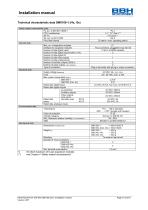
Installation manualTechnical characteristic data SMX100-1 (/4x, /5x) Safety related characteristic data (*) Of which maximum of 6 axis expansion modules (**) see Chapter 4 "Safety related characteristics"
Open the catalog to page 19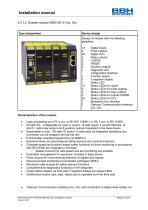
Type designation Device design Design of module with the following periphery: 14 Digital inputs configuration interface 1 Function button 14 Status LEDs for inputs 2 Status LEDs for pulse outputs 2 Status LEDs for relay outputs 2 Status LEDs for outputs HISIDE 20 Status LEDs for I/O‘s 1 Optional: Communication interface Characteristics of the module: • Logic processing up to PL e acc. to EN ISO 13849-1 or SIL 3 acc. to IEC 61508 • 20 safe I/O - configurable as input or output, 14 safe inputs, 3 cut-off channels, of which 1 safe relay output and 6 auxiliary outputs integrated in the base device...
Open the catalog to page 20All BBH Products GmbH catalogs and technical brochures
 SCU-2-EC/x
8 Pages
 SCU-1-EC/x
7 Pages
 SCU-0-EC/x
6 Pages
- IO module
- Analog I/O
- Monitoring software solution
- Digital IO module
- Interface software
- Fieldbus I/O module
- Programming software solution
- Analog IO module
- Remote I/O
- Machine software
- Remote IO module
- Ethernet programmable logic controller
- Safety software
- Fieldbus PLC
- Networked PLC
- Safety I/O
- Compact programmable logic controller
- Distributed I/O