
- Catalogs
- BBE Bamberg + Bormann-Electronic GmbH
- portable stroboscope

portable stroboscope

portable stroboscope
The MOVISTROB® products are subjected to stringent quality and functionality tests to ensure they adhere to high safety and performance standards. Users are encouraged to read the operating instructions thoroughly to avoid damage or injury.
General Description
The stroboscope is designed to study rapid periodic motions by producing short light flashes, enabling motion observation and speed measurement without mechanical interference. The MOVISTROB® series 300 models are microprocessor-controlled, providing high precision and stability, with an adjustable flash rate ranging from 150 to 18000 flashes per minute.
Controls and Indicators
The device features several controls, including a mains pushbutton, flash frequency range selector, control knob with dial, and an input for external control. The flash bulb is protected by a fiberglass cover, and the device can be externally controlled via a trigger input.
General Instructions
The instrument should be connected to the specified AC line and operated using the pushbutton. The flash rate can be controlled internally or externally, with specific instructions for each mode. The maximum permissible flash rate is 18000 RPM, with a short-term allowance up to 30000 RPM.
Stroboscopic Principle
Stroboscopy enables the observation of high-speed periodic motion by illuminating objects with brief light impulses. The document details the principles of stopped images, RPM measurement, slow-motion cycles, and phantom objects.
Replacing Flash Tube and Fuses
If the flash fails, the tube may need replacement. Instructions are provided for safely replacing the flash tube and fuses, emphasizing the need to turn off the device and allow the bulb to cool before replacement.
Flash Tube Operation and Maintenance
To extend the lifespan of approximately 350 hours, it is advised not to use the flash bulb unnecessarily. The instrument should be switched off during long intervals between measurements or motion control actions. The fuse (0.5 A for 110V AC = 0.63) can be easily replaced after removing the housing inset.
Maintenance and Repair
If the instrument is suspected to be unsafe, it should be permanently taken out of operation. This includes cases of physical damage, non-functionality, or stress beyond tolerable limits. Repairs, part replacements, and calibrations should be performed by trained personnel or returned to the manufacturer for inspection. Always quote the type and serial number from the type plate on the housing's bottom when corresponding about the instrument.
Technical Specifications
- Model 350.10: Features a Xenon white light tube with a 4-pin plug-in type and includes a BNC-Outlet for digital counters. Peak light intensity is approximately 550 lux, with a flash duration of 2 - 7 µs. The flashing-rate range is 2.5 - 300 flashes/sec (Hz), equivalent to 150 - 18000 flashes/min (RPM) in two overlapping ranges. Accuracy is less than ± 2% of dial reading. External triggering is possible via mechanical contactor or pulse signals. The housing is made of sheet-steel, weighing 1.7 kg, with dimensions of 180 x 105 x 105 mm.
- Model 350.00: Similar specifications to Model 350.10 but lacks a BNC-Outlet for digital counters, input for external control, and a slide switch for external control. The power cable is not pluggable.
Catalog excerpts
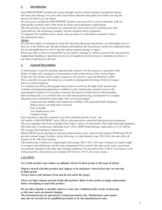
tr.row {} td.cell {} div.block {} div.paragraph {} .font0 { font:9.00pt "Times New Roman", serif; } 1. Introduction Each MOVISTROB® product has to pass through various controls during its production phases and must also undergo very strict and conscientious function and quality tests before leaving the factory for delivery to our clients. We can assure you that the MOVISTROB® product you received is in strict conformity with our high quality standards and it fully meets all safety and performance requirements. All relevant data on this instrument are electronically stored and can be recalled...
Open the catalog to page 2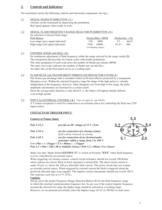
The instrument carries the following controls and functional components (see fig.):3.1SIGNAL MAINS PUSHBUTTON ( 1 ) switches on the instrument by depressing the pustbutton.Red signal appears when ready to work.3.2SIGNAL FLASH FREQUENCY RANGE SELECTOR PUSHBOTTON ( 3 ) for selection of desired flash range:Push ButtonFlashes/Min = RPM Flashes/Sec = Hz Low range (grey signal indicated) 150 - 4000 2.5 - 66.67 High range (red signal indicated) 3700 - 18000 61.67 - 300. > (overlapping ranges) 3.3CONTROL KNOB with DIAL ( 4 ) for continuous adjustment of flash frequency within the range selected by the...
Open the catalog to page 3
(5) > (does not apply for models 350.00 and 300.00) The BNC-Outlet is placed next to the input for external control (5) .The pulse voltage is between 5 to 10 V making an average of 7 V.The impedance does not exceed 10 K Ω .3.7MODE SWITCH EXT / INT for SELECTION of INTERNAL or EXTERNAL CONTROL (7) serves to select the desired mode of synchronization.The switch has to be set on position "EXT" when the flash frequency is to be controlled by anexternal source via "Trigger Input (6) ".On position "INT" the flash rate can be adjusted by means of Control Knob with Dial (4) withinthe selected range 4....
Open the catalog to page 4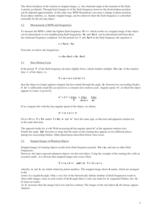
To measure the RPM v either the highest flash frequency f1 = v which results in a stopped image of the objectcan be determined, or two neighbouring flash frequencies fn and fn+1 can be determined and from thesethe rotational frequency computed. For the periods for f and fn+1 in the flash frequency the equation is: r = Tn+1 - Tn From this we derive the frequencies: v = fn > ՕՕ fn+1 緷 fn - fn+1 5.3Slow-Motion Cycle If the period T of the flash frequency deviates slightly from a whole-number multiple Tn = nr of the rotationtime r of the object, i.e. T = (n + e) r with /e/ < 1 then the object no...
Open the catalog to page 5
k with increasing n . The interval in whichthe mark is illuminated at one corner of the k -angle amounts to n rotation periods. In conclusion , the k markimages must not overlap. Altogether we may expect observable images only with low values of n and k .In objects with a complicated texture the phantom objects mostly disappear in an untextured background.5.5Objects with a Finite Rotational Symmetry In many cases the axis of the rotating object is an m -number symmetrical axis, i.e. the object overlaps itselfthrough a rotation about the angle 2/m . In the example of the disc this is achieved...
Open the catalog to page 6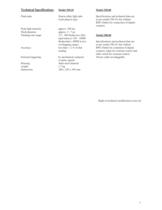
Model 350.10 Model 350.00 Flash tubeXenon white light tubeSpecifications and technical data are4-pin plug-in typeas per model 350.10, but withoutBNC-Outlet for connection of digital counters.Peak light intensityapprox. 550 luxFlash durationapprox. 2 - 7 sFlashing-rate range2.5 - 300 flashes/sec (Hz) Model 300.00 equivalent to 150 - 18000flashes/min = RPM in twoSpecifications and technical data are overlapping ranges.as per model 350.10, but withoutAccuracyless than ձ 2 % of dialBNC-Outlet for connetion of digitalreadingcounters, input for external control andslide switch for external control.External...
Open the catalog to page 7All BBE Bamberg + Bormann-Electronic GmbH catalogs and technical brochures
 MINISTROB 2000N/S-EXT
1 Page
 Type 600 KS
1 Page
 Type 915
1 Page
 MINISTROB MS 2006
1 Page
 MOVISTROB® 400.00-S/LW2
1 Page
 MOVISTROB 600.00-2GS-19
1 Page
 MOVISTROB 600.00
1 Page
 MOVISTROB® 500.00
1 Page
 MOVISTROB® 420.00-S/2HL
1 Page
 MOVISTROB® 420.00
1 Page
 MOVISTROB® 400.01
1 Page
 MOVISTROB® 400.00
1 Page
 MOVISTROB® Typ 350.10-99
1 Page
 MOVISTROB® Typ 350.00-99
1 Page
 MOVISTROB® Typ 300.00-99
1 Page
 MOVISTROB® 350.00-BD
1 Page
 Series 3000
8 Pages
 Series 2800
6 Pages
 Series 2500
10 Pages
 Series 2100
7 Pages
 Series 2006
6 Pages
 Series 1000
27 Pages
 Series 600
10 Pages
 Series 500
8 Pages
 Series 400
7 Pages
 300 series
7 Pages
 compact stroboscope
7 Pages


