
- Catalogs
- BBC Bircher Smart Access
- Light Barriers


Light Barriers

Light Barriers
Light Barriers and Active Infrared Detectors are optoelectronic sensors that detect objects and persons using light without physical contact. Light Barriers respond to interruptions in the beam between the transmitter and receiver, while Active Infrared Detectors detect objects when light is reflected off their surfaces. These sensors generate an electrical output signal upon detection, with evaluation electronics and outputs integrated into the system.
One-way-beam Light Barriers
The transmitter and receiver are housed separately, with optical systems directed at each other. The light beam travels from transmitter to receiver, allowing for extensive ranges and high operating reserves. Objects interrupting the beam trigger a switch.
Advantages: Reliable operation under adverse conditions, easy reproducibility of switching points, and detection of reflective, non-transparent objects.
Reflection Light Barriers
Both transmitter and receiver are in one housing, requiring a retro-reflector in the beam path. The transmitter's light is reflected to the receiver, and interruptions trigger a switch.
Advantages: Single device installation and availability of custom-built reflectors.
Reflection Light Barriers with Polarisation Filters
Polarisation filters are used to define two polarisation planes, ensuring the receiver only detects light from the triple reflector. Glossy surfaces are reliably detected.
Advantage: Clean interruption of the beam by glossy and reflective objects.
Active Infrared Detectors
Transmitter and receiver are housed together, with the beam reflected by the object itself. The scanning range is influenced by the object's reflectance.
Advantage: No need for a reflector as the object acts as one.
Active Infrared Detectors with Background Suppression
Transmitter and receiver are housed together with optical systems aligned at an angle. The receiver discerns if the beam is reflected by an object within the scanning area or the background.
Advantages: Consistent scanning range for reflective objects, reliable detection of dark objects against light backgrounds, insensitivity to undesired background reflections, and high operating reserve.
Special Variants
Includes Safety Light Barriers, Data Transmission Light Barriers, Increased-safety type Light Barriers, Laser Light Barriers, and Printed Label Readers.
Typical Applications
These sensors have a variety of everyday applications, with detailed examples available in product brochures.
Catalog excerpts
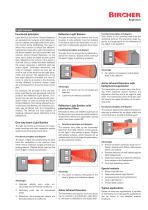
Light barriers Functional principles Reflection Light Barriers Light Barriers and Active Infrared Detectors are optoelectronic sensors which detect persons an objects using light without any physical contact being established. The way in which they function is simple but effective. Light Barriers respond to each interruption of the beam between the light transmitter and receiver. Active Infrared Detectors, on the other hand, detect an object as soon as the light reflected by the surface of the object is received. Once an object has been detected, the sensor generates a definded electrical output signal. Evaluation electronics and relay or transistor outputs are thus just as much a part of the sensor as the light transmitter and receiver. The applications of the two basic detection principles are very diverse. In order to do justice to this diversity, various different functional sensor types were developed from these two basic principles. The light transmitter and receiver are in one housing. A retro-reflector must be installed in the beam path of the transmitter in such a way that it is physically separate from these. For example, the principle of the one-waybeam Light Barrier was developed further to produce the Reflection Light Barrier. If required, this can also be equipped with polarisation filters. In order to prevent the Active Infrared Detector from being affected by environmental interference, the reflection principle was combined with the triangulation method. The devices are thus capable of masking undesired optical reflections in the background. One-way-beam Light Barriers The light transmitter and receiver are in separate housings with their respective optical systems pointing toward each other. Functional principles and diagram The beam of light only passes along the path from the transmitter to the receiver once which means extensive ranges and high operating reserve. Objects which interrupt the beam trigger a switching operation. Functional principles and diagram Each object in the scanning area trips the switching function. The scanning range depends, to a large extent, on the reflectance of the object to be detected. Functional principles and diagram The light from the transmitter is reflected towards the receiver. Objects which interrupt the beam trigger a switching operation. Only one device can be connected and installed Custom-built reflectors available Reflection Light Barriers with polarisation filters Polarisation filters are installed upstream of the transmitter and receiver optical systems. These filters define two polarisation planes which have been rotated 90°. ■ No reflector is necessary as the object itself is the reflector Active Infrared Detectors with background suppression The transmitter and receiver are in one housing. Their separate otpical systems are aligned so that they are at an angle to each other. The intersection point of the two optical axes is the upper boundary of the scanning area. Functional principles and diagram The receiver determines whether the beam it receives is reflected by an object within the scanning area or outside it (background). Functional principles and diagram The receiver only picks up the transmitter light from the triple reflector as this polarises the light in the desired manner. Objects with glossy surfaces, which likewise act as reflectors but do not change the polarisation, are thus detected reliably. Advantages ■ Almost constant scanning range for reflective objects with diffuse reflectances which vary greatly ■ Reliable detection of dark objects against light backgrounds ■ Insensitive towards undesired reflection from objects in the background ■ Very high operating reserve Special variants Advantage ■ The beam is cleanly interrupted in the case of glossy and reflective objects Operates reliably even under unfavourable environmental conditions Switching point can be reproduced easily Reflective, non-transparent objects are detected without any difficulty Active Infrared Detectors The transmitter and receiver are in one housing. In contrast to the Reflection Light Barrier, the beam is reflected by the object itself. Safety Light Barriers Data transmission Light Barriers Increased-safety type Light Barriers Laser Light Barriers Printed label readers Typical applications Variety of every-day applications. A number of interesting and type-specific applications can be found in our detailed product brochures.
Open the catalog to page 1All BBC Bircher Smart Access catalogs and technical brochures
 Safety mats
8 Pages
 S-Line
4 Pages
 PrimeMotion C
2 Pages
 RegloBeam 2
2 Pages
 EsGate 3
4 Pages
 EsGate 2
4 Pages
 PrimeMotion B
2 Pages
 PIR 20
4 Pages
 PrimeTec A
4 Pages
 Herkules 2E
4 Pages
 ProLoop2
4 Pages
 ProAccess
4 Pages
 ExpertSystem XL
4 Pages
 Pressure Wave Switches
8 Pages
 EsMatix 3
2 Pages
 CleanSwitch
4 Pages
 LBDoor
4 Pages
 ProLoop Lite
4 Pages
 ArtMotion 2
2 Pages
 CleanSwitch
4 Pages
 CR3
CR32 Pages
 SpotScan
4 Pages
 EsMatix 3
2 Pages
 UniScan
4 Pages
 Sensorama 2019
8 Pages
 Passive Infrared
1 Page
 Light Sensors
1 Page
 Merkur 2
6 Pages
 Brochure Safety Mats
8 Pages
 Sensorama 2014
8 Pages
 CareMat®
4 Pages
 New colors for safety mats
4 Pages
 TopScan
4 Pages
 PIR20
PIR204 Pages
 PIR30
PIR304 Pages
 ProLoop
4 Pages
 UniScan
4 Pages
 PrimeTec A / PrimeScan A
4 Pages


- Single-pole switch
- Technology switch
- Wireless remote control
- Industrial remote control
- Remote control with buttons
- Industrial detector
- Monitoring detector
- Light barrier
- Polymer mat
- Compact detector
- Through-beam light curtain
- IP65 switch
- Detector with digital display
- Waterproof light curtain
- Illuminated switch
- Process detector
- Automatic detector
- Remote detector
- Door switch