
- Catalogs
- BAVA TESTING SOLUTIONS
- Impulsive test bench

Impulsive test bench

Impulsive test bench
- Pressure Test: Ranges from 0.3 to 5 bar.
- Square Wave Pulse: Duration between 0.5 to 5 seconds.
- Maximum Temperature: 140 °C with a tolerance of +/-2.
- Flow Rate: Between 600 to 5000 liters per hour.
- Volume Test Specimen: Maximum of 15 liters.
- Pressure Transmitter: Full scale 6 bar, class 0.25%.
- Temperature Sensor: PT100.
- Electric control and interlock for open doors.
- Metal lids in test area to prevent shots and fluid leaks.
- Emergency button and automatic test shutdown in case of component failure, oil leakage, or warnings.
- Electric: 400 Vac-50 Hz–30 kW.
- Air: 6 bar.
- Water: Temperature <= 20°C.
- Dimensions (L x W x H): 3400 x 2000 x 2400 mm.
- Weight: Approximately 2300 kg.
- Fluid and adapters are not included.
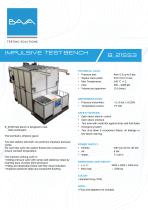
- Designed to test heat exchangers using ethylene glycol as the test fluid.
- Features two test stations for impulsive pressure cycles.
- Includes a flushing system to maintain constant temperature during each test cycle.
- Working cycle involves setting pressure cycles with ramps and stationary steps, filling and deaeration with flow visual indication, and impulsive pressure steps with component flushing.
- Equipped with a PC and NI data acquisition system.
- Software allows setting test profiles and generating complete test reports (pressure vs time).
- Complies with Industry 4.0 standards, enabling interface with external software, remote assistance, and control.
- GUI is customizable in multiple languages.
- Headquarters: Via San Quintino 26/A - 10121 Torino - Italy.
- Offices & Workshop: Via Riccardo Lombardi 9 - 10028 Trofarello (TO) - Italy.
- Tel / Fax: +39 011 349 66 06.
- Email: [email protected], PEC: [email protected].
- Website: www.bavasrl.com.
Catalog excerpts
Impulsive test bench TECHNICAL DATA: • Pressure test: • Square wave pulse: • Max Temperature: • Flow • Volume test specimen INSTRUMENTATION: • Pressure transmitter: • Temperature sensor: B_21553 test bench is designed to test: - heat exchangers. The test fluid is ethylene glycol. Two test stations test bech can performs impulsive pressure cycles. For each test cycle the system flushes the component to ensure constant temperature. The machine working cycle is: • Setting pressure cycle with ramps and stationary steps by inserting pairs of points (time-pressure). • Filling and deaeration phase with flow visual indication. • impulsive pressure steps and component flushing. SAFETY DEVICES: • Open doors electric control • Open doors interlock • Test area with metal lids against shots and fluid leaks • Emergency button • Test shut down if component failure; oil leakage or test bench warning POWER SUPPLY: • Electric: • Air: • Water: DIMENSIONS AND WEIGHT: • L, p, h: 3400 x 2000 x 2400 mm; • Raw load: ~ 2300 kg COLOR: • Standard Gray
Open the catalog to page 1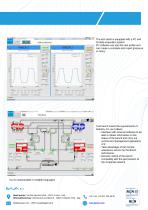
The test stand is equipped with a PC and NI data acquisition system PC software can sets the test profile and can create a complete test report [pressure vs time]. Test bench meets the requirements of Industry 4.0, as it allows: • Interface with external software to be able to obtain information on the status of the bench and carry out control and management operations of it; • Take advantage of the remote assistance service by the BAVA technicians; • Remote control of the bench compatibly with the permissions of the corporate network. Gui is customizable in multiple languages S.r.l. Head quarter:...
Open the catalog to page 2All BAVA TESTING SOLUTIONS catalogs and technical brochures
 BURST TEST IN WATER BENCH
2 Pages
 Holding pressure test stand
2 Pages
 GAC TEST BENCH
2 Pages
 HEAT EXCHANGERS TEST BENCH
2 Pages
 air intake filter test bench
2 Pages
 Erosion test beNch
2 Pages
 BURST TEST STAND
2 Pages
 leak test bench
1 Page
 FLOW TEST BENCH
2 Pages
 FLIGHT SURFACE ACTUATORS T.B
2 Pages
 DATAACQUISITIONSYSTEM
4 Pages
 Pressure test stand
2 Pages
 NOZZLE FLOW TEST BENCH
2 Pages
 ENGINE TEST CELLS
2 Pages
 GBx PUMP FLOW TEST CART
2 Pages
 industries
9 Pages
 B_21472
2 Pages
 RESEARCH & DEVELOPMENT
14 Pages
 EQUIPMENT
18 Pages
 AUTOMOTIVE
22 Pages
 AEROSPACE
16 Pages


- Automated test bench
- Leak tester
- Industrial test bench
- Pressure test bench
- Computer-controlled test stand
- Valve test bench
- Hydraulic test bench
- Manual test station
- Steam generator
- Leak test station
- Test station for the automotive industry
- PLC-controlled test bench
- Pneumatic test station
- Torque test bench
- Leak tester for automotive applications
- Performance test station
- Motor test stand
- Electric steam generator