
- Catalogs
- Baumer Group
- Ultrasonic sensors.


- Company
- Products
- Catalogs
- News & Trends
- Exhibitions
Ultrasonic sensors.

Ultrasonic sensors.
Baumer's ultrasonic sensors are compact, robust, and versatile, designed for demanding applications. They operate by emitting ultrasonic bursts that reflect off objects and are received back by the sensor, providing digital or analog outputs. Unlike optical sensors, they are unaffected by color, transparency, or reflectivity, making them ideal for harsh environments.
- Distance Measuring Sensors: Provide absolute position information, suitable for level detection and stack height control.
- Proximity Sensors: Detect objects within a set range, unaffected by surface properties.
- 2 Point Proximity Switches: Offer precise detection at two points.
- Retro-reflective Sensors: Use a fixed reflector to detect objects, ideal for sound-absorbing materials.
- Through Beam Sensors: Consist of an emitter and receiver, used for fast-moving or transparent objects.
Ultrasonic sensors are used in various applications such as height measurement, liquid level detection, and distance detection in confined spaces. They are particularly useful in environments with dust, smoke, or vapors.
Ultrasonic sensors use a sonic transducer for alternating transmission and reception of sound waves. The time between emission and reception is proportional to the object's distance. They feature a digital output and can be adjusted using a potentiometer or Teach-in technology.
Proper mounting is crucial for optimal performance. Sensors should be spaced appropriately to avoid interference. The LED indicator assists in setup by showing signal strength and output state.
Baumer focuses on miniaturization, precision, and robustness. They offer customized solutions for unique applications, working closely with customers to meet specific needs.
Baumer's ultrasonic sensors are reliable, precise, and adaptable, making them suitable for a wide range of industrial applications. Their innovative design and robust performance ensure they meet the demands of modern automation.
- Synchronization and Multiplex Features: Up to eight sensors can be synchronized. The multiplex feature allows two sensors to alternate measurements, doubling the response time.
- Scanning Range: The scanning range can be adjusted using a Teach-in button or potentiometer, with a close limit (Sdc) and far limit (Sde).
- Environmental Influences: Factors such as humidity, air streams, and temperature can affect sensor performance. Temperature drift is mostly compensated within the sensor.
- Blind Range (St): Objects within this range may cause false switching.
- Scanning Distance (Sd): Correct detection occurs up to the set far limit (Sde).
- Hysteresis: The effective scanning distance is enlarged by the hysteresis value after object recognition.
- Repeat Accuracy: Defined as the difference between two subsequent measurements under identical conditions.
- Teach-in Mode: Allows setting of close and far limits by positioning the target and using the Teach-in button.
- Output Signal: Can be inverted from 0-10 V to 10-0 V by adjusting the order of setting limits.
- Restoring Defaults: Holding the Teach-in button for more than 6 seconds restores default settings.
- Rectangular and Cylindrical Designs: Various models are available with different scanning ranges and housing materials.
- Operating Temperature: Ranges from -10 to +60 °C depending on the model.
- Protection Class: IP 67 for most models, ensuring resistance to dust and water.
- Voltage Supply: 15-30 VDC with a maximum current consumption of 35 mA.
- Output Circuit: Options include voltage output and push-pull/IO-Link.
- Mechanical Data: Includes dimensions and housing material specifications.
- Voltage Supply Range: 15 ... 30 VDC
- Current Consumption (no load): 35 mA
- Output Circuit: RS 232 and voltage output options
- Baud Rate: 115200 for RS 232
- Residual Ripple: < 10% Vs
- Short Circuit Protection: Yes
- Reverse Polarity Protection: Yes, Vs to GND
- Type: Rectangular
- Housing Material: PA 12
- Dimensions: Width/Diameter 8.6 mm, Height/Length varies (48.8 mm to 82 mm), Depth 24.5 mm to 30.5 mm
- Operating Temperature: 0 ... +60 °C
- Protection Class: IP 67
- Scanning Range: 3 ... 200 mm depending on the model
- Repeat Accuracy: < 0.5 mm, with filter active < 0.1 mm
- Resolution: < 0.3 mm, with filter active < 0.1 mm
- Sonic Frequency: 380 kHz
- Response Time: < 7 ms to < 35 ms
- Temperature Drift: < 2% of distance to target So
- Adjustment: Teach-in and IO-Link options
- Light Indicator: Yellow/Red LED, Green/Red LED for some models
- Standard Cable Length: 200 mm
- Connector Types: M8, 4 pin, straight and angular options
- Connection Diagrams provided for RS232 and analog output configurations
These sensors are suitable for high-resolution measurements, short response times, and are capable of detecting small objects, making them ideal for use in small containers and stackable configurations.
- Housing Material: Polyester / Die-cast zinc for rectangular types; Brass nickel-plated for cylindrical types.
- Dimensions: Rectangular sensors have dimensions of 30 mm width, 65 mm height, and 31 mm depth. Cylindrical sensors have a diameter of 12 mm or 18 mm and lengths ranging from 70 mm to 90 mm.
- Operating Temperature: -10 to +60 °C.
- Protection Class: IP 67, ensuring resistance to dust and water.
- Voltage Supply Range: 15 to 30 VDC.
- Output Signals: Options for 0 to 10 V or 4 to 20 mA, with invertible signals.
- Current Consumption: Maximum 35 mA for voltage output and 55 mA for current output.
- Short Circuit and Reverse Polarity Protection: Yes.
- Scanning Range: Varies by model, from 2 mm to 2000 mm.
- Repeat Accuracy: Less than 0.5 mm for most models.
- Resolution: Less than 0.3 mm.
- Sonic Frequency: Ranges from 200 kHz to 400 kHz depending on the model.
- Response and Release Time: Typically less than 80 ms.
- Adjustment: Teach-in or potentiometer options available.
- Light Indicators: Green, yellow, and red LEDs for status indication.
- Connectors: M12 connectors with 3 or 4 pins, available in straight or angular configurations.
- Accessories: Sensofix series, converters, and Teach-in adapters available for enhanced functionality.
These sensors are suitable for use in environments requiring precise distance measurement, such as automation and process control industries.
- Electrical Data: The sensors operate within a voltage supply range of 15 to 30 VDC, with a maximum output current of 20 mA. They feature short circuit and reverse polarity protection. The voltage output signal ranges from 0 to 10 V, while the current output signal ranges from 4 to 20 mA.
- Mechanical Data: The sensors are cylindrical and threaded, with housing materials including stainless steel and brass nickel-plated. Dimensions vary, with diameters of 18 mm and 30 mm, and lengths ranging from 70 mm to 95 mm.
- Ambient Conditions: Operating temperatures range from -10 to +60 °C, and the sensors have a protection class of IP 67.
- Teach-in Adjustment: Adjustments are made via an internal button or external wire. The procedure involves setting the scanning range by placing the target and confirming with the Teach-in button.
- Resetting: Holding the Teach-in button for more than 6 seconds restores factory settings.
- Scanning Range: The sensors have scanning ranges from 100 to 2500 mm, with repeat accuracy of less than 0.5 mm for most models.
- Resolution and Frequency: Resolution is less than 0.3 mm, with sonic frequencies of 120 kHz to 380 kHz.
- Indicators: LED indicators provide visual feedback for alignment and status.
- Connectors: Various M12 and M8 connectors are available, including straight and angular versions.
- Additional Accessories: Include Sensofix series, Sonic beam deflectors, and 3-point converters.
- Connection Diagrams: Illustrate the wiring for analog outputs and Teach-in controls.
- Sonic Cone Profiles: Show typical sensing limits and object distances for different sensor models.
- Load Resistance: Maximum load resistance is less than 1100 Ohm, and minimum is less than 400 Ohm.
- Pressure Durability: The sensor front is durable against pressures up to 6 bar for 20,000 cycles.
- Temperature Drift: Less than 2% of the distance to the target.
This document provides detailed specifications and features of various ultrasonic proximity sensors offered by Baumer. These sensors are designed for different scanning ranges and applications, with specific models tailored for high-speed operations and small container measurements.
- Scanning Range: Varies from 0 to 1000 mm depending on the model.
- Hysteresis: Typically 4% of the scanning range far limit (Sde).
- Repeat Accuracy: Less than 0.5 mm.
- Temperature Drift: Less than 0.18% Sde/K for most models.
- Response and Release Time: Ranges from less than 1.3 ms to 50 ms.
- Sonic Frequency: Varies from 240 kHz to 400 kHz.
- Output Indicator: LED green for status indication.
- Voltage Supply Range: 12 to 30 VDC.
- Current Consumption: Maximum 35 mA without load.
- Output Current: Less than 200 mA.
- Protection: Short circuit and reverse polarity protection included.
- Housing Material: Options include polyester/die-cast zinc and brass nickel-plated.
- Protection Class: IP 67, suitable for harsh environments.
- Various models offer different connection types, including cable and M12 connectors.
- Accessories such as Sensofix series and Teach-in adapters are available for enhanced functionality.
- These sensors are suitable for applications requiring precise distance measurement and object detection in industrial settings.
- High-speed models are ideal for rapid measurement tasks, while others are optimized for small container measurements.
Baumer's ultrasonic proximity sensors offer a range of features and specifications to meet diverse industrial needs, ensuring reliable performance and adaptability in various environments.
The document provides detailed specifications and operational guidelines for various ultrasonic proximity sensors manufactured by Baumer. These sensors are designed for different applications, offering features such as adjustable scanning ranges, synchronization, and Teach-in capabilities for easy setup.
The sensors come in different models with varying scanning ranges from 60 mm to 2500 mm. They operate within a voltage supply range of 12 to 30 VDC and have a maximum current consumption of 35 mA. The sensors are equipped with short circuit and reverse polarity protection, ensuring durability and reliability.
The sensors are housed in cylindrical threaded designs made from brass or stainless steel, with diameters ranging from 12 mm to 30 mm. They are rated IP67 for protection against dust and water, and can operate in temperatures from -25°C to +60°C.
The sensors use M12 connectors and are compatible with various accessories such as Sensofix series and Sonic beam deflectors. Additional cable connectors and field wireable connectors are available for extended applications.
The sensors feature a Teach-in function for easy programming of switching points, with LED indicators for status confirmation. They also offer synchronization capabilities and have a typical response time of less than 50 ms.
These ultrasonic sensors are suitable for a wide range of industrial applications, providing reliable distance measurement and object detection with high repeat accuracy and minimal temperature drift.
The document provides detailed specifications and operational guidelines for ultrasonic 2-point proximity switches and retro-reflective sensors manufactured by Baumer. These sensors are designed for precise distance measurement and object detection using ultrasonic waves.
- Designs: Available in rectangular and cylindrical designs with varying scanning ranges from 30 mm to 2500 mm.
- Materials: Rectangular sensors are made from polyester and die-cast zinc, while cylindrical sensors use brass nickel-plated housing.
- Protection: All models have an IP67 protection class, suitable for harsh environments.
- Electrical Data: Operate within a voltage supply range of 12 to 30 VDC, with a maximum current consumption of 40 mA.
- Output: PNP and NPN output circuits with a maximum output current of 200 mA.
- Teach-in Adjustment: Allows for easy setup of switching points using a teach-in process.
- Resetting: Holding the button for more than 6 seconds restores factory settings, indicated by a fast-flashing LED.
- Accuracy: Repeat accuracy is less than 0.5 mm for most models, with a temperature drift of less than 2% Sde.
- Response Time: Varies by model, ranging from less than 20 ms to 160 ms.
- Ensure proper alignment using the target indication flashing feature for optimal performance.
- Use the appropriate connector types (M12) for secure and reliable connections.
Includes connectors and Sensofix series for enhanced installation flexibility.
- These sensors operate by measuring the propagation time of ultrasonic signals to a reflector.
- The sensing distance can be adjusted using a potentiometer, with LED indicators providing feedback on the reflector's position.
The document provides detailed specifications and operational guidelines for ultrasonic retro-reflective sensors, focusing on their design, functionality, and technical parameters. These sensors are used for object detection by reflecting ultrasonic waves off a target object and back to the sensor.
The sensors come in various designs, including rectangular and cylindrical shapes, with different scanning ranges and housing materials. The scanning range varies from 0 to 2000 mm, depending on the model. The sensors operate within a temperature range of -10 to +60 °C and have a protection class of IP 67, indicating they are dust-tight and water-resistant.
The sensors feature a Teach-in button for easy adjustment of the reflector's position. Holding the button for more than two seconds enters adjustment mode, indicated by a flashing green LED. The position of the reflector can be taught by subsequent button presses.
Connecting the white Teach-in wire to +Vs for more than six seconds resets the sensor to its original factory settings, confirmed by a fast-flashing LED.
The sensors are designed to detect standard objects with specific dimensions and materials that reflect sound effectively. The document specifies the minimum object size required for reliable detection at various ranges.
Key technical parameters include a repeat accuracy of less than 1.5 mm, a response time of less than 7 ms, and a sonic frequency of 380 kHz. The sensors are equipped with push-pull output circuits and have short circuit and reverse polarity protection.
Ultrasonic retro-reflective sensors offer long sensing ranges without blind spots, quick response times, and the ability to detect sound-absorbing objects. They are compact and lightweight, making them suitable for various industrial applications.
The document includes connection diagrams and details on available connectors and accessories, such as mounting brackets and sonic beam deflectors, to enhance sensor functionality.
This document provides technical specifications and details for various ultrasonic sensors, including retro-reflective and through-beam types. It covers different models, their electrical and mechanical data, and operational parameters.
- Accuracy and Alignment: Repeat accuracy is less than 1.5 mm, with alignment aid through target indication flashing.
- Temperature Drift: Less than 2% Sde across models.
- Response and Release Time: Typically less than 50 ms for most models, with high-speed versions having times less than 1.5 ms.
- Sonic Frequency: Ranges from 120 kHz to 400 kHz depending on the model.
- Output Indicators: LED green indicators are standard for output status.
- Voltage Supply Range: 12 to 30 VDC.
- Current Consumption: Maximum 35 mA without load.
- Output Current: Less than 200 mA with a voltage drop of less than 2 VDC.
- Protection: Short circuit and reverse polarity protection are included.
- Housing Types: Rectangular and cylindrical threaded designs, with materials including polyester, die-cast zinc, brass nickel-plated, and stainless steel.
- Dimensions: Vary by model, with widths/diameters ranging from 12 mm to 30 mm and lengths from 42 mm to 95 mm.
- Connection Types: M8 and M12 connectors are standard.
- Operating Temperature: -10 to +60 °C.
- Protection Class: IP 67 for all models.
- URDK Series: Includes NPN and PNP output circuits with make (NO) and break (NC) functions.
- URAM Series: High-speed sensors with external Teach-in and beam columnator for small containers.
- URAR Series: Chemically resistant sensors with stainless steel housing and internal/external Teach-in.
Various connectors and adapters are available, including Sensofix series and Teach-in adapters.
The document provides comprehensive details on the specifications, electrical and mechanical data, and operational parameters of ultrasonic sensors, suitable for various industrial applications.
Specifications
The document details specifications for ultrasonic through beam sensors, including scanning ranges of 0 to 1000 mm and 0 to 700 mm, with a typical hysteresis of 5 mm and repeat accuracy of less than 3 mm. The sensors operate at a sonic frequency of 250 kHz or 220 kHz, depending on the model, and have a response time of less than 5 ms.
The sensors feature a Teach-in process for sensitivity and response time adjustments. Sensitivity is adjusted using a Teach-in key, with LED indicators showing the current sensitivity level. The response time can be set between 5 ms and 320 ms, with LED indicators showing the selected delay.
The sensors are designed with short circuit and reverse polarity protection, and they operate within a voltage supply range of 12 to 30 VDC. They are housed in IP67-rated enclosures, suitable for operating temperatures between 0 and +60 °C.
For optimal performance, the document recommends using the appropriate mounting accessories and connectors, such as the Sensofix mounting kits and M8 or M12 connectors, which are available in various configurations and lengths.
The document includes dimension drawings and connection diagrams for both the emitter and receiver units, specifying the mechanical and electrical configurations. It also lists various connector options, highlighting their compatibility with flexible cable carriers and UL listing.
The sensors are equipped with LED indicators for power and output status, and they support both PNP and NPN output circuits. The document emphasizes the importance of proper alignment and sensitivity adjustment to ensure accurate object detection.
The document provides technical specifications and a quick reference list for the Sensofix series 12 round sensors and related mounting kits. It includes details on ultrasonic sensors and their order references, as well as information about Baumer's global presence and product portfolio.
The Sensofix-Mounting kit is designed for sensors in the M12 housing. It includes clamps made of stainless steel, ball pivots made of galvanized steel, and a mounting panel made of stainless steel.
The document lists various ultrasonic sensors with their order references and corresponding page numbers for detailed specifications. This list is extensive and covers multiple models and configurations.
Baumer has a worldwide presence with customer service and sales organizations in Africa, America, Asia, Europe, and Oceania. The company emphasizes personalized consultation and comprehensive solutions tailored to customer needs.
Baumer offers a wide range of products including presence detection sensors, distance measurement devices, angle measurement encoders, identification/image processing tools, and process instrumentation for level, temperature, pressure, and conductivity measurement.
Baumer Group's international sales contact details are provided, including their address in Switzerland, phone number, fax, and email.
Catalog excerpts
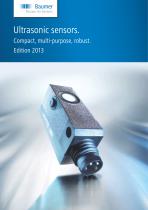
Ultrasonic sensors Compact, multi-purpose, robust
Open the catalog to page 1
Easy to operate and ideal for demanding applications – ultrasonic sensors by Baumer.
Open the catalog to page 2
Visibly better: Baumer sensors. The Baumer Group is leading at international level in the development and production of sensors, shaft encoders, measuring instruments as well as components for automatic image processing. As an owner-managed family business, we employ about 2500 workers worldwide in 36 subsidiaries and 18 countries. With marked customer orientation, consistently high quality and vast innovation potential worldwide, Baumer develops specific solutions for many industries and applications. Our standards – your benefits. Passion coupled with expertise – both have made us a sensor pioneer...
Open the catalog to page 3
All-round talents. Most ultrasonic sensors are based on the principle of measuring the propagation time of sound in air. Packages of ultrasonic sound, so-called bursts, are emitted by the sensor, reflected by an object and received again by the sensor. The integraged transducers with sonic frequencies far beyond the range of human hearing, constantly switch to and fro between emission and reception. The returned echo signals are evaluated by the integrated electronics of the sensor. Depending on the sensor type, the information is provided at the output either as digital or analog signals. Unlike...
Open the catalog to page 4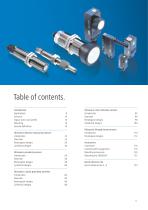
Typical sonic cone profile General definitions Ultrasonic proximity sensors Rectangular designs Cylindrical designs Ultrasonic distance measuring sensors Ultrasonic 2 point proximity switches Ultrasonic retro-reflective sensors Rectangular designs Cylindrical designs Ultrasonic through beam sensors Rectangular designs Connectors/Pin assignment Mounting accessories Mounting kits SENSOFIX Quick reference list Quick reference list A-Z
Open the catalog to page 5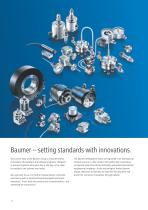
Baumer – setting standards with innovations. The success story of the Baumer Group is characterized by innovations. By hardware and software engineers, designers or process engineers who work day in and day out to make our products and systems even better. Our particular focus is on further miniaturization, enhanced precision as well as improved measuring speed and sensor robustness. That’s what our products are characterized by - and something we are proud of. The Baumer development teams are organized in an international network and are in close contact with well-known universities, recognized...
Open the catalog to page 6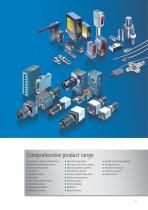
Comprehensive product range Actuators and positioning drives Capacitive proximity sensors Conductivity sensors Counters Digital cameras Encoders Force and strain sensors Inductive sensors Level measurement Magnetic sensors Network Components OCR and code reader systems Optical inspection systems Photoelectric sensors Precision switches My-Com Pressure measurement Process analysis Process displays Resolvers Speed switches Spindle positioning systems Tachogenerators Temperature sensors Ultrasonic sensors Vision sensors
Open the catalog to page 7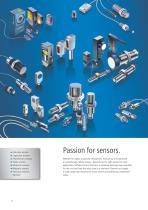
Inductive sensors Capacitive sensors Photoelectric sensors Vision sensors Ultrasonic sensors Magnetic sensors Precision switches My-Com Passion for sensors. Whether for object or position recognition, measuring, a miniaturized or exceptionally robust design – Baumer has the right sensor for every application. Different sensor functions in standard housings ease assembly for the user and limit the setup time to a minimum. Baumer can supply a wide range from inductive to vision sensors and advise you comprehensively.
Open the catalog to page 8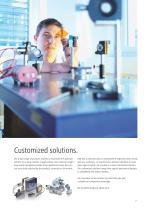
Customized solutions. Our broad range of products enables us to provide the optimum solution for a large number of applications. But customers might have needs completely outside these application areas that cannot be entirely satisfied by the products currently on the market. And this is precisely why our development engineers work closely with our customers. In searching for optimum solutions to meet these special needs, we are able to create customized solutions. Our customized solutions range from special mechanical designs to completely new sensor systems. An innovative sensor solution can...
Open the catalog to page 9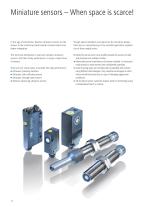
Miniature sensors – When space is scarce! In this age of automation, Baumer ultrasonic sensors are the answer to the continuing trend towards miniaturization and higher integration. This trend has led Baumer’s small and compact ultrasonic sensors, with their hardy performance, to enjoy a major focus of interest. There are four sensor types to provide this high performance: Ultrasonic proximity switches Ultrasonic retro-reflective sensors Ultrasonic through beam sensors Distance measuring ultrasonic sensors Though special emphasis was placed on the miniature design, there was no compromising on...
Open the catalog to page 10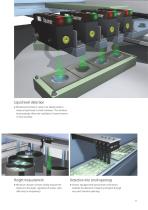
Liquid level detection Miniaturized ultrasonic sensors are ideally suited to measure liquid levels in small containers. The miniature housing design allows the installation of several sensors in close proximity. Height measurement Miniature ultrasonic sensors reliably measure the distance to the object, regardless of surface color, reflectivity or transparency. Detection into small openings Sensors equipped with special beam columnators facilitate the detection of objects and liquids through very small container openings.
Open the catalog to page 11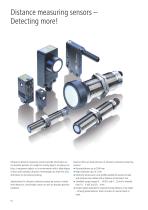
Distance measuring sensors – Detecting more! Ultrasonic distance measuring sensors provide information on an absolute position of a target or moving object. For glossy surfaces, transparent objects or in environments with a high degree of dust and humidity, ultrasonic technologies are often the only alternative to mechanical probing. Applications for ultrasonic distance measuring sensors include level detection, stack height control as well as absolute position feedback. Baumer offers a broad selection of ultrasonic distance measuring sensors: Sensing distance up to 2500 mm High resolution up...
Open the catalog to page 12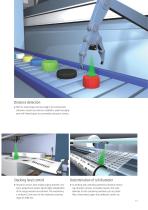
Distance detection With its small shape and low weight, the miniaturized ultrasonic sensors can also be installed in small microgrippers with limited space to accomodate ultrasonic sensors. Stacking level control Utrasonic sensors with analog outputs provide a distance proportional output signal highly independent of the target material encountered. The resolution is a uniform 0,3 mm even for the maximum scanning range of 2000 mm. Determination of roll diameter In winding and unwinding operations distance measuring ultrasonic sensors accurately measure the outer diameter of rolls containing materials...
Open the catalog to page 13All Baumer Group catalogs and technical brochures
 GT 5
GT 53 Pages
 AlphaProx
6 Pages
 OM70
OM702 Pages
 IFRM 12/18 series
230 Pages
 DPPC DS02.5
5 Pages
 CX series
22 Pages
 TCR6
TCR610 Pages
 TFR5
TFR56 Pages
 DLRx L003
2 Pages
 TFRN
TFRN9 Pages
 CTX
CTX6 Pages
 GCA5
GCA55 Pages
 TDP 0,2, TDPZ 0,2
5 Pages
 CIP - Clean in place sensors
6 Pages
 Cable transducers
8 Pages
 SmartReflect® Transparent
2 Pages
 AlphaProx inductive sensors
6 Pages
 HMG 10 & PMG 10
6 Pages
 VeriSens® Vision Sensoren
26 Pages
 Digital industrial cameras
20 Pages
 Force and strain sensors.
126 Pages
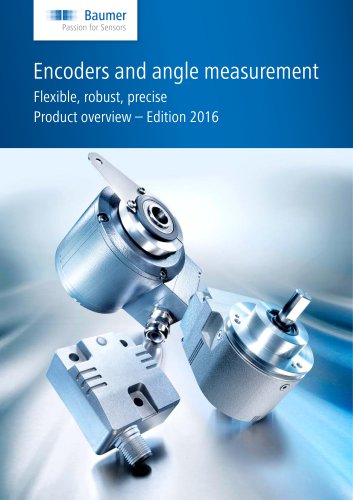 Encoders and angle measurement
100 Pages
 Innovative Sensor Solutions
72 Pages
 Capacitive sensors
60 Pages
 Inductive sensors.
200 Pages







- Visible imager
- Force sensor
- CMOS camera module
- Angular encoder
- Industrial camera module
- Pressure transmitter
- Incremental encoder
- Full-color camera system
- Tension/compression force transducer
- Level limit switch
- Steel load cell
- Cloud-based software
- Strain gauge force sensor
- Liquid level detector
- Level probe
- USB camera module
- Liquid level sensor
- Incremental rotary encoder