
- Catalogs
- Baumer Group
- IFRM 12/18 series


- Company
- Products
- Catalogs
- News & Trends
- Exhibitions
IFRM 12/18 series

IFRM 12/18 series
Inductive sensors are crucial in automation technology for monitoring metal machine parts, valves, and gears. Baumer provides a wide range of high-performance inductive sensors known for their reliability, precision, and quality.
These sensors are designed for confined spaces and fast processes with high switching frequencies, suitable for applications like position detection in robotic systems and condition monitoring in machine tools.
Resistant to chemicals and high-pressure cleaning, these sensors are made from rugged materials that prevent bacterial residue formation, ideal for environments with high hygiene standards.
Designed for harsh environments, these sensors operate in a wide temperature range and are resistant to mechanical loads and abrasive media, suitable for onshore and offshore applications.
These sensors maintain consistent sensing distances across different metals, ideal for applications involving non-ferromagnetic metals, featuring high switching speeds and minimal temperature drift.
Providing micrometer-accurate distance measurements, these sensors are used in applications requiring high precision, such as tape tension control and vibration measurements.
The document details various sensing characteristics, including nominal, effective, and assured sensing distances, correction factors for different materials, hysteresis, and repeat accuracy.
Baumer sensors meet high protection standards, including IP 67 and IP 69K, ensuring durability in harsh conditions. The proTect+ concept enhances reliability and extends sensor service life.
Guidelines for mounting sensors include maintaining minimum distances to prevent interference and considerations for different materials, ensuring optimal sensor performance and longevity.
Adhering to specified mounting instructions and maintaining minimum distances is crucial to avoid reduced sensing distances. Strong housing loads should be avoided to prevent damage.
Specifications for mounting sensors without threads include wire diameter and cable material for various housing diameters, with maximum installation torque values specified to prevent damage.
Inductive proximity switches detect conducting metal targets through a high-frequency electromagnetic field. The document explains PNP and NPN outputs, connection diagrams, and the importance of load resistance positioning.
Sensors are available with PNP, NPN, or Namur outputs, with specific voltage and current outputs. The document details connection types and the importance of decoupling diodes in parallel connections.
Key terms such as reverse polarity protection, ripple, sensor standards, and hysteresis are defined, along with the importance of cable material selection based on environmental resistance requirements.
The document provides an overview of various inductive proximity switches, detailing dimensions, sensing distances, mounting types, switching frequencies, and output currents, including information on protection classes, housing materials, and connection types for different product families.
Inductive proximity switches are available in various dimensions and configurations, designed to detect metal objects without physical contact using electromagnetic fields.
- Nominal sensing distances range from 0.8 mm to 12 mm.
- Switching frequencies vary from 100 Hz to 5 kHz.
- Operating temperature ranges from -40°C to +180°C, depending on the model.
- Protection classes include IP 67, IP 68, and IP 69K.
- Housing materials include stainless steel, brass, and PBT.
- Output circuits are available in PNP, NPN, and NAMUR configurations.
- Output functions include break (NC) and make (NO).
- Connection types include connectors (M8, M12) and cables.
- Outdoor Design: Models like IFRR and IFRM for outdoor applications.
- Hygienic Design: IFBR models for high hygiene standards.
- Washdown Design: IFRR models for frequent cleaning environments.
- Full Metal Housings (DuroProx): IFRD models for enhanced durability.
- High Temperature: IFRM and IFRH models for high-temperature environments.
- High Pressure: IFRP models for high-pressure conditions.
- ATEX/NAMUR: Models like IFR and IFRM for explosive environments.
- Voltage supply ranges from 6 to 30 VDC.
- Current consumption is typically around 10-12 mA.
- Output current is generally up to 200 mA, with short circuit and reverse polarity protection.
- Housing materials and dimensions vary, with options for cylindrical smooth types and threaded designs.
- Various connectors and clamping nuts are available for different sensor models.
Inductive proximity switches from Baumer offer a wide range of options for different industrial applications, ensuring reliable performance in various environmental conditions.
This document provides technical specifications and details for various models of inductive proximity switches used in factory automation, including information on electrical and mechanical data, connection types, and accessories.
- Electrical Data: Voltage supply range of +Vs 10 ... 30 VDC, maximum current consumption of 12 mA (no load), voltage drop Vd of less than 2 VDC, and output current of less than 100 mA.
- Mechanical Data: Cylindrical switches with dimensions of 4 mm or 5 mm, housing lengths ranging from 15 mm to 45 mm, sensing face material of POM or LCP, and housing material of stainless steel.
- Ambient Conditions: Operating temperature ranges from -25 to +75 °C, with a protection class of IP 67.
- Available with flylead connectors, cables, and connectors M5 and M8.
- Standard cable lengths are 200 mm or 2 m.
- Available in NPN and PNP configurations, with make (NO) and break (NC) functions.
- LED indicators for output status.
- Accessories include clamping nuts for sensors, adapters for pulse stretching, and various connectors.
- Designed for flush mounting with nominal sensing distances of 0.8 mm, 1 mm, or 1.6 mm, and a hysteresis of 2 ... 20% of Sr.
- Fully contained electronics and high switching frequencies of up to 5 kHz.
This document provides technical specifications and details for Baumer's inductive proximity switches used in factory automation, designed for flush mounting and featuring various connection types and output circuits, including NPN and PNP configurations.
- Mounting Type: Flush
- Nominal Sensing Distance: 1 mm to 2 mm depending on the model
- Hysteresis: 2% to 20% of Sr
- Switching Frequency: Up to 5 kHz
- Voltage Supply Range: 10 to 30 VDC
- Current Consumption: Max 12 mA (no load)
- Voltage Drop: Less than 2 VDC
- Output Current: Up to 200 mA
- Protection: Short circuit and reverse polarity protection
- Operating Temperature: -25 to +75 °C
- Protection Class: IP 67
- Type: Cylindrical threaded or smooth
- Material (Sensing Face): LCP or PBT
- Housing Material: Stainless steel
- Dimensions: 5 mm to 6.5 mm diameter
- Housing Length: Varies from 20 mm to 36 mm
- Flylead connector M8
- Cable, 2 m
- Connector M5
- Connector M8
- Fully contained electronics
- Integrated LED-status display
- Robust steel housing
- High switching frequency
- Increased sensing distance in some models
- Various connectors and mating connectors are available, including straight and angular configurations.
- Additional accessories include mounting brackets, clamping nuts, and adapters for pulse stretching.
The document provides comprehensive details on the specifications, mechanical data, and available accessories for Baumer's inductive proximity switches, highlighting their suitability for factory automation applications.
This document provides technical specifications and details for various models of inductive proximity switches used in factory automation. These switches are designed for flush and non-flush mounting and are available in different configurations with varying sensing distances and output functions.
- Mounting Type: Flush and non-flush options available.
- Nominal Sensing Distance (Sn): Ranges from 2 mm to 6 mm depending on the model.
- Hysteresis: 3% to 20% of the sensing range (Sr).
- Temperature Drift: ±10% to ±15% depending on the model and temperature range.
- Protection Class: IP 67, suitable for harsh environments.
- Switching Frequency: Up to 5 kHz for standard models, reduced for extended distance models.
- Voltage Supply Range: 6 to 36 VDC depending on the model.
- Current Consumption: Maximum 12 mA (no load).
- Voltage Drop: Less than 2 VDC.
- Output Current: Up to 200 mA for standard models, 100 mA for extended distance models.
- Short Circuit and Reverse Polarity Protection: Yes.
- Housing Material: Stainless steel for robustness.
- Sensing Face Material: PBT (Polybutylene Terephthalate).
- Dimensions: Vary by model, typically cylindrical with diameters of 6.5 mm or 8 mm.
- Available with flylead connectors, cables, or M8 connectors.
- Output Circuits: NPN or PNP with make (NO) or break (NC) functions.
- Mounting brackets, clamping nuts, and adapters for pulse stretching are available.
- Additional cable connectors and field wireable connectors can be found in the accessories section.
- GammaProx models offer enhanced sensing distances and are available for both shielded and non-shielded mounting.
- Correction factors are provided for different mounting materials such as mild steel, stainless steel, and aluminum.
This document provides technical specifications and details for various models of inductive proximity switches used in factory automation. The switches are designed for different mounting types and offer various output functions and connection types.
- Hysteresis: 3 ... 25% of Sr
- Nominal Sensing Distance (Sn): 8 mm or 12 mm depending on the model
- Switching Frequency: Less than 500 Hz
- Voltage Supply Range: +Vs 10 ... 50 VDC
- Current Consumption: Max 10 mA (no load)
- Output Current: Less than 200 mA
- Protection: Short circuit and reverse polarity protection
- Operating Temperature: -25 ... +75 °C
- Protection Class: IP 67
- Type: Cylindrical threaded
- Material: Sensing face made of PBT, housing made of brass nickel plated
- Dimensions: 18 mm diameter, varying housing lengths
- Tightening Torque: Max 40 Nm
- Cable, 2 m
- Connector M12 or M8
- NPN or PNP, make (NO) or break (NC) functions
- Antivalent output available in some models
- Quasi-flush, flush, or non-flush
- Shielded or non-shielded options
- Sensofix series 18
- Mounting brackets (standard, short, long)
- Adapters for pulse stretching
For correct installation, refer to the mounting instructions. Additional cable connectors and field wireable connectors are available in the accessories section.
This document provides technical specifications and details for various models of inductive proximity switches used in factory automation. The switches are designed for different mounting types and offer varying sensing distances, electrical characteristics, and mechanical properties.
- Switching frequency: < 400 Hz or < 500 Hz depending on the model.
- Voltage supply range: +Vs 6 ... 36 VDC or 10 ... 50 VDC.
- Current consumption: Maximum 10 mA (no load).
- Voltage drop: < 2 VDC or < 3 VDC.
- Output current: < 100 mA or < 200 mA.
- Short circuit and reverse polarity protection: Yes.
- Type: Cylindrical threaded.
- Material (sensing face): PBT.
- Housing material: Brass nickel plated.
- Dimensions: 18 mm or 30 mm diameter, with varying housing lengths.
- Tightening torque: Max. 40 Nm or 140 Nm.
- Connector: M12, with cable lengths of 2 m.
- Operating temperature: -25 ... +75 °C or 0 ... +65 °C.
- Protection class: IP 67.
- Mounting types: Flush and non-flush.
- Nominal sensing distances (Sn): 10 mm, 15 mm, 18 mm, and 24 mm.
- Temperature drift: ± 10%.
- Hysteresis: 3 ... 20% of Sr.
- Correction factors for different materials: Mild steel 100%, stainless steel 70-115%, aluminum 40-100%.
- Available with NPN and PNP output circuits.
- Functions include make (NO) and break (NC) functions.
- Output indicators: Red LED.
- Various connectors and mounting brackets available.
- Adapters for pulse stretching.
- Special versions with extended sensing distances (GammaProx).
- Non-shielded and shielded mounting options.
This document provides technical specifications and details for various models of inductive proximity switches used in factory automation. The switches are designed for different mounting types and have varying sensing distances, electrical characteristics, and mechanical properties.
- Electrical Data: The switches operate within a voltage supply range of 6 to 36 VDC, with a maximum current consumption of 12 mA (no load). They feature a voltage drop of less than 2 VDC and an output current of up to 200 mA. Short circuit and reverse polarity protection are included.
- Mechanical Data: The switches are available in cylindrical threaded and rectangular types, with housing materials including brass nickel-plated and stainless steel. Dimensions vary, with housing lengths ranging from 16 mm to 60 mm.
- Ambient Conditions: Operating temperatures range from -25 to +75 °C, and all models have a protection class of IP 67.
- IR30.P24S: Features a nominal sensing distance of 24 mm, non-flush mounting, and enhanced distance capabilities (GammaProx). It supports both NPN and PNP output circuits with complementary NO/NC functions.
- IFFM 04 Series: Offers a nominal sensing distance of 0.8 mm, flush mounting, and is available in NPN and PNP output circuits with make (NO) and break (NC) functions.
- IFFM 06 Series: Provides a nominal sensing distance of 1 mm, flush mounting, and high switching frequency. Available with both cable and connector versions.
- IFFM 08 Series: Features a nominal sensing distance of 2 mm, flush mounting, and high switching frequency. It includes both cable and connector versions, with options for NPN and PNP output circuits.
This document provides technical specifications and details for various models of inductive proximity switches used in factory automation. These switches are designed for different sensing distances and configurations, offering features like high switching frequency, robust housing, and protection against short circuits and reverse polarity.
- Electrical Data: The switches operate within a voltage supply range of 5 to 50 VDC, with a maximum current consumption of 12 mA (no load) and an output current of less than 200 mA. They feature a voltage drop of less than 2 VDC and include short circuit and reverse polarity protection.
- Mechanical Data: The switches are available in rectangular and cylindrical shapes, with housing materials including brass nickel-plated and stainless steel. Dimensions vary by model, with housing lengths ranging from 23.5 mm to 60 mm.
- Ambient Conditions: Operating temperatures range from -25 to +75 °C, with storage temperatures extending from -40 to +85 °C. All models have a protection class of IP 67.
- IFFM Series: Includes models with nominal sensing distances of 2 mm, 4 mm, 5 mm, and 8 mm. They offer both NPN and PNP output circuits with make (NO) and break (NC) functions. The series features high switching frequencies and various connector options.
- IR Series (Factor 1): Designed for consistent performance across different materials, these models offer sensing distances of 2 mm, 4 mm, 6 mm, and 8 mm. They are available with cable or connector options and feature robust steel housings.
The document provides comprehensive details on the specifications, features, and accessories of inductive proximity switches, highlighting their suitability for diverse industrial applications in factory automation.
The document provides technical specifications and details for various inductive sensors designed for hygienic and washdown environments. These sensors are characterized by their robust construction, high protection class, and suitability for harsh conditions.
- Housing and Material: Sensors feature robust steel housing with options for brass nickel-plated or stainless steel 1.4404 (V4A) construction. The sensing face is made from PBT or LCP materials.
- Electrical Characteristics: Operating voltage ranges from 5 to 36 VDC, with a maximum current consumption of 12 mA. Sensors offer short circuit and reverse polarity protection.
- Switching Frequency: Varies by model, with frequencies up to 3 kHz.
- Output Types: Available in NPN and PNP configurations, with make (NO) and break (NC) functions.
- Dimensions: Cylindrical designs with diameters ranging from 6.5 mm to 17 mm, and housing lengths from 50 mm to 60 mm.
- Connection Types: M12 connectors are standard, with options for straight or angular configurations.
- Operating Temperature: Ranges from -40°C to +80°C, with cleaning temperatures up to 100°C for limited durations.
- Protection Class: IP 67 to IP 69K, ensuring resistance to dust and water ingress.
This document provides technical specifications and details for various inductive sensors designed for washdown and outdoor environments. These sensors are characterized by their robust construction, high protection class, and suitability for harsh conditions.
- Voltage Supply Range: 10 ... 30 VDC
- Current Consumption: Max 10 mA (no load)
- Voltage Drop: Vd < 2 VDC
- Output Current: < 200 mA (standard), < 100 mA (at cleaning temperature)
- Switching Frequency: < 1 kHz for most models, < 500 Hz for some
- Short Circuit and Reverse Polarity Protection: Yes
- Type: Cylindrical threaded
- Material: Sensing face made of LCP, housing made of stainless steel 1.4404 (V4A) and LSR
- Dimensions: Varying diameters (8 mm, 12 mm, 18 mm) with housing lengths of 55 mm or 60 mm
- Connector: M12
- Cable: PVC, 2 m length
- Operating Temperature: -40 ... +80 °C
- Cleaning Temperature: 80 ... +100 °C (30 min/day)
- Protection Class: IP 68/69K & proTect+
- Vibration Resistance: EN 61373: 2010 (category 3), 5h per axis (14.4 gRMS, 10-500 Hz, EN 60068-2-64)
- Shock Resistance: EN 61373: 2010 (category 3), 10 bumps per axis (100 g, 6 ms, EN 60068-2-27)
- Output Circuit: Available in NPN and PNP configurations with make (NO) and break (NC) functions
- Connection Types: Cable PVC, 2 m or connector M12
- Ecolab Certification
- DNV GL Certification for marine applications
The document provides detailed specifications and descriptions of various inductive sensors designed for outdoor and high-temperature environments. These sensors are manufactured by Baumer and are categorized based on their housing material, sensing distance, and operational features.
- General Specifications: These sensors have a non-flush mounting type with a nominal sensing distance of 12 mm. They operate within a temperature range of -40 to +80 °C and have a protection class of IP 67.
- Electrical Characteristics: The sensors support a voltage supply range of 10 to 30 VDC, with a maximum current consumption of 10 mA. They feature short circuit and reverse polarity protection.
- Mechanical Features: The sensors are cylindrical and threaded, with a housing material of brass nickel-plated and a sensing face made of PBT.
- General Specifications: These sensors are designed with a full stainless steel housing (1.4404 V4A) and have a quasi-flush mounting type. They offer a nominal sensing distance of 2 mm and operate within a temperature range of -25 to +100 °C.
- Protection and Performance: The sensors have a protection class of IP 69K and can handle output currents of less than 200 mA. They are equipped with short circuit and reverse polarity protection.
- Mechanical Features: The sensors are available in cylindrical smooth and threaded types, with dimensions ranging from 6.5 mm to 18 mm.
- General Specifications: These sensors are designed for high-temperature applications, with a flush mounting type and a nominal sensing distance of 2 mm. They can operate up to +100 °C.
- Electrical Characteristics: The sensors have a switching frequency of less than 5 kHz and support a voltage supply range of 12 to 30 VDC.
- Mechanical Features: The sensors are cylindrical and threaded, with a housing material of stainless steel and a connection type of FEP cable.
This document provides technical specifications and details for various types of sensors, including high temperature, weld field immune, high pressure, and ATEX/NAMUR sensors. Each sensor type is designed for specific applications and environmental conditions, with detailed specifications on their electrical, mechanical, and ambient operating parameters.
- Designed for use up to +180°C with integral electronics and FEP cable.
- Nominal sensing distances range from 1.5 mm to 5 mm, with switching frequencies up to 4 kHz.
- Housing materials include stainless steel and brass nickel plated, with protection class IP 67.
- Temperature drift specifications are provided for different temperature ranges.
- Resistant to welding spark-induced damage with PTFE coated sensing face.
- Nominal sensing distances of 2 mm and 5 mm, with switching frequencies up to 1 kHz.
- Housing made of chromium plated brass, with protection class IP 67.
- Designed to withstand pressures up to 500 bar, with a zirconium oxide ZrO2 sensing face.
- Nominal sensing distance of 2 mm, with switching frequencies up to 5 kHz.
- Housing material is stainless steel, with protection class IP 68/67.
- ATEX certified for use in hazardous areas, with nominal sensing distances ranging from 0.8 mm to 4 mm.
- High switching frequency and robust steel housing, with protection class IP 67.
- Available in both shielded and unshielded versions, with various connection types.
- Voltage supply range: 5 ... 30 VDC, with specific normal operating voltages for NAMUR sensors.
- Current consumption varies based on sensor type and load conditions.
- Short circuit and reverse polarity protection are standard features.
- All sensors are cylindrical threaded, with various housing materials and lengths.
- Operating temperature ranges from -25°C to +180°C, depending on the sensor type.
- Protection classes range from IP 67 to IP 68, ensuring durability in harsh environments.
This document provides technical specifications and details for various inductive sensors, including ATEX/NAMUR sensors and AlphaProx® distance sensors. These sensors are designed for use in hazardous areas and factory automation, offering high stability, protection, and precision.
- Inductive Sensors: Available in NPN and PNP configurations with make (NO) and break (NC) functions. They feature high stability across temperature ranges, ATEX certification, and protection class IP67.
- Electrical Data: Switching frequency is less than 2 kHz, with a voltage supply range of 10 to 30 VDC. Current consumption is a maximum of 10 mA with a voltage drop of less than 2 VDC.
- Mechanical Data: Cylindrical threaded design with a sensing face made of PBT and housing material of brass nickel-plated. Dimensions vary with housing lengths of 30.4 mm and 40 mm.
- Ambient Conditions: Operating temperature ranges from -25 to +65 °C, with ATEX marking II 3D Ex tc IIIC T100°C Dc X.
- These sensors are designed for hazardous areas with ATEX certification. They offer a nominal sensing distance of 4 mm and are available in flush and non-flush mounting types.
- Electrical specifications include a switching frequency of less than 1 kHz and a normal operating voltage of 8.2 VDC.
- Mechanical specifications include cylindrical threaded designs with housing materials of brass nickel-plated and dimensions of 18 mm.
- These sensors are used for factory automation with cylindrical and rectangular designs. They offer high resolution, repeat accuracy, and short response times.
- Specifications include measuring distances ranging from 0 to 24 mm, with various mounting types such as flush and quasi-flush.
- Operating temperatures range from -10 to +75 °C, with protection class IP67.
Inductive sensors with analog output signals are suitable for applications in measurement and control engineering, including travel/position/displacement, diameter/eccentricity, deflection/deformation, size comparison, and taper/ramp measurements.
The document provides technical specifications and operational procedures for Baumer AlphaProx® inductive distance sensors, focusing on their dynamic and static resolution, response time, and repeat accuracy. It also details the teach-in functions and accessories available for these sensors.
- Resolution: Static resolution is less than 0.001 mm, and dynamic resolution is less than 0.005 mm.
- Repeat Accuracy: Less than 0.005 mm.
- Linearity Error: ±100 μm.
- Temperature Drift: ±5% (Full Scale).
- Response Time: Less than 0.5 ms.
- Voltage Supply Range: 15 to 30 VDC.
- Output Signal: 0 to 10 VDC.
- Protection Class: IP 67.
- 1-Point Teach Analog: Allows teaching-in of start, center, or end positions of the measuring range for electronic compensation of installation tolerances.
- 2-Point Teach Analog: Used for applications requiring two reference points, allowing adjustment of the measuring range and sensitivity.
- Window Teach Digital: Defines a valid or invalid distance range for the digital output, independent of the analog output signal.
This document provides technical specifications for various inductive distance sensors used in factory automation, under the AlphaProx® brand by Baumer. It includes details on different models, their specifications, and compatible connectors and accessories.
- Mounting Types: Flush and quasi-flush options are available.
- Measuring Distances: Ranges from 0 to 24 mm depending on the model.
- Resolution: Varies from <0.001 mm to <0.01 mm, both static and dynamic.
- Repeat Accuracy: Generally <0.02 mm.
- Linearity Error: Ranges from ±70 μm to ±3000 μm based on the sensor model and measuring distance.
- Temperature Drift: Varies from ±2% to ±8% of full scale, depending on the model and temperature range.
- Response Time: Typically <2 ms, with some models offering <0.5 ms.
- Voltage Supply Range: Generally 12 to 36 VDC, with some models supporting 8 to 36 VDC.
- Output Signals: Options include 0 to 10 VDC and 4 to 20 mA.
- Load Resistance: Varies by output type, generally >4000 Ohm for voltage output.
- Protection: Short circuit and reverse polarity protection are standard.
- Housing Material: Brass nickel plated is common across models.
- Dimensions: Cylindrical threaded designs with diameters ranging from 5 mm to 30 mm.
- Tightening Torque: Varies by model, up to 100 Nm.
- Protection Class: IP 67 for all models, ensuring dust and water resistance.
- Operating Temperature: Ranges from -25°C to +75°C, depending on the model.
- Various connectors are available, including M5, M8, and M12 types, with options for straight, angular, and shielded configurations.
- Additional accessories include Sensofix series and mounting brackets for different sensor sizes.
- Large measuring distances and high resolution are emphasized across models.
- Linear analog output is available for certain models.
The document provides detailed specifications and technical data for various models of inductive distance sensors used in factory automation, specifically the AlphaProx® series by Baumer. These sensors are designed for precise distance measurement with features like linearized output, high resolution, and short response times.
- Mounting Type: Flush and quasi-flush options available.
- Measuring Distance: Ranges from 0 to 6 mm depending on the model.
- Resolution: As low as <0.001 mm for static measurements.
- Repeat Accuracy: Typically <0.01 mm.
- Linearity Error: Varies by model, with some as low as ±10 μm.
- Temperature Drift: Generally ±2% to ±6% of full scale.
- Voltage Supply Range: 12 to 36 VDC, depending on the model.
- Output Signal: Options include 0 to 10 VDC and 4 to 20 mA.
- Load Resistance: Typically >1000 Ohm for voltage output.
- Protection: Short circuit and reverse polarity protection included.
- Housing Material: Brass nickel-plated or stainless steel.
- Dimensions: Vary by model, with cylindrical and rectangular options.
- Protection Class: IP 67 for all models, ensuring dust and water resistance.
- Standard connectors include M8 and M12 options, with straight and angular configurations.
- Additional cable connectors and field wireable connectors are available as accessories.
- Some models offer linearized output for improved accuracy.
- Teach-in functionality for easy calibration and adjustment.
- Integrated electronics for simplified installation and use.
This document provides technical specifications for various models of inductive distance sensors with linearized characteristic curves, known as AlphaProx®. These sensors are designed for precise distance measurement and feature different mounting types, measuring distances, and output configurations.
- Mounting Types: Quasi-flush, flush, and non-flush.
- Measuring Distances: Ranges from 0 to 24 mm depending on the model.
- Resolution: Varies by model, with static resolutions as low as <0.00025 mm.
- Repeat Accuracy: As precise as <0.001 mm.
- Linearity Error: Ranges from ±5 μm to ±480 μm.
- Temperature Drift: Varies by model, with some models having a drift of ±2% to ±12% of full scale.
- Voltage Supply Range: Typically 12 to 36 VDC.
- Output Signals: Options include 0 to 10 VDC and 4 to 20 mA.
- Response Time: As fast as <1 ms for some models.
- Protection Features: Short circuit and reverse polarity protection are standard.
- Housing Material: Brass nickel-plated.
- Dimensions: Cylindrical threaded designs with diameters ranging from 12 mm to 30 mm.
- Protection Class: IP 67 for all models.
The document provides an overview of Baumer's global presence and product offerings. Baumer emphasizes its commitment to customer proximity and transparency in delivering information to decision-makers worldwide.
- Presence Detection: Inductive, photoelectric, ultrasonic, capacitive, magnetic sensors, and mechanical precision switches.
- Distance Measurement: Inductive, photoelectric, ultrasonic sensors, bearingless linear encoders, and cable-pull encoders.
- Rotary Encoders/Angle Measurement: Absolute, incremental, HeavyDuty, bearingless encoders, format alignment, and inclination sensors.
- Identification/Image Processing: Industrial cameras and vision sensors.
- Process Instrumentation: Level, temperature, pressure, conductivity measurement, force/strain sensors, counters, and process displays.
Catalog excerpts

Inductive Sensors. Compact, reliable and highly precise – Indispensable in all machines.
Open the catalog to page 1
Partnership. Precise. Pioneering.
Open the catalog to page 2
Visibly better: Baumer sensors. The Baumer Group is leading at international level in the development and production of sensors, shaft encoders, measuring instruments as well as components for automatic image processing. As an owner-managed family business, we employ about 2600 workers worldwide in 38 subsidiaries and 19 countries. With marked customer orientation, consistently high quality and vast innovation capability, Baumer develops specific solutions for many industries and applications worldwide. Our standards – your benefits. Passion coupled with expertise – both have made us a sensor pioneer...
Open the catalog to page 3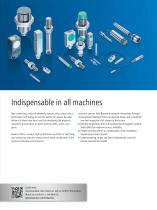
Indispensable in all machines Non-contacting, inductive proximity sensors play a major role in automation technology all over the world. For several decades millions of them have been used for monitoring the presence, movement and position of metal machine parts, valves, and gears. Baumer offers a unique, high-performance portfolio of switching and measuring inductive sensors which work reliably even in the toughest industrial environments. Inductive sensors from Baumer distinguish themselves through: Guaranteed reliability thanks to patented design and comprehensive final inspection of all sensors...
Open the catalog to page 4
Table of contents. Introduction Miniature sensors for confined installation spaces Sturdy sensors for demanding environments Factor 1 sensors – treat all metals equally AlphaProx® – Measure distances accurate to a micrometer Sensing characteristics Protection classes Mounting and mounting procedure General definitions Inductive proximity switches for factory automation Overview Proximity switches for factory automation Factor 1 Hygienic design Washdown design Outdoor design Full metal housings DuroProx High temperature sensors up to +100 °C Sensors immune to welding and magnetic fields High pressure...
Open the catalog to page 5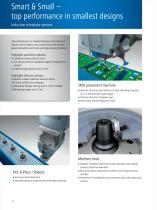
Smart & Small – top performance in smallest designs Inductive miniature sensors SMD placement machine Ideal for fast processes thanks to a high switching frequency up to 5 kHz and their light weight Position detection of gripper jaws Work piece presence/absence check Machine tools Pick & Place / Robotic Precise position detection Absolute distance measurement with high resolution Reliable condition detection during automatic tool change prevents machine downtime Minimum space requirement enables more compact motor spindles Detection of misalignment and incorrect tools with measuring sensors.
Open the catalog to page 6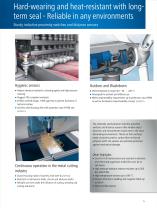
Hard-wearing and heat-resistant with longterm seal - Reliable in any environments Sturdy inductive proximity switches and distance sensors Hygienic sensors Highest chemical-resistant to cleaning agents and high-pressure cleaning Rugged, FDA compliant materials EHEDG certified design, 100% gap-free to prevent formation of bacterial residue Stainless steel housings V4h with protection class IP 69K and proTect+ Outdoor and Washdown Wide temperature range from –40 … +80 °C Developed for onshore and offshore use Meets impermeability requirements up to protection class IP69K as well as the Baumer impermeability...
Open the catalog to page 7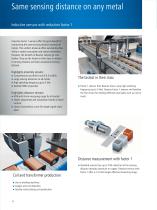
Same sensing distance on any metal Inductive sensors with reduction factor 1 The fastest in their class Factor 1 sensors from Baumer have a very high switching frequency (up to 3 kHz). Baumer Factor 1 sensors are therefore the first choice for feeding different small parts such as nuts or rivets. Distance measurement with factor 1 Coil and transformer production Use in winding machines Copper wire coil detection Quality control during coil production Standard sensors face up to 70% reduction of the sensing distance towards aluminum or copper. Distance sensors with factor 1 offer a 2-3 times larger...
Open the catalog to page 8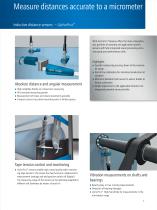
Measure distances accurate to a micrometer Inductive distance sensors – AlphaProx® Absolute distance and angular measurement High reliability thanks to contact less measuring Dirt-resistant measuring system Measurement of linear and rotary movements possible Compact sensor sizes allow mounting even in limited spaces Tape tension control and monitoring AlphaProx® sensors enable high control quality when monitoring tape tensions. The sensor has two functions: displacement measurement (analog) and end position switch-off (digital). The measuring range of the sensor can be optimally adapted to different...
Open the catalog to page 9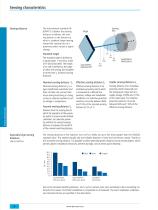
Sensing characteristics Sensing distance The international standard EN 60947-5-2 defines the sensing distance as follows: the sensing distance is the distance at which a standard target moving toward the sensing face of a proximity switch causes a signal change. Sensing face Standard target The standard target is defined as a square plate, 1 mm thick, made of Fe 360 (mild steel). The length of its side is defined as the larger of either the sensing face diameter or three times sn (nominal sensing distance). Nominal sensing distance Sn Effective sensing distance Sr Usable sensing distance Su Nominal...
Open the catalog to page 10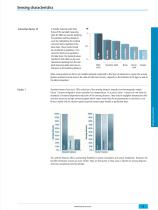
Sensing characteristics Mild steel Stainless Steel If metallic materials other than those of the standard measuring plate (Fe 360) are used for damping, the specified switching distances must be multiplied by the material correction factor specified in the data sheet. These results should be considered as guidelines. If no correction factors are specified in the data sheet, the standard values specified in this table can be used. Geometries deviating from the standard measuring plate also have an influence on the switching distance. When sensing aluminum foil or non-metallic materials coated with...
Open the catalog to page 11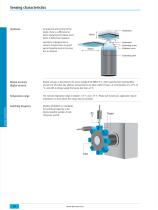
Sensing characteristics At approach and removal of the target, there is a difference between operating and release point which is defined as Hysteresis. Hysteresis Motion Hysteresis is designed into a sensor's characteristics to guard against possible incorrect pick-up due to vibration. Hysteresis Operating curve Release curve Operating point Repeat accuracy is described in the sensor standard EN 60947-5-2, which specifies that reproducibility amounts to 5% when two arbitrary measurements are taken within 8 hours, at a temperature of +23°C ±5 °C, and with a voltage supply that varies less than...
Open the catalog to page 12All Baumer Group catalogs and technical brochures
 GT 5
GT 53 Pages
 AlphaProx
6 Pages
 OM70
OM702 Pages
 DPPC DS02.5
5 Pages
 CX series
22 Pages
 TCR6
TCR610 Pages
 TFR5
TFR56 Pages
 DLRx L003
2 Pages
 TFRN
TFRN9 Pages
 CTX
CTX6 Pages
 GCA5
GCA55 Pages
 TDP 0,2, TDPZ 0,2
5 Pages
 Ultrasonic sensors.
132 Pages
 CIP - Clean in place sensors
6 Pages
 Cable transducers
8 Pages
 SmartReflect® Transparent
2 Pages
 AlphaProx inductive sensors
6 Pages
 HMG 10 & PMG 10
6 Pages
 VeriSens® Vision Sensoren
26 Pages
 Digital industrial cameras
20 Pages
 Force and strain sensors.
126 Pages
 Encoders and angle measurement
100 Pages
 Innovative Sensor Solutions
72 Pages
 Capacitive sensors
60 Pages
 Inductive sensors.
200 Pages







- Digital imager
- Visible imager
- Force sensor
- CMOS camera module
- Pressure transmitter
- Incremental encoder
- Full-color camera system
- Tension/compression force transducer
- Level limit switch
- Steel load cell
- Cloud-based software
- Strain gauge force sensor
- Liquid level detector
- Level probe
- USB camera module
- Incremental rotary encoder
- Liquid level sensor