
- Catalogs
- Bauer Gear Motor
- Geared Motors for Monorail Systems


Geared Motors for Monorail Systems

Geared Motors for Monorail Systems
- Bevel-Geared Motor Series BK: Known for high efficiency and right-angle design, suitable for various applications.
- Shaft-Mounted Geared Motor Series BF: Features integrated torque arms for easy integration.
- Helical-Geared Motor Series BG: Offers compact and economical solutions for demanding conditions.
- Worm-Geared Motor Series BS: Economical and suitable for tight spaces.
- Overhead Monorail Geared Motor Series BM: Designed for light and heavy load applications with improved efficiency.
- Frequency Converter Geared Motor Series Eta-K: Combines geared motors with frequency converters for compact drive solutions.
- Gear Unit Designs: Various configurations are available, including worm-gear, helical-gear, and bevel-gear combinations. Options for flanges, foot threads, and output shafts are specified for different models (BM09, BM10, BM20, BM30Z, BM40Z).
- Motor Types: The document details three-phase, single-phase, PM-synchronous, and explosion-proof motors, with options for enhanced efficiency (IE1, IE2, IE3) and special features like unventilated designs and multiple voltage ranges.
- Brake Configurations: Options include single-disc and two-disc brakes, with variations for holding and service applications. Braking torque and manual release features are specified.
- Corrosion Protection: Three levels of corrosion protection (Coro1, Coro2, Coro3) are available, with Coro2 being highlighted in the example configuration.
- Geared Motor Selection: The document outlines a step-by-step process for selecting the appropriate geared motor based on wheel load, running wheel diameter, travelling speed, and required torque. It includes formulas for calculating acceleration torque and braking requirements.
- Project Planning Advice: Recommendations are provided for matching geared motor dimensions with carriage designs and ensuring compatibility with electrical data from inverters.
- Permissible Radial Forces: Tables specify maximum permissible radial forces for different gear unit types and wheel diameters.
- Carriage Design Principles: Various design principles for carriage configurations are discussed, including considerations for cornering and load distribution.
- Tables provide detailed specifications for gear unit types, motor configurations, and permissible radial forces.
- Formulas and calculations for torque, speed, and braking requirements are included to assist in project planning and motor selection.
- Motor Types: The document covers 8/4-pole, 8/2-pole, 12/2-pole, and 4-pole motors, each designed for specific operational duties such as continuous running (S1) and intermittent periodic duty (S3).
- Rated Output: Motors are rated for different outputs at 50 Hz and 60 Hz mains frequencies, with specifications provided for each configuration.
- Torque and Current: Detailed tables list rated torque (MN), rated current (IN), and other performance factors like power factor (cos φ), starting current (IA/IN), and various torque ratios (MA/MN, MS/MN, MK/MN).
- Efficiency and Inertia: Efficiency ratings (η) at different load levels and rotor moment of inertia (Jrot) are provided for each motor type.
- Voltage Compatibility: Motors are designed for a voltage range of 440–480 V or 460 V +/- 10%, with adjustments needed for different voltages.
- Brake Configuration: Recommendations for brake configurations are included, particularly for 4-pole motors.
- Duty Cycles: Specific duty cycles such as S1 for continuous operation and S3 for intermittent duty are outlined, with corresponding technical data.
- Performance Metrics: The tables provide a comprehensive view of motor performance, including starting and breakdown torques, which are critical for understanding motor capabilities under different load conditions.
- Application Suitability: The document helps in selecting the appropriate motor type based on operational requirements and environmental conditions.
- Rated Speed: Motors are designed for rated speeds of 1500, 2250, and 3000 1/min.
- Power Output (Pn): Ranges from 0.75 kW to 15 kW depending on the motor type.
- Torque (Mn): Varies with motor type, with peak torque values provided for each configuration.
- Efficiency (η): Motors are classified under IE3 and IE4 efficiency standards, with efficiencies ranging from 84.7% to 93.7%.
- Voltage and Frequency: All motors operate with a converter supply voltage of 380 to 500 V and nominal frequencies of 50 to 150 Hz.
- Converter Settings: Minimum clock frequency is 3 kHz, with a short-term current limit of 160% of the rated current. Maximum overload time is 60 seconds.
- Frequency Range: Motors operate between 5 Hz and 120 Hz, with specific permissible operating times below minimum frequency.
- Environmental Conditions: Motors are designed to operate within ambient temperatures of -20°C to +50°C.
- Detailed tables provide motor performance data at different speeds and configurations, including torque, power, voltage, current, and frequency.
- Characteristic curves illustrate motor performance under various operational conditions.
- Ensure all converter settings are selected according to the specific requirements of the drive system.
- Consider voltage drop at motor terminals and adjust permissible motor torque accordingly.
- Consult manufacturer for non-standard operating conditions.
- Type S11LA6: Rated output of 7.50 to 13 kW, torque of 48 Nm, and speed range of 1500 to 2600 rpm. Operates with a frequency converter in both wye and delta circuits.
- Type S08MA4: Rated output of 2.0 kW, torque of 6.50 Nm, and speed of 3000 rpm. Operates with a frequency converter in a wye circuit.
- Type S08LA4: Rated output of 3.0 kW, torque of 9.55 Nm, and speed of 3000 rpm. Operates with a frequency converter in a wye circuit.
- Type S09SA4 and S09XA4: Both have a rated output of 6.3 kW, torque of 20 Nm, and speed of 3000 rpm. Operate with a frequency converter in a wye circuit.
- The voltage at motor terminals should not fall below the rated value by more than 10% as per IEC 60034-1 Range "B".
- Maximum permissible frequency converter input voltage is 500 V +10%, 50/60 Hz.
- Ambient temperature range for operation is -20 °C to +50 °C.
- Converter settings include a minimum clock frequency of 3 kHz, short-term current limit of 160% of rated current, and a maximum overload time of 60 seconds.
- Changes to rated values within the permissible operating range are allowed and specified by the manufacturer.
- Continuous current limit, torque, and speed adjusting range are detailed on the motor nameplate.
- Permissible operating time below minimum frequency (fmin) is 60 seconds, based on a 10-minute interval.
- Type S11SA6: Rated output of 7.1 kW, torque of 22.5 Nm, and current of 15 A. Operates at a speed of 3000 rpm with a nominal frequency of 150 Hz.
- Type S11MA6: Rated output of 11.0 kW, torque of 35 Nm, and current of 22.5 A. Similar operational parameters as S11SA6.
- Type S11LA6: Rated output of 15.0 kW, torque of 48 Nm, and current of 30 A. Also operates at 3000 rpm and 150 Hz.
- Motors are designed to operate with a frequency converter, with specific voltage and current parameters outlined for different torque and power levels.
- The maximum permissible input voltage for the frequency converter is 500 V +10%, with a frequency range of 50/60 Hz.
- Ambient temperature range for operation is -20 °C to +50 °C.
- Minimum clock frequency: 3 kHz.
- Short-term current limit: 160% of rated current.
- Maximum overload time: 60 seconds.
- Brakes are categorized into holding brakes (ES.. / ZS..) and service brakes (ESX.. / ZSX..).
- Brakes are spring-actuated and can be manually released. Options include microswitches for monitoring.
- Braking torque should be selected based on application requirements, with safety factors considered for different operational scenarios.
- Encoders: Incremental and absolute encoders are available for precise motor control.
- Modular motor system allows for customization based on specific application needs.
- Braking Energy: The document outlines the thermally allowable braking energy for service brakes, emphasizing the need to balance heat input and dissipation to prevent overheating.
- Lifting Operation: During lowering operations, the motor acts as a generator, requiring additional braking torque to stop the load. The document specifies the need for 200% braking torque for effective deceleration.
- Brake Lifetime: Brake disc wear increases the air gap, affecting the magnetic field's strength. Maintenance is required when the air gap exceeds a certain limit.
- Deceleration Time: The document provides a formula for calculating deceleration time, considering load torque and braking effect.
- Electrical Connection: Two options for supplying voltage to the DC electromagnet are discussed: external DC control voltage or a rectifier built into the motor or brake terminal box.
- Response Time: The response time of the brake is influenced by the method of voltage application and interruption. Overexcitation can reduce response time by 50%.
- Switching Off: Different methods of switching off the AC and DC supply voltage are discussed, with emphasis on the effects on response time and contact erosion.
- The document includes tables listing various brake types, their braking torque, maximum allowable friction energy, and response times. It notes that these values do not apply to explosion-proof drives and highlights the need for periodic inspection.
- Braking torque tolerance varies by brake type, and specific configurations require an MSG rectifier for overexcitation.
- Actual response times and braking energy values may vary due to operational conditions and manufacturing tolerances.
The document details the specifications for ZSXxx type brakes used in geared motors for electric overhead conveyors. It includes information on manual release, response times for different excitation methods, and power consumption of the electromagnet coil. The brakes are available in standard voltages of 380–420 V 50/60 Hz, 220–230 V 50/60 Hz, and 24 V DC, with other voltages available at additional cost.
Procedures:
The brakes must be connected via separate terminals in the motor or brake terminal box directly to the DC voltage. The document outlines the connection procedures for DC and AC supply, including the use of half-wave rectifiers for DC-side circuit interruption.
Standards and Approvals:
All BAUER brakes comply with IP 65 protection and are marked with the CE mark, complying with the Machinery Directive, Low-Voltage Directive, and EMC Directive. Special regulations apply for brakes used in hazardous areas.
Recommendations:
For applications in corrosive atmospheres, enhanced corrosion protection is recommended. The document also advises on the use of protective fan cowls for outdoor installations and provides options for motor-independent fans.
Additional Features:
The document describes the availability of incremental and absolute encoders for special applications, detailing their specifications and features. It also mentions the option for a second motor shaft extension and the use of backstops for motors of certain sizes.
Key Data from Tables and Diagrams:
The document includes tables and diagrams illustrating the electrical connections, voltage ranges, and configurations for different motor and brake setups. It highlights the importance of separate electrical connections for brakes when operating with frequency converters or pole-changing motors.
The document outlines the specifications for differential and absolute rotary encoders used in geared motors for electric overhead conveyors. Key parameters include supply voltage ranges (5–30 V DC for differential and 11–27 VDC for absolute encoders), no-load current consumption, pulse rate, signal levels, and rise/fall times. The encoders are CE compliant and have specific protection features like short-circuit proof outputs and reverse polarity protection.
Procedures and Standards:
The encoders comply with standards such as EN 61000-6-2, EN 61000-6-3, and EN 61000-6-4 for electromagnetic compatibility. The document also specifies environmental conditions like operating and storage temperatures, vibration, and shock resistance according to EN standards.
Recommendations:
The document recommends using specific connector types (M12, M23, MIL) and provides pin assignments for proper installation. It also suggests configurations for various encoder parameters like counting direction and output code.
Data Summary:
The document includes detailed tables of electrical and mechanical specifications, such as maximum cable length, permissible mechanical speed, and bearing life. It also provides contact information for Bauer Gear Motor's international offices across North America, Latin America, Europe, and other regions.
Key Features:
- Differential encoders have a maximum pulse rate of 300 kHz and are short-circuit proof.
- Absolute encoders offer resolutions up to 33 bits and support interfaces like Profibus DP and SSI.
- Environmental ratings include IP 65 enclosure protection and compliance with EMC standards.
- The document emphasizes the importance of using the correct mating connectors to maintain enclosure ratings.
- Precision Couplings and Air Motors: Huco Dynatork offers precision couplings and air motors, with contact information for their offices in England and the USA.
- Flexible Couplings and Bearing Isolators: Lamiflex Couplings provides flexible couplings, bearing isolators, and coupling guards, with contact details for their office in Brazil.
- Engineered Bearing Assemblies: Guardian Couplings and Kilian Manufacturing offer various coupling types and engineered bearing assemblies, with contact information for their offices in the USA.
- Overrunning Clutches and Holdbacks: Formsprag Clutch, Marland Clutch, and Stieber Clutch specialize in overrunning clutches and holdbacks, with contact details for their offices in the USA and Germany.
- Clutches and Brakes: Warner Electric, Matrix International, Inertia Dynamics, and Wichita Clutch provide electromagnetic, pneumatic, and other types of clutches and brakes, with contact information for their offices in the USA, France, and Scotland.
- Gearing and Drives: TB Wood’s, Boston Gear, and Bauer Gear Motor offer belted drives, gearing, and geared motors, with contact details for their offices in the USA and Germany.
- Industrial Brakes and Systems: Svendborg Brakes and Twiflex Limited provide industrial brakes and brake systems, with contact information for their offices in Denmark and England.
Catalog excerpts
ALTRA INDUSTRIAL MOTION A. Bauer ^ \ Gear Motor An Altra Industrial Motion Company
Open the catalog to page 1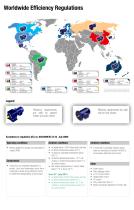
Worldwidea glance Efficiency Regulations The Standards at CANADA Regulation CSA Efficiency Class NEMA Premium (cf. IE3) Start Date January 2011 USA Regulation NEMA-EISAct Efficiency Class NEMA Premium (cf. IE3) Start Date December 2010 RUSSIA Regulation GOST R Efficiency Class n.A. Start Date n.A. MEXICO Regulation NOM 016 Efficiency Class MEPS Start Date since 2004 CHINA Regulation GB 18613 Efficiency Class Grade 2 Start Date June 2011 EUROPE Regulation Efficiency Class Start Date BRASIL Regulation NBR 17094 Efficiency Class Alto Redimento (cf. IE2) Start Date December 2009 KOREA* Regulation...
Open the catalog to page 2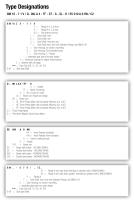
UO = Foot bottom and top 1 = Solid Shaft, front 2 = Solid Shaft, rear 3 = Solid Shaft, front and rear 7 = Solid Shaft front, flush with Standard-Flange only BM30-40 0 = Gear Housing, no surface machining 6 = Gear Housing, Foot-threaded bores 7 = Gear Housing, C - Flange - = seperates gear type from gear design X = reinforced bearings for higher wheel loading Z = Gearbox with pre-stage • • = Gear Size (09, 10, 20, 30, 40) B M = Gear type (BM) S = rectifier TF = Motor monitoring 4 = No. of pole for motor LA = Motor core length and design 09 = Motor size .. = SE Three-Phase Motor with increased...
Open the catalog to page 3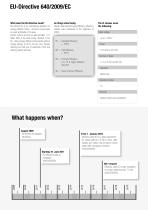
What does the EU directive mean? EN 60034-30 is an international standard for energy-efficient motors and will in future years be used worldwide in this area. Electric motors account for approximately 1.07 billion kWh of the total energy demand of the EU. Using energy efficient motors would achieve energy savings of 20 to 30 per cent, thereby reducing the total cost of ownership (TCO) and reducing global warming. As things stand today New IE (International Energy Efficiency) efficiency classes were introduced at the beginning of 2009: IE1 = Standard Efficiency (~ EFF2) IE2 = High Efficiency (~...
Open the catalog to page 4
Geared motors for electric overhead conveyors series BM Edition 03/14 Geared motors for electric overhead conveyors series BM
Open the catalog to page 5
Geared motors for electric overhead conveyors series BM
Open the catalog to page 6
Geared motors for electric overhead conveyors series BM Edition 03/14 Page Advantages for Bauer Geared Motors Product Description Type Designations Gear Motor Selection Motor Components BAUER global Selection tables PMSM - IE4 3000 1/min Мотор-редукторы Motoreductores Monorail Motoréducteurs Hängebahn- para de convoyer aérien для подвесных Geared Motors transportadores монорельсовых конвейеров Getriebemotorenaéreos для подвесных монорельсовых конвейеров Flange mit Gewindelöchern delante впереди Bride avectaladros roscados front Flanschwithtrous taraudésat l'avant Brida con tapped holes à vorne...
Open the catalog to page 7
Geared motors for electric overhead conveyors series BM
Open the catalog to page 8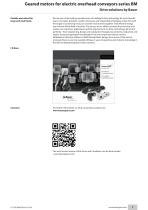
Geared motors for electric overhead conveyors series BM Drive solutions by Bauer Flexible and robust for large and small loads We are one of the leading manufacturers of intelligent drive technology for more than 85 years. Innovative products, modern processes and responsible employees realise this with the target of conserving resources and the environment together with efficient energy use over our whole field of activity. The success of our efforts assumes that we know and master our customers applications and the requirements on drive technology. We do this perfectly - from engineering, design...
Open the catalog to page 9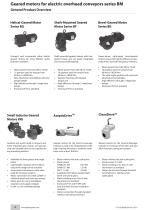
Geared motors for electric overhead conveyors series BM General Product Overview Helical-Geared Motor Series BG Shaft-Mounted Geared Motor Series BF Bevel-Geared Motor Series BK Compact and economical inline helical geared motors for long lifetime under arduous conditions. Shaft-mounted geared motors with integrated torque arm are easily integrated and economically applied. Power-dense, right-angle, bevel-geared motors ensure the highest efficiency especially when used with frequency inverters. Motor power from 0.03 kW to 75 kW 13 gearbox sizes for torques from 20 Nm to 18500 Nm New attachment...
Open the catalog to page 10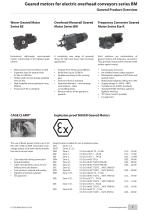
Worm-Geared Motor Series BS Overhead Monorail Geared Motor Series BMFrequency Converter Geared Motor Series Eta-K Economical, right-angle, worm-geared motors install easily in the tightest applications. A completely new range of monorail drives for light and heavy load monorail applications. Eta-K solutions are combinations of geared motors and frequency converters. They provide compact drive solutions with infinite speed control. • Motor power from 0.03 kW to 5.5 kW • 8 gearbox sizes for torques from 25 Nm to 1000 Nm • Hollow shaft version already available from 25 Nm • High loadable worm gearing...
Open the catalog to page 11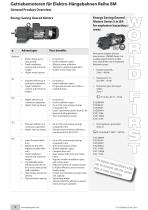
Energy Saving Geared Motors Energy Saving Geared Motors Series S in IE4 for explosion hazardous Permanent magnet synchronous motors (PMSM) Series S as variable-speed motors in efficiency class IE4 for use in explosion hazardous areas. • Design torque MN: 5 Nm - 48 Nm • Rated power PN: 0,75 kW - 15 kW • Dust explosion protection Zone 21 • Protection type: Increased Safety Zone 1 O II 2 G Ex e IIC T1 - T3 Gb S.XE.08MA4 S.XE.08LA4 S.XE.09SA4 S.XE.09XA4 S.XE.11SA6 S.XE.11MA6 S.XE.11LA6
Open the catalog to page 12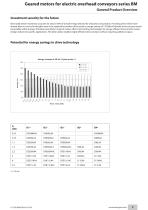
Investment security for the future Electrically driven machinery accounts for around 70% of overall energy demand for industrial consumption. If existing drives which have already been in service for decades were to be replaced by modern drive systems, energy savings of 135 billion kilowatt-hours per year would be possible within Europe. The Bauer Gear Motor range of motors offers trend-setting technologies for energy-efficient drives and for motor designs tailored to specific applications. The latter option enables highly efficient drive solutions without requiring additional space.
Open the catalog to page 13
Geared motors for electric overhead conveyors series BM
Open the catalog to page 14
Advantages for Bauer Electric overhead 11-14 conveyors systems Bauer-Electric overhead conveyors systems Bauer-Gearboxes Bauer-Motors Bauer-Brakes
Open the catalog to page 15
Geared motors for electric overhead conveyors series BM
Open the catalog to page 16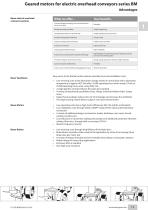
Bauer-electric overhead conveyors systems Easy access to the fixation points reduces assembly times and installation costs Bauer Gearboxes • Low servicing costs as the lubrication change results in normal duty with a lubrication temperature of approx. 80°C first after 15.000 operating hours when using CLP oils or 25.000 operating hours when using PGLP oils • 2-stage gearbox concept reduces the spare part stocking • A variety of attachment possibilities (Foot, Flange, Solid and Hollow shafts, Torque arms) • Sealed housing design reduces the risk of oil leakage and increases the oil lifetime •...
Open the catalog to page 17All Bauer Gear Motor catalogs and technical brochures
 EtaK2.0 Geared Motors
2 Pages
 Gear Units with C-Adapter
2 Pages
 Product overview
8 Pages
 ALTRA MOTION
2 Pages
 HiflexDRIVE
2 Pages
 Worm Geared Motor Series BS
2 Pages
 Your driving power since 1927
16 Pages
 BS Fact Sheet
2 Pages
 Fact Sheet Roller Table
2 Pages
 C Adapter Fact Sheet
2 Pages
 Eta-K Fact Sheet
2 Pages
 BM Fact Sheet
2 Pages
 BK Fact Sheet
2 Pages
 P-7100-BGM
2 Pages
 P-7101-BGM
2 Pages
 Fact Sheet Aseptic Drive TM
2 Pages
 Aseptic Fact Sheet
2 Pages
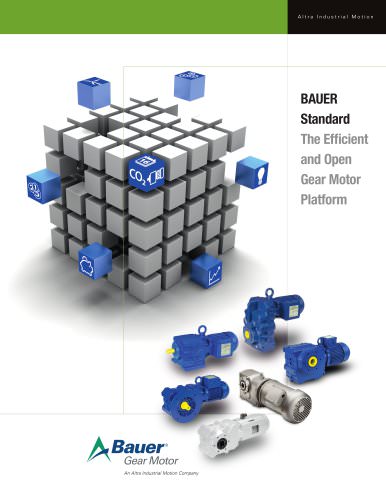 The BAUER 2010 Platform
5 Pages
 Cage Clamp Fact Sheet
2 Pages
 Global Service
6 Pages
 Food & Beverage
4 Pages
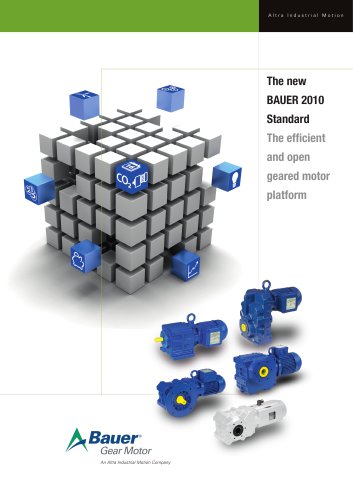 The new BAUER 2010 Standard
8 Pages
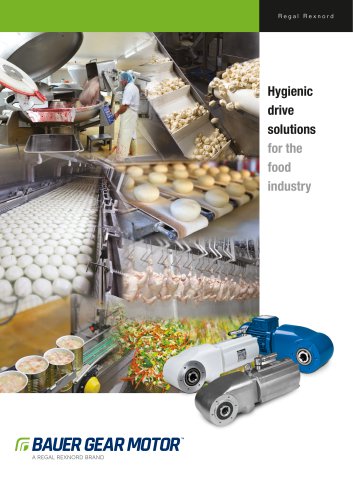


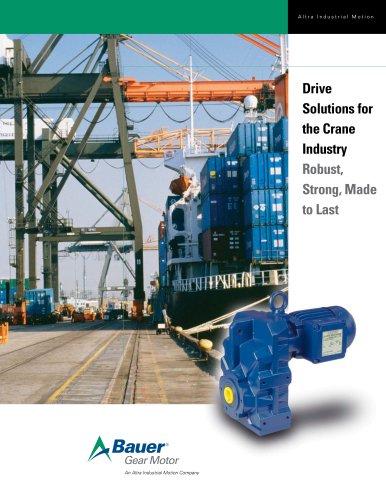











- Electric gearmotor
- Management software solution
- Planetary gearbox
- Coaxial gearhead
- Compact gearhead
- Solid-shaft gearhead
- Gearbox for industrial applications
- Transmission gearhead
- Industrial electric gearmotor
- AC gear-motor
- Right angle electric gearmotor
- Coaxial gearmotor
- Solid-shaft gear-motor
- Gear train gearmotor
- Compact gear-motor
- High-efficiency gearhead
- High-torque gearhead
- Low-noise level gear-motor
- Parallel-shaft electric gearmotor
- Maintenance-free gear reducer