
- Catalogs
- BANNER ENGINEERING CORP.
- Sensors Selection Guide


- Company
- Products
- Catalogs
- News & Trends
- Exhibitions
Sensors Selection Guide
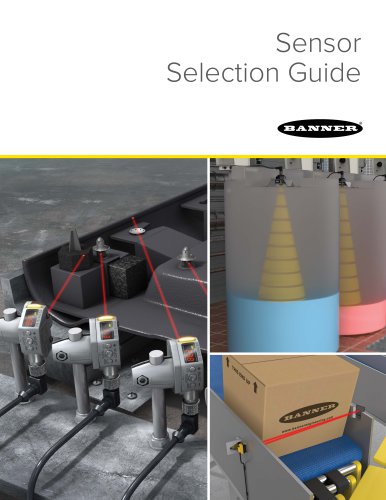
Sensors Selection Guide
- Photoelectrics: These sensors emit a light beam to detect objects by measuring changes in light patterns, suitable for various materials and applications like material handling and packaging.
- Lasers: Known for high precision in detection and distance measurement, lasers are useful for challenging targets and long-range applications.
- Fiber Optics: Utilizing amplifiers and cables, fiber optics are ideal for remote sensing in constrained or harsh environments, offering flexibility and versatility.
- Ultrasonics: These sensors emit sound waves to detect targets regardless of color or surface finish, making them ideal for measuring challenging targets at close ranges.
- Radar: Using microwaves, radar sensors are unaffected by environmental conditions, suitable for outdoor and low-visibility applications.
- Arrays: These include measuring and detection arrays for applications like product dimensioning and edge tracking.
- 3D Time of Flight: These sensors emit signals to measure multiple targets in a 3D field, ideal for non-uniform targets.
- Vision: Utilizing imaging technology, vision sensors enhance process throughput and are used for quality applications.
- Photoelectrics: Recommended for general applications.
- Radar: Best for transparent object measurement and reliability in dusty environments.
- Lasers: Suitable for longer range and precision.
- Ultrasonics: Consistent detection within the field of view.
- Arrays: Ideal for wide inspection areas and multiple measurements.
- Fiber Optics: Perfect for remote sensing in space-constrained or harsh environments.
- 3D Time of Flight: Suitable for wide area, multi-point inspection.
- Vision: Best for complex quality checking.
- Photoelectric Sensors: Consider housing, range, and environmental resistance.
- Laser Sensors: Evaluate range, precision, and application suitability.
- Ultrasonic Sensors: Options vary by range and environmental conditions.
- Radar Sensors: Configurable beam patterns and environmental resistance are key factors.
- Fiber Optic Amplifiers: Consider response speed, range, and specific sensing needs.
- Fiber Optic Cables: Evaluate fiber type, sensing mode, and sensing head design.
- Sensor Arrays: Focus on range, resolution, and IP rating.
- Detection Arrays: Used for material handling with specifications like sensing mode, range, and response speed.
- 3D Time of Flight Sensors: High resolution and multizone sensing capabilities with easy configuration.
- Vision Cameras: Robust inspection capabilities with integrated lighting and multiple communication protocols.
- Other Sensing Technologies: Includes color sensors, luminescence sensors, and registration mark sensors for specific applications.
- Slot and Label Sensors: Ideal for counting and detecting small objects with specifications like slot width and response time.
- Remote I/O and Connectivity: Optimizes control system performance with solutions like cordsets and junction blocks.
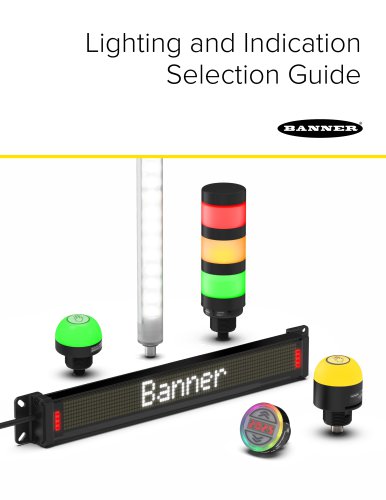
- Lighting and Indication: LED products provide superior illumination and status indication.
Catalog excerpts
Sensor Selection Guide
Open the catalog to page 1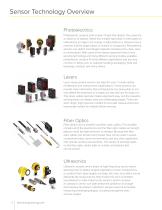
Sensor Technology Overview Photoelectrics Photoelectric sensors emit a beam of light that detects the presence or absence of objects. When this emitted light beam is interrupted or reflected by an object, the change in light patterns is measured by a receiver and the target object or surface is recognized. Photoelectric sensors can detect most target materials including shiny, dark, clear, or multicolored. With some of the fastest response times of any sensing technology and many different sensing modes available, photoelectric sensors fit many different applications and are very common in fields...
Open the catalog to page 2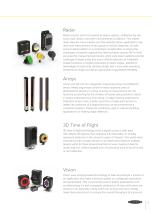
Radar Radar sensors emit microwaves to detect objects, unaffected by rain, snow, dust, steam, and other environmental conditions. This makes radar ideal for many outdoor and low-visibility indoor applications, like tank level measurement of dry goods or vehicle detection. A radar sensor’s beam pattern is an important consideration in solving the challenges of specific applications. Narrow beam sensors (15° or less) are great for measuring liquid levels, while wide beam patterns provide coverage of larger areas and more reliable detection of irregularly shaped surfaces or targets presented at...
Open the catalog to page 3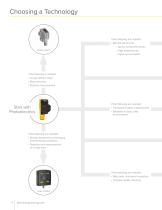
select Lasers • Space constrained areas • High temperatures • Harsh environments • Longer diffuse range • More precision • Distance measurement • Strong resistance to challenging environmental conditions • Detection and measurement of a large area • Transparent object measurement • Reliability in dusty, dirty environments • Wide area, multi-point inspection • Complex quality checking
Open the catalog to page 4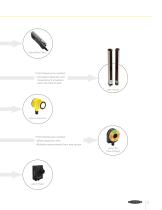
If the following are needed: • Consistent detection and measurement anywhere within the field of view
Open the catalog to page 5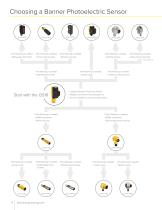
Choosing a Banner Photoelectric Sensor If the following is needed: • Rectangular form factor If the following is needed: • 18 mm barrel housing If the following is needed: • Miniature housing If the following is needed: • Contrast sensing If the following is needed: • Measurement sensing* *See page 8-9 If the following is needed: • Alternative form factor If the following is needed: • Longer range If the following is needed: • Problem solving sensors • Largest selection of sensing modes • Multiple convenient mounting options • IO-Link available in many sensing modes If the following is needed:...
Open the catalog to page 6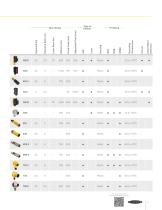
Clear Object Detection Operating Temperature
Open the catalog to page 7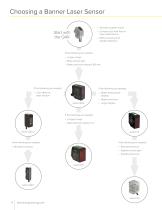
Choosing a Banner Laser Sensor Versatile problem solver Compact size with best-inclass performance Robust housing and reliable detection • Longer range • More excess gain • Better precision beyond 100 mm • Cost effective laser solution • Better temperature stability • Higher precision • Larger display • Longest range • Best precision beyond 1 m If the following are needed: • Miniature housing • Best performance • Highest excess gain • Smallest spot size
Open the catalog to page 8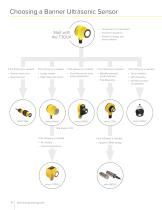
Temperature compensation Chemical resistance Variety of ranges and beam patterns • Shorter dead zone • Best precision • Longer ranges • Wider detection areas • Cost effective for short range applications • Reliable opposed mode detection • Fast Response • Serial interface • Wireless solution compatibility select Radar* select QS18U
Open the catalog to page 10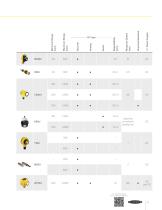
Chemical Resistant • Depends on network polling rate
Open the catalog to page 11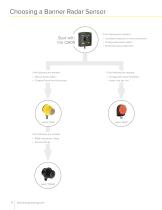
Choosing a Banner Radar Sensor • Consistent detection in any environment • Configurable beam pattern • Multi-Dimensional detection • Narrow beam pattern • Configurable visual feedback • Compact barrel mount housing • Lower cost per unit If the following are needed: • IP69K washdown rating • Process fittings
Open the catalog to page 12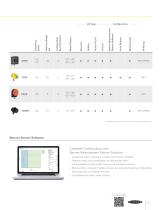
Remote Input Banner Measurement Sensor Software Beam Pattern Configurable Sensing Zones Push Buttons *Global telecom approval for use in mobile equipment applications. Banner Sensor Software Complete Configuration with Banner Measurement Sensor Software • Customize region of interest to detect only what is intended • Program easily using visualization of what sensor sees • Independently configure both outputs and use fewer sensors • Reduce time to program multiple sensors by saving and loading configurations • Download and use software for free • Compatible
Open the catalog to page 13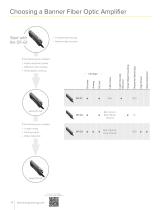
Choosing a Banner Fiber Optic Amplifier • Fundamental sensing • Ambient light receiver Red, Green, Blue, White, Infrared Water Detection High Power • Small object counting Light Intensity Receiver • Different color emitters • Faster response speed Small Object Counting If the following are needed: • Longer range • Analog output • Water detection For more information on our Fiber Optic Amplifiers
Open the catalog to page 14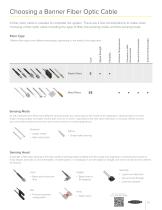
Choosing a Banner Fiber Optic Cable A fiber optic cable is needed to complete the system. There are a few considerations to make when choosing a fiber optic cable including the type of fiber, the sensing mode, and the sensing head. Transmit Infrared Light Vacuum Environments Glass Fibers Plastic Fibers Signal Strength Different fiber types have different advantages, depending on the needs of the application. Extreme Temperatures Fiber Type Sensing Mode As with photoelectrics, fibers have different sensing modes too, depending on the needs of the application. Opposed fibers will have longer sensing...
Open the catalog to page 15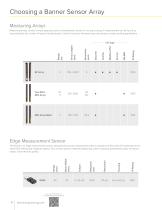
Measuring arrays consist of many opposed pairs of photoelectric sensors in a long housing. A measurement can be found by accounting for the number of beams being blocked. Useful in product dimensioning, hole sizing, or edge tracking applications. • IP54 Edge Measurement Sensor The EG24 is an edge measurement sensor designed for precise measurement with a resolution of less than 0.01 millimeter and a rapid 0.65-millisecond response speed. This ensures precise material positioning, which improves downstream yield, minimizes waste, and enhances quality.
Open the catalog to page 16All BANNER ENGINEERING CORP. catalogs and technical brochures
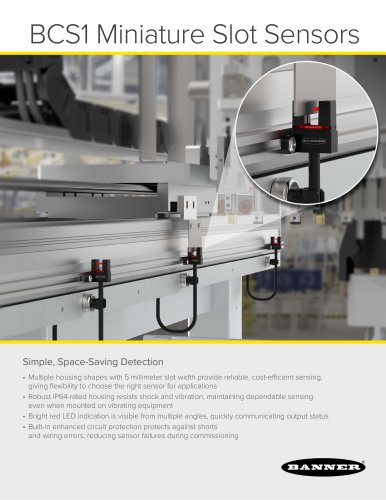 BCS1 Miniature Slot Sensors
2 Pages
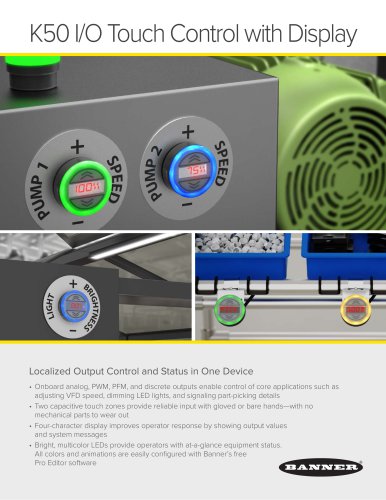 K50 Touch with Display
4 Pages
 New Products
37 Pages
 SD50 Display
4 Pages
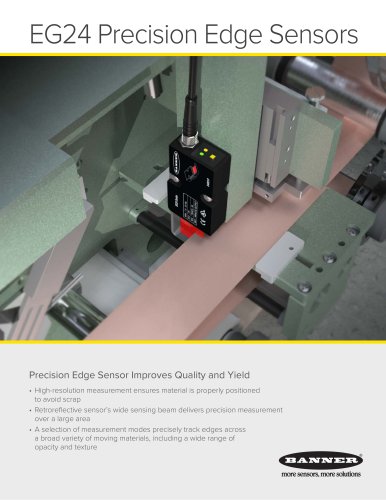 EG24 Sell Sheet
4 Pages
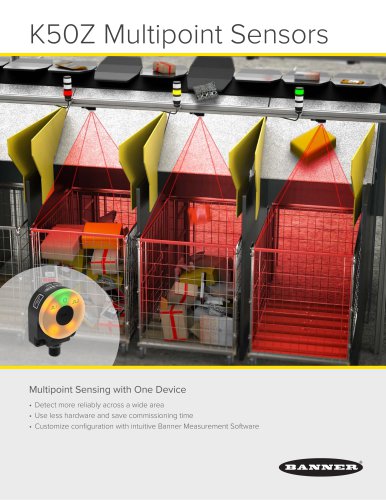 K50Z Sell Sheet
4 Pages
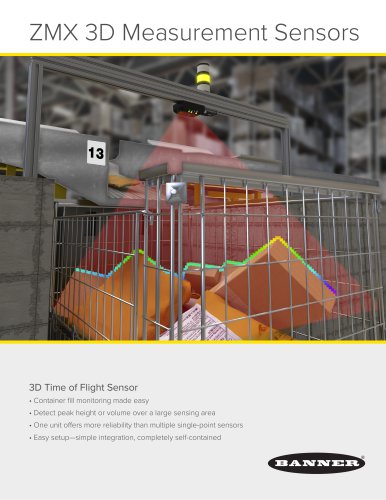 ZMX Sell Sheet
3 Pages
 Wirreless Catalogue
92 Pages
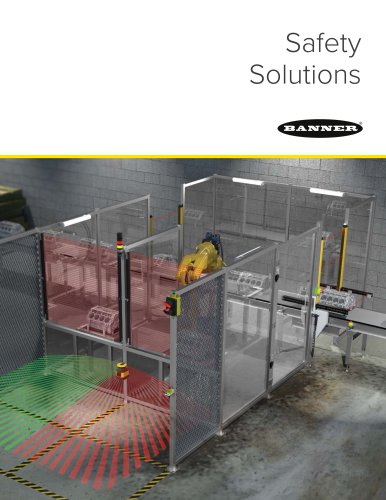 Safety Solutions
33 Pages
 Banner Overview Flyer
3 Pages
 AGV Solutions Brochure
3 Pages
 Car Wash Solutions Brochure
5 Pages
 Connectivity Solutions Brochure
28 Pages
 IO-Link Solutions Brochure
20 Pages
 Laser Sensor Solutions Brochure
11 Pages
 Lighting and Indication Catalog
55 Pages
 Monitoring Solutions Brochure
11 Pages
 Packaging Solutions Brochure
80 Pages
 Radar Sensor Solutions Brochure
13 Pages
 Remote IO Brochure
9 Pages
 Safety Solutions Catalog
33 Pages
 Snap Signal Brochure
25 Pages
 Vision Lighting Brochure
17 Pages
 Leading Edge Brochure
16 Pages



- Connector
- Power supply unit
- DC power supply
- Electrical cable
- Data connector
- AC/DC power supply
- Temperature probe
- Electrical power supply connector
- Metal connector
- Industrial display panel
- BANNER LED lighting
- Digital I/O
- Single-pole switch
- Junction block
- IO module
- Screw-in connector
- Socket electrical connector
- Terminal box
- BANNER push-button switch