
- Catalogs
- BAKKER MAGNETICS
- separation systems for waste processing and recycling industries

separation systems for waste processing and recycling industries

separation systems for waste processing and recycling industries
Bakker Magnetics, established in 1971 by Gerard H. Bakker, is a prominent European manufacturer of magnetic materials and systems. The company prioritizes quality, innovation, and service, with a global distribution network and ISO 9001 certification, aiming for QS 9000 certification.
The document discusses the profitability of waste processing due to rising raw material costs and technological advancements. Metal separation systems, especially eddy current systems, are crucial for recycling non-ferrous metals, reducing energy consumption compared to new metal processing.
Bakker Magnetics provides various magnetic systems for metal separation, including overbelt, drum, headroller, and block magnets, designed to efficiently separate metals from waste streams and enhance recycling processes.
The modular system offers flexible configuration and integration into existing plants, featuring a conveyor belt with an integrated magnet rotor, vibrating feeders, and drum magnets, designed for easy maintenance and efficient operation.
The magnet rotor uses Neodymium quality BM 42 magnets to enhance separation. Bakker Magnetics offers simulation software for visualizing discharge curves and performing grade/recovery calculations.
The document details the technical specifications and advantages of Bakker Magnetics' non-ferrous separators, focusing on the induction rotor and magnet rotor systems.
The induction rotor, integrated into a reverse drum, operates at speeds from 500 to 3000 rpm, with checks at 3500 rpm. It features a 7.5 kW Euronorm drive gear and is shielded by side plating, with speed electronically limited to 3000 rpm.
A centrally placed magnet rotor improves the grade/recovery ratio and separation efficiency, especially for smaller particles, by keeping non-ferrous particles in the magnetic field longer.
This section explains eddy current separation, using magnetic fields to induce currents in conductive particles, creating forces that separate metals from non-metals, with forces dependent on particle size.
The document provides technical data and examples of eddy current separators in applications like domestic waste and electronic scrap, emphasizing best results with high-conductivity, low-weight metals.
Describes ECSM non-ferrous separation systems components, including drum magnets, vibrating feeders, and separation units, with specifications for material, speed, and capacity.
Used to separate ferrous materials from non-ferrous ones on conveyor belts, equipped with permanent magnets, available in different models with varying motor power and weight.
Concludes with detailed specifications for ECSM units and overbelt magnet systems, highlighting capacities and applications in various industrial settings.
The document provides detailed specifications and descriptions of Bakker Magnetics' magnet systems, including Overbelt, Drum, Head Roller, and Block Magnets, outlining technical specifications, applications, and unique features.
Designed for separating ferrous materials on conveyor belts, with different series (220, 320, 400, 500) listing dimensions, motor power, and weight.
Used for de-ironing abrasive materials, available in models with ceramic or neodymium magnets, detailing construction and specifications.
Used at conveyor belt ends to attract and separate iron particles, with standard and optional configurations, providing specifications for models.
Versatile for various applications like conveyor belts and chutes, with specifications for models, highlighting use in de-ironing material flows.
Mentions Bakker Magnetics' capabilities in developing magnetic materials for industries like automotive and electronics, with contact information for inquiries.
Catalog excerpts

Separation systems for waste processing and recycling industries [for ferrous and non-ferrous metals] Centre of magnetic knowledge...
Open the catalog to page 1
C O N T E N T S L I S T Business profile 3 Metal separation systems 4 BM delivery programme 6 Modular system concept 8 Magnet rotor 12 Technical data + Practical examples 14 ECSM non-ferrous separation systems 18 Overbelt magnet systems 20 Drum magnet systems 24 Headroller magnet systems 28 Block magnets 30
Open the catalog to page 2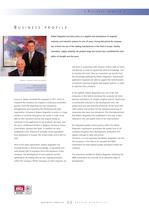
B U S I N E S S P R O F I L E [3] B A K K E R M A G N E T I C S [ B U S I N E S S P R O F I L E ] Gerard H. Bakker founded the company in 1971. Since its inception the company has enjoyed a continuous controlled growth. From the beginning we have focused on strengthening and expanding the Marketing and Sales organisation. At present, Bakker Magnetics is active in a large number of countries throughout the world. In order to be able to offer maximum service and support locally to customers in the application of our products, we have, over the years, established facilities in Belgium, Germany,...
Open the catalog to page 3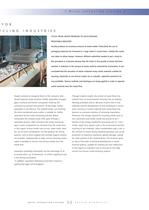
M E T A L S E P A R A T I O N S Y S T E M S [5] B A K K E R M A G N E T I C S [ M E T A L S E P A R A T I O N S Y S T E M S ] Through modern insight, the control of waste flows has evolved from an environmental necessity into an industry, allowing profitable returns. Because of price-rises in raw materials and the development of new techniques in recent years, recovery of useful materials from waste flows has become an economic industry of increasing importance. Moreover, the energy required for recycling metals such as iron, aluminium and similar metals has proved to be a fraction of the energy...
Open the catalog to page 5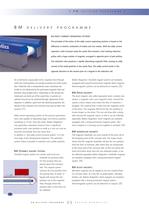
B M D E L I V E R Y P R O G R A M M E [7] B A K K E R M A G N E T I C S [ B M D E L I V E R Y P R O G R A M M E ] Bakker Magnetics’ Overbelt magnet systems are standard, equipped with powerful permanent magnetic block magnets. Electromagnetic systems can be delivered on request. [2] BM DRUM MAGNETS The drum magnet, also called separation drum, contains two sectors: a magnetic and a non-magnetic sector. Around this system a drum rotates onto which the flow of materials is dropped. This material flow is fedd onto the magnetic sector of the drum. The magnetic field forces the iron particles to remain...
Open the catalog to page 7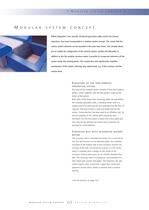
M O D U L A R S Y S T E M C O N C E P T [9] B A K K E R M A G N E T I C S [ M O D U L A R S Y S T E M C O N C E P T ] STRUCTURE OF THE NON-FERROUS SEPARATION SYSTEM The base of the modular system consists of two steel support girders, which, together with the box girders, make up the frame of the system. Both sides of the frame have mounting plates for assembling the modular separation units, a vibrating feeder and/or a magnet drum for removing the iron particles from the flow of material. This base ensures a solid and stable seat for the system. Great attention has been paid to an effective...
Open the catalog to page 9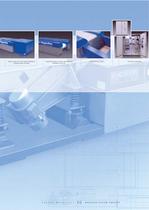
B A K K E R M A G N E T I C S [10] M O D U L A R S Y S T E M C O N C E P T STRUCTURE OF THE NON-FERROUS SEPARATION SYSTEM CONVEYOR BELT WITH INTEGRATED MAGNET ROTOR. SEPARATION UNITS SYSTEM CONTROL
Open the catalog to page 10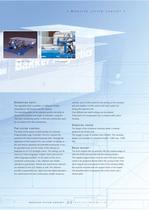
M O D U L A R S Y S T E M C O N C E P T [11] B A K K E R M A G N E T I C S [ M O D U L A R S Y S T E M C O N C E P T ] controls: one 2.2 kW control for the driving of the conveyor belt and another 7.5 kW control with brake option for driving the induction roll. Four different pre-select settings can be entered. These parts are incorporated into a compact solid system housing. VIBRATING FEEDER The design of the imbalance vibrating feeder is entirely geared to the ECSM units. The trough is made of stainless steel AISI304. The vibrating feeders are available in 2 standard lengths: 1,500 resp. 2,500...
Open the catalog to page 11
B A K K E R M A G N E T I C S [12] M A G N E T R O T O R Bakker Magnetics has at its disposal simulation software for Windows, allowing you for example, to visualise discharge curves. This software also offers the facility for making grade/recovery calculations. After consultation it can be obtained on a CD-ROM.
Open the catalog to page 12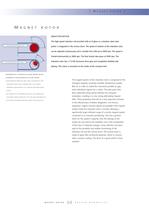
M A G N E T R O T O R [13] B A K K E R M A G N E T I C S [ M A G N E T R O T O R ] The magnet system of the induction rotor is composed of the strongest magnets currently available: Neodymium quality BM 42. In order to realise the narrowest possible air gap, each individual magnet has a radius. The pole pairs have been optimised using special software for computer simulation, resulting in a very strong alternating magnet field. These properties have led to a very important increase in the effectiveness of Bakker Magnetics’ non-ferrous separators. Higher machine speeds are possible if the magnet...
Open the catalog to page 13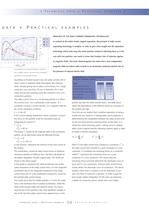
T E C H N I C A L D A T A + P R A C T I C A L E X A M P L E S [15] B A K K E R M A G N E T I C S [ T E C H N I C A L D A T A + P R A C T I C A L E X A M P L E S ] D A T A + P R A C T I C A L E X A M P L E S particle-size than the other exerted forces. The table above shows the dependency of the different forces as a function of the particle-size (dp). From this we can deduce that a selective separation of various metals and non-metals in a rotating eddy current separator is determined by the competition between the eddy current force on the one hand and the remaining forces on the other. In a...
Open the catalog to page 15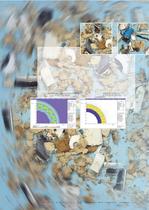
B A K K E R M A G N E T I C S [16] T E C H N I C A L D A T A + P R A C T I C A L E X A M P L E S "VISUALISATION OF MAGNETIC INDUCTION" 18-POLE ECSM-MOTOR "MAGNETIC FLUX PLOT" 18-POLE ECSM -MOTOR
Open the catalog to page 16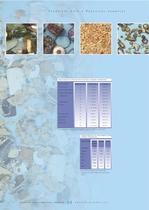
T E C H N I C A L D A T A + P R A C T I C A L E X A M P L E S [17] B A K K E R M A G N E T I C S T E C H N I C A L D A T A + P R A C T I C A L E X A M P L E S CHARACTERISTICS OF NON-FERROUS EDDY CURRENT SEPARATION Type of metal Electr. Density Ratio conductivity Aluminium 0,35 2,7 13,0 Copper 0,59 8,9 6,7 Silver 0,63 10,5 6,0 Zinc 0,17 7,1 2,4 Brass 0,14 8,5 1,7 Tin 0,09 7,3 1,2 Lead 0,05 11,3 0,4 Best results are obtained with electrical highconducting non-ferrous metals with a low specific weight. MAIN FIELDS OF APPLICATION FOR EDDY CURRENT SEPARATORS Flow of materials Magnet rotor type Particle-size...
Open the catalog to page 17All BAKKER MAGNETICS catalogs and technical brochures
 Ceiling Magnets
2 Pages
 Alnico Magnetic
2 Pages
 BM magnetic sheeting
2 Pages
 Permanent Magnet Coupling
2 Pages
 Wind Energy
2 Pages
 Plastic Bonded Neodymium
2 Pages
 Samarium-Cobalt Magnetic
2 Pages


- Liquid filter
- Solids separator
- Stainless steel pre-filter
- Centrifugal classifier
- Eddy current separator
- Cascade separator
- Separator for the recycling industry
- Basket filter
- Neodymium magnet
- Separator for the food industry
- Particle separator
- Flange pre-filter
- Separator for the chemical industry
- Metal pulley
- Filter for chemical applications
- Stainless steel separator
- Waste separator
- Self-cleaning separator
- Rectangular magnet
- Magnetic separator filter