
- Catalogs
- BAKKER MAGNETICS
- Permanent Magnet Coupling

Permanent Magnet Coupling

Permanent Magnet Coupling
Bakker Magnetics, a leader in magnetic engineering, specializes in Permanent Magnet Couplings (PMC) for power transmission applications. With over 35 years of experience, they offer innovative solutions to meet diverse customer needs, focusing on optimizing machine performance and system cost.
- Magnetic Material Selection: Expertise in selecting and validating appropriate magnetic materials from a wide range of permanent and soft magnetic materials, considering factors like cost, performance, and environmental conditions.
- Magnetic Circuit Design: Advanced tools and expertise in synthesizing, analyzing, and optimizing magnetic circuits to meet specific torque requirements.
- Magnetization Services: Safe handling and magnetization of high-energy rare earth magnets, ensuring optimal performance through proper magnetization techniques.
- Rapid Prototyping and Testing: Fast prototyping capabilities to evaluate design results, supported by skilled technicians and modern machinery.
- Assembly Expertise: Extensive experience in assembling high-energy magnets safely, using various techniques and in-house developed tools.
PMCs are categorized into four types: Synchronous, Hysteresis, Eddy Current, and Variable-Reluctance couplings. Each type has unique characteristics and applications, with Synchronous Permanent Magnet Coupling (SPMC) being the most common.
- Reliability: Enables contact-free motion transmission, reducing the risk of fluid leakage and enhancing safety.
- Durability: Designed to withstand severe conditions, offering potentially unlimited service life.
- Cost-effectiveness: Eliminates mechanical wear and tear, reducing maintenance and downtime costs.
- Radial-flux Type: Features a concentric design with radial magnetic flux paths, optimized using electromagnetic FEA software.
- Axial-flux Type: Compact disc-type design with axial flux paths, analyzed using 3D FEA for optimal performance.
Bakker Magnetics is headquartered in Eindhoven, the Netherlands, with additional offices in Belgium and France. For inquiries, contact via email or phone as provided in the document.
Catalog excerpts
Value-added Services and Solutions “Over the past 35 years, we have accumulated a large database and much know-how for magnetic coupling applications” Centre of magnetic knowledge... Summary Bakker Magnetics is in an excellent position to meet or exceed all your demands in all types of power transmission applications by exploring the applied magnetism, with abundant knowledge and expertise. Above all, we strive to achieve the best ratio of machine performance and system cost. Developing a high-performance permanent magnet coupling device is a highly demanding task today, driven not only by a rapid development and commercialization of various magnetic materials, but also by an ever-growing business competition and non-saturating market/customer needs. Bakker Magnetics is, in such demanding circumstances, able to and capable of creating more values for our customers by providing services and innovative solutions. Just to name a few: Magnetic material selection, specification and validation A booming application of magnetic materials is in full swing. However, an appropriate and cost-effective selection of magnetic materials is becoming a specialist area, due to the fact that there is a large range of both permanent and soft magnetic materials of varying types and grades. Even within each type of magnetic material, the magnetic, electrical, mechanical and thermal properties and capabilities change to a great degree. In case of modern NdFeB permanent magnets, there are more than 100 types and grades available for a device design engineer, including both sintered and bonded types. Selection and specification of the best magnetic material for a specific application is a joint effort of the cost consideration and the material performance over the device service time in a specific environment. In this circumstance, the continuous working temperature and the maximum transient temperature is a common issue that has a tremendous impact on the magnetic material. Furthermore, an appropriate range of testing and measurement methods and equipment must be chosen for the magnets specified to be validated for a targeted application. Over the past 35 years, we have accumulated a large database and much know-how for magnetic coupling applications. Magnetic circuit synthesis, analysis and optimization A desired magnetic circuit structure, for a given magnetic material, delivers a specific magnetic field profile across a defined air gap, in order to meet or exceed a torque curve requested or defined by the customer. We have a wide range of expertise and design tools, both analytically and numerically, to overcome any coupling challenge. Magnetization, stabilization and demagnetization service Permanent magnets, and in particular high energy rare earth magnets, are difficult or even dangerous to handle. It is preferred, in some cases, that the magnets are assembled in a non-magnetized state which will be magnetized after a final assembly. In this context, an appropriate magnetizer, which could be DC-electromagnetic field, pulsed field, or even permanent magnetic field-based, must be compared and selected. Quality of permanent magnet magnetization, including level of saturation, magnetization/orientation direction and its deviation, plays a key role in permanent magnet coupling performance. Rapid prototyping and testing Once the design and optimization of a specific PMC is finalized, it is common to make a prototype in order to ascertain and evaluate the design results. We are able to perform a fast prototyping made by our skilled technicians with a number of modern machine tools. Assembly know-how Great care must be taken when assembling or mounting magnetized high energy rare earth permanent magnets due to a dangerous repulsion and attraction among the magnets themselves, and between the magnets and the soft magnetic steels as a flux return path. We have considerable experience in permanent magnet gluing, screwing, anchoring and retaining by various high strength sleeves or tapes. In addition, a large number of in-house assembly tools and methods for various magnetic components and devices have been developed. < Centre of magnetic knowledge... Permanent Magnet Couplings for magnetic Bakker Magnetics b.v. energy transmission Sciencepark Eindhoven 5502 5692 EL Son - The Netherlands E-mail: [email protected] Phone: +31 40 2 678 678 Fax: +31 40 2 678 899 www.bakkermagnetics.com Belgium Bakker Magnetics Belgium N.V. E-mail: [email protected] Phone: +32 - 15 29 49 49 Fax: +32 - 15 29 49 40 France BLS Magnet E-mail: [email protected] Phone: +33 - 3 82 26 06 00 Fax: +33 - 3 82 26 06 06
Open the catalog to page 1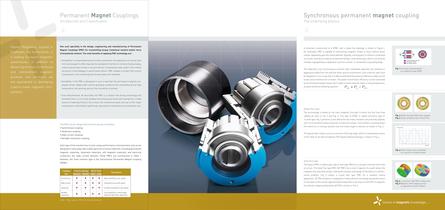
Centre of magnetic knowledge... Radial-flux type The terminology is based on the main magnetic flux path in which the flux lines flow radially as seen in Fig. 2 and Fig. 3. This type of SPMC is called concentric type or co-axial type. Fig. 2 presents a case where the two rotary members are precisely aligned, with no transmitted torque produced. A maximum torque transmitted is achieved when the maximum co-energy variation over the rotary angle is reached, as shown in Fig. 3. The typical static torque curve as a function of the slip angle, which is computed by means of the-state-of-art electromagnetic...
Open the catalog to page 2All BAKKER MAGNETICS catalogs and technical brochures
 Ceiling Magnets
2 Pages
 Alnico Magnetic
2 Pages
 BM magnetic sheeting
2 Pages
 Wind Energy
2 Pages
 Plastic Bonded Neodymium
2 Pages
 Samarium-Cobalt Magnetic
2 Pages


- Liquid filter
- Solids separator
- Stainless steel pre-filter
- Centrifugal classifier
- Eddy current separator
- Cascade separator
- Separator for the recycling industry
- Basket filter
- Neodymium magnet
- Separator for the food industry
- Particle separator
- Flange pre-filter
- Separator for the chemical industry
- Metal pulley
- Filter for chemical applications
- Stainless steel separator
- Waste separator
- Self-cleaning separator
- Rectangular magnet
- Magnetic separator filter