
- Catalogs
- Badotherm Group
- diaphragm seal introduction and basic principles

diaphragm seal introduction and basic principles
diaphragm seal introduction and basic principles
Diaphragm seals are essential in chemical processing and manufacturing for accurate pressure, level, and flow measurements. They protect instruments from process media, enhancing their lifespan and performance.
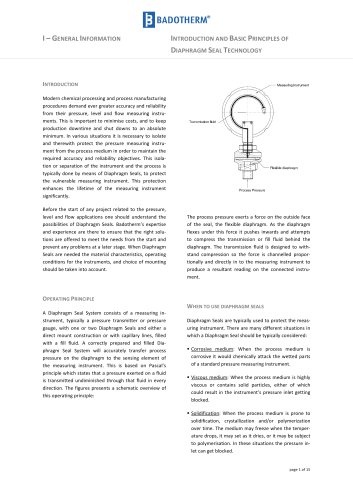
Diaphragm seal systems use Pascal's principle to transmit process pressure to a measuring instrument via a fluid-filled diaphragm.
Diaphragm seals are used with corrosive or viscous media, extreme temperatures, sanitary requirements, specific connections, and hydrogen permeation.
Factors affecting performance include temperature effects, system volume, mounting effects, zero shift, and diaphragm and fill fluid characteristics. Proper evaluation is crucial for optimal performance.
BaseCal is a web-based tool for selecting diaphragm seal systems, calculating performance based on variables like mounting style, pressure type, and temperature.
Pressure is crucial for controlling reactions, expressed in units like absolute, gauge, and differential pressure. Key pressures include maximum working, design, operating, static, and hydrostatic pressure.
Diaphragm seals for vacuum applications require careful specification to prevent fill fluid expansion. Badotherm's technology ensures reliability through degassing and welded constructions.
Diaphragm size affects the minimum pressure range. Factors like material, thickness, and shape influence flexibility. Badotherm diaphragms have a standard thickness of 75 µm.
Tables detail pressure ranges for various diaphragm sizes, adjusted according to diaphragm size, transmitter, and capillary diameter.
Temperature affects diaphragm seal systems by altering fill fluid volume and density. Techniques to minimize effects include reducing capillary volume and using insulation.
Proper mounting is crucial for accurate measurement. Instruments can be mounted in various positions relative to the diaphragm seal.
Zero point shifts due to mounting effects, influenced by gravity and installation height, impacting measurement range.
Different mounting styles for DP and GP applications have specific advantages and limitations. Proper selection is crucial to avoid damage.
For absolute pressure, mounting the instrument below the diaphragm seal is recommended to prevent damage.
Diaphragm seals offer advantages over wet legs, such as easier maintenance and reduced vulnerability to plugging or freezing.
A balanced system minimizes effects of temperature changes and static pressure fluctuations by using equal fill volumes and capillary lengths.
To minimize errors, keep capillary lengths short, use equal lengths and diameters, avoid direct sunlight, and ensure consistent temperature exposure.
The document concludes with a disclaimer regarding the accuracy of the information and the user's responsibility to determine its suitability for specific applications.
Catalog excerpts
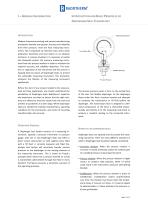
INTRODUCTION AND BASIC PRINCIPLES OF DIAPHRAGM SEAL TECHNOLOGY INTRODUCTION Modern chemical processing and process manufacturing procedures demand ever greater accuracy and reliability from their pressure, level and flow measuring instruments. This is important to minimise costs, and to keep production downtime and shut downs to an absolute minimum. In various situations it is necessary to isolate and therewith protect the pressure measuring instrument from the process medium in order to maintain the required accuracy and reliability objectives. This isolation or separation of the instrument and the process is typically done by means of Diaphragm Seals, to protect the vulnerable measuring instrument. This protection enhances the lifetime of the measuring instrument significantly. Before the start of any project related to the pressure, level and flow applications one should understand the possibilities of Diaphragm Seals. Badotherm’s expertise and experience are there to ensure that the right solutions are offered to meet the needs from the start and prevent any problems at a later stage. When Diaphragm Seals are needed the material characteristics, operating conditions for the instruments, and choice of mounting should be taken into account. The process pressure exerts a force on the outside face of the seal, the flexible diaphragm. As the diaphragm flexes under this force it pushes inwards and attempts to compress the transmission or fill fluid behind the diaphragm. The transmission fluid is designed to withstand compression so the force is channelled proportionally and directly in to the measuring instrument to produce a resultant reading on the connected instrument. OPERATING PRINCIPLE WHEN TO USE DIAPHRAGM SEALS A Diaphragm Seal System consists of a measuring instrument, typically a pressure transmitter or pressure gauge, with one or two Diaphragm Seals and either a direct mount construction or with capillary lines, filled with a fill fluid. A correctly prepared and filled Diaphragm Seal System will accurately transfer process pressure on the diaphragm to the sensing element of the measuring instrument. This is based on Pascal’s principle which states that a pressure exerted on a fluid is transmitted undiminished through that fluid in every direction. The figures presents a schematic overview of this operating principle: Diaphragm Seals are typically used to protect the measuring instrument. There are many different situations in which a Diaphragm Seal should be typically considered: Corrosive medium: When the process medium is corrosive it would chemically attack the wetted parts of a standard pressure measuring instrument. Viscous medium: When the process medium is highly viscous or contains solid particles, either of which could result in the instrument’s pressure inlet getting blocked. Solidification: When the process medium is prone to solidification, crystallization and/or polymerization over time. The medium may freeze when the temperature drops, it may set as it dries, or it may be subject to polymerisation. In these situations the pressure inlet can get blocked.
Open the catalog to page 1
High/low temperatures: When the process medium temperature is very high or very low and exceeds the temperature limits of the pressure measuring instrument resulting in damaged measurement instruments. Sanitary requirements: When the process is easily affected by the formation of bacteria on or in the process connection. The presence of bacteria in the process medium can lead to rejection of production batches. These applications where hygiene is of paramount importance are often found in the pharmaceutical, food and beverage industry. Specific process connections: When the location of the pressure...
Open the catalog to page 2
INTRODUCTION AND BASIC PRINCIPLES OF DIAPHRAGM SEAL TECHNOLOGY BASECAL BaseCal is Badotherm’s web-based Diaphragm Seal performance calculation software. BaseCal simplifies the proper selection of Diaphragm Seal transmitter combinations. Regardless the application (flow, pressure, level, etc), users can select the Diaphragm Seal System for the needs of the application. The software requests you to fill out the application parameters and will then calculate the correct calibration range. BaseCal considers the following application variables: Mounting style Differential, absolute or gauge application...
Open the catalog to page 3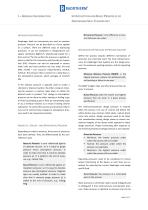
INTRODUCTION PRESSURE Diaphragm Seals on instruments are used to measure pressure. Pressure can be described as a force applied on a surface. There are different ways of expressing pressures. It can be expressed in kilogramforce per square centimetre (kgf/cm²), whereby kgf stands for a force and cm² for the surface the pressure is applied on. Same is valid for the commonly used Pounds per Square Inch (PSI). Pressure can also be expressed in various other units and most common are: bar, mbar, kPa and MPa, mmHG = Torr (vacuum measurement), mmH20, inchH2O. The pressure that is present on a daily...
Open the catalog to page 4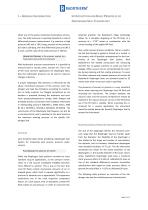
either one of the above mentioned nominations of pressure. The static pressure is especially important in case of differential pressure measurement. E.g. pressure at high pressure (HP) side is 100,1 barg; pressure at low pressure (LP) side is 100 barg, then the differential pressure (dP) is 0,1 bar, and the value of the static pressure is 100 bar. HYDROSTATIC PRESSURE: is the pressure exerted by a fluid column due to the force of gravity With hydrostatic pressure measurement it is possible to measure level in vessels, tanks, reactors etc. This is one of the most common applications for Diaphragm...
Open the catalog to page 5
I - GENERAL INFORMATION INTRODUCTION AND BASIC PRINCIPLES OF DIAPHRAGM SEAL TECHNOLOGY MINIMUM PRESSURE RANGE OR SPAN Notes: Testing variables: ■ Maximum pressure ranges are only related to the diaphragm ■ AISI 316(L) diaphragm material. sizes. The pressure range of the transmitter or pressure gauge, flange rating and the capillary diameter should be ■ Reference temperature 20°C. adjusted accordingly. ■ Capillary inside diameter 1mm. ■ Pressure gauge dimensions refer to the internal size.
Open the catalog to page 6All Badotherm Group catalogs and technical brochures
 DLD Diaphragm Leak Detection
2 Pages
 TC Temperature Compensator
2 Pages
 US FH
US FH3 Pages
 BRC
BRC3 Pages
 EXT
EXT3 Pages
 BC
BC4 Pages
 Thermowells
14 Pages











Archived catalogs
 commercial catalogue 2006/07
324 Pages
- Analog pressure gauge
- Industrial thermometer
- Stainless steel pressure gauge
- Dial pressure gauge
- Threaded pressure gauge
- Process pressure gauge
- Waterproof pressure gauge
- Bourdon tube pressure gauge
- Analog thermometer
- Liquid pressure gauge
- Differential pressure gauge
- Dial thermometer
- IP65 pressure gauge
- Bi-metal thermometer
- Diaphragm pressure gauge
- Insertion thermometer
- Pressure gauge diaphragm seal
- Explosion-proof pressure gauge