
- Catalogs
- Axel Semrau
- Determination of Mineral Oil Contamination in Foodstuff, Cosmetics and Packaging Materials with the CHRONECT Workstation MOSH/MOAH

Determination of Mineral Oil Contamination in Foodstuff, Cosmetics and Packaging Materials with the CHRONECT Workstation MOSH/MOAH

Determination of Mineral Oil Contamination in Foodstuff, Cosmetics and Packaging Materials with the CHRONECT Workstation MOSH/MOAH
Mineral oil residues, divided into MOSH (mineral oil saturated hydrocarbons) and MOAH (mineral oil aromatic hydrocarbons), are found in various products. MOSH accumulates in the human body, while MOAH may contain carcinogenic substances. Contamination pathways include recycled packaging, production accidents, and mineral oil-based lubricants. The Federal Institute for Risk Assessment (BfR) recommends minimizing these transitions into food.
Device Setup
The determination of MOSH/MOAH involves sample purification and pre-separation using normal-phase HPLC. The method aligns with DIN EN 16995:2017-08 and DGF standard method C-VI 22 (20). The system includes components like the CHRONECT LC-GC Interface, Agilent HPLC and GC systems, and software for analysis. Optional extensions are available for epoxidation and purification.
Sample Preparation
Samples require preparation before measurement. Cosmetics and oils can be injected after dilution, while complex foods and packaging need extraction. Techniques like manual saponification and hexane extraction are used for high emulsifier content foods.
Results
HPLC separation effectively isolates MOSH and MOAH fractions. The system quantifies these between C10 and C50, indicating the nature of mineral oils. Figures illustrate chromatograms showing successful separation and quantification.
Validation Techniques
For uncertain MOSH/MOAH presence, additional validation like GCxGC-MS is used. The Fract & Collect option allows for further analysis. In cosmetics, MOSH depletion is necessary to avoid false MOAH detection.
Summary
The coupling of HPLC and GC-FID provides reliable quantification of mineral oil residues. Additional purification techniques enhance quantification reliability. The system achieves determination limits of 10 mg/kg, with potential for lower limits using enrichment techniques.
Literature
References include studies and standards related to mineral oil hydrocarbons in food and packaging.
Catalog excerpts
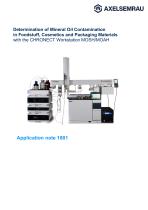
Determination of Mineral Oil Contamination in Foodstuff, Cosmetics and Packaging Materials with the CHRONECT Workstation MOSH/MOAH
Open the catalog to page 1
Determination of MOSH/MOAH Application note 1801 Introduction and pre-purified with aluminum oxide depending on their origin and type [2]. Undesirable mineral oil residues are found in numerous products. These substances can be divided into two classes: Saturated (MOSH mineral oil saturated hydrocarbons) and aromatic hydrocarbons (MOAH - mineral oil aromatic hydrocarbons). While the first substance class accumulates in the human body, the second compound class is suspected of containing carcinogenic substances. Substance classes such as POSH (polyolefin oligomeric saturated hydrocarbons) or PAO...
Open the catalog to page 2
Determination of MOSH/MOAH Application note 1801 Optional extension for aluminum oxide purification: additional Agilent Infinity II 1260 HPLC pump HPLC valve Aluminum oxide HPLC column Optional extension for MOSH depletion in cosmetics: HPLC valve Depletion HPLC column Optional extension for fraction collection: Fract & Collect collection tool Alternatively, the Nexera LC-40B XR and the Nexis GC-2030 from Shimadzu can be used. We reserve the right to make changes in the device configuration. Sample preparation All samples must be prepared before the actual measurement. Depending on the sample...
Open the catalog to page 3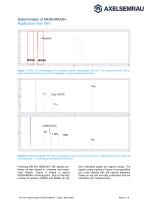
Determination of MOSH/MOAH Application note 1801 [AU] 1.0 Figure 1: HPLC-UV chromatogram of a standard injection (wavelength: 230 nm). The marked fractions (450 µL each) are transferred to the gas chromatograph in large volumes without loss. [mV] Cycy (ISTD) Figure 2: MOSH and MOAH GC-FID chromatograms of the injection from Figure 1. Both fractions were measured simultaneously. C11 and 5B are quantitatively recovered. Following DIN EN 16995:2017-08, spiked sunflower oil was diluted in n-hexane and measured directly. Figure 3 shows a typical MOSH/MOAH chromatogram. Due to the high number of isomers,...
Open the catalog to page 4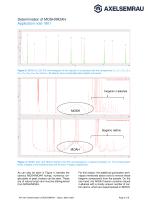
Determination of MOSH/MOAH Application note 1801 Figure 3: MOSH LC-GC-FID chromatogram of the injection of a standard with the components C 10, C11, C13, C16, C20, C24, C25, C35, C40 and C50. All alkanes have comparable peak heights and areas. [mV] C:\Clarity\LC-GC_GC\Data\MKW\20150810\2B_MOSH - FID biogenic n-alkanes biogenic olefins Voltage Figure 4: MOSH (top) and MOAH (bottom) GC-FID chromatograms of spiked sunflower oil. The contamination levels (integral of the marked areas) are 40 and 14 mg/kg, respectively. As can also be seen in Figure 4, besides the obvious MOSH/MOAH humps, numerous...
Open the catalog to page 5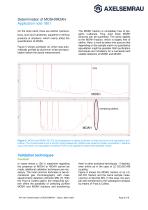
Determination of MOSH/MOAH Application note 1801 On the other hand, there are olefinic hydrocarbons, such as β-carotenes, squalene or refining products of sitosterol, which mainly affect the quantification of MOAH. The MOSH fraction is completely free of biogenic n-alkanes. Thus, even lower MOSH amounts can be quantified. The same applies to the MOAH fraction, which is largely free of olefins. Here, it must be taken into account that depending on the sample matrix no quantitative epoxidation might be possible. Both purification techniques are mandatory for a successful and reliable detection...
Open the catalog to page 6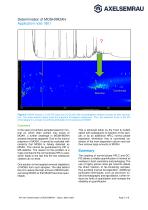
Determination of MOSH/MOAH Application note 1801 Carotinoids Sterenes Figure 6: MOAH fraction: LC-GC-FID (top) and LC-GCxGC-MS chromatograms (bottom) of palm oil after epoxidation. The mass spectra clearly show the presence of biogenic substances. Thus, the observed hump in the FID chromatogram is at least not entirely attributable to the presence of MOAH. Cosmetics In the case of cosmetic samples based on mineral oil, which often contain only traces of MOAH, a further challenge in MOSH/MOAH analysis becomes apparent. Due to the natural presence of MOSH, it cannot be excluded with certainty that...
Open the catalog to page 7
Determination of MOSH/MOAH Application note 1801 The direct coupling to other analytical techniques, such as GCxGC or NMR, further increases the reliability of quantification. The determination limits of 10 mg/kg specified in DIN EN 16995:2017-08 can be safely achieved with this system. With additional enrichment techniques, as described in the DGF standard method C-VI 22 (20), named by the BfR and other authors, even lower limits below 1 mg/kg can be achieved [2, 4, 8-10]. European Food Safety Authority, Scientific opinion on mineral oil hydrocarbons in food, EFSA J. 10(6) (2012) 2704. Messung...
Open the catalog to page 8All Axel Semrau catalogs and technical brochures
 CHRONECT Quantos
3 Pages
 CHRONECT Workstation MCPD
5 Pages
- Measuring device
- Automation software solution
- Liquids analyzer
- Measuring machine
- Automatic analyser
- Control software
- Filter cartridge
- Industrial filter cartridge
- Automatic dispensing system
- Plastic filter cartridge
- General purpose filter cartridge
- Automatic measurement system
- Analyzer for the food industry
- Solid dosing unit
- Laboratory chromatograph
- Chemical product filter cartridge
- Pumping system
- Industrial workstation
- Industrial pump unit