- Catalogs
- Avari Wireless
- Avari® VL™ Series INTRO TO PUBLIC SAFETY IN- BUILDING COMMUNICATION


Avari® VL™ Series INTRO TO PUBLIC SAFETY IN- BUILDING COMMUNICATION
Avari® VL™ Series INTRO TO PUBLIC SAFETY IN- BUILDING COMMUNICATION
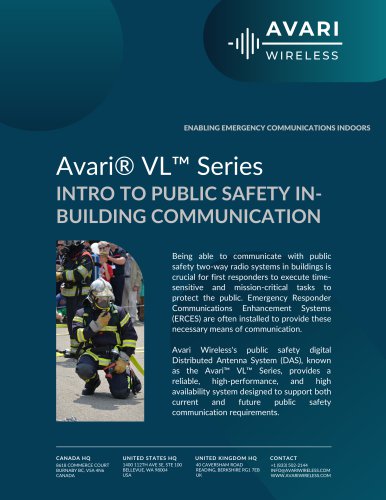
Effective in-building communication is essential for first responders during emergencies. The Avari VL Series by Avari Wireless provides a digital Distributed Antenna System (DAS) to improve public safety communications indoors, overcoming challenges from modern building materials and higher frequency bands.
Current Requirements for In-Building Coverage Systems
These systems must ensure reliable radio coverage, especially in critical areas, and comply with local fire codes and standards such as NFPA and IFC. They should guarantee service availability and redundancy to prevent communication failures during emergencies.
Future Requirements for In-Building Coverage Systems
With the evolution of public safety communications, there is a shift towards broadband LTE technology, which will coexist with current narrowband systems. Systems must support both current and future technologies to ensure interoperability and efficient communication.
Options for Public Safety In-Building Coverage Systems
Options include Off-Air Bi-Directional Amplifiers (BDA) and Distributed Antenna Systems (DAS). BDAs amplify signals from external antennas, while DAS distributes signals within buildings. Active DAS, using fiber optics, is preferred for larger venues due to its efficiency over passive DAS.
Avari's State-Of-The-Art Approach to Digital DAS
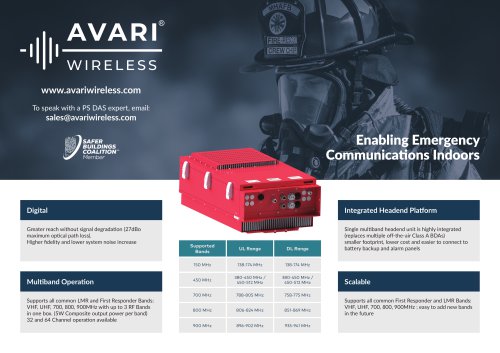
Avari Wireless offers a digital DAS solution supporting both current and future public safety requirements. It uses a two-tier or three-tier architecture to distribute signals digitally over fiber, reducing deployment costs and enhancing capabilities. Digital filtering is employed to minimize interference and optimize signal quality.
Overview
Avari Wireless provides a digital DAS designed for public safety communications, supporting both current and future requirements to ensure reliable communication for first responders in critical situations.
Key Features
- Long Distance Signal Transmission: Capable of carrying optical signals up to 40 km without degradation, suitable for wide-area networks like railway stations and large campuses.
- Flexible Topology: Supports multiple network configurations (star, daisy-chain, hybrid) to reduce costs and enhance redundancy.
- IP Backhaul: Provides a 1Gbps Ethernet tunnel for applications like alarms and security cameras, with Power over Ethernet (POE) support.
- Automatic Optical Delay Compensation: Automatically synchronizes transmission delays across fibers, saving time and minimizing interference.
- Support for LTE and FirstNet: Compatible with current and future technologies, allowing easy upgrades and expansions.
- System Redundancy and Self-Healing: Features hot-standby components and automatic failure detection to ensure uninterrupted communication.
- Data Scrambling & Encryption: Enhances security by scrambling data over fiber links in addition to existing encryption methods.
Conclusion
The Avari VL™ Series DAS is a next-generation solution supporting both narrowband and broadband communications, providing a seamless migration path to LTE and FirstNet. It offers a flexible, future-proof infrastructure for public safety operators and system integrators.
References
Includes links to FirstNet, Emergency Services Network (ESN), and other relevant resources.
Catalog excerpts
ENABLING EMERGENCY COMMUNICATIONS INDOORS Being able to communicate with public safety two-way radio systems in buildings is crucial for first responders to execute time-sensitive and mission-critical tasks to protect the public. Emergency Responder Communications Enhancement Systems (ERCES) are often installed to provide these necessary means of communication. Avari Wireless's public safety digital Distributed Antenna System (DAS), known as the Avari™ VL™ Series, provides a reliable, high-performance, and high availability system designed to support both current and future public safety communication requirements. 8618 COMMERCE COURT BURNABY BC, V5A 4N6 CANADA 40 CAVERSHAM ROAD READING, BERKSHIRE RG1 7EB UK
Open the catalog to page 1
Introduction Reliable public safety in-building radio communications are vital in today’s emergency services operation, from dispatch to mission-critical situations, and from voice-only capabilities to voice and data. Public safety communications have evolved from fire call boxes and trunked radio systems including analog and digital mobile radios. This evolution was mainly driven by technological advancements and the need for higher reliability. Traditionally, public safety uses lower frequency bands such as 150 MHz and 450 MHz. As the public safety network operations move to higher spectrum...
Open the catalog to page 2
Current Requirements for Public Safety In-Building Coverage Systems The purpose of an in-building public safety system is to provide enhanced coverage when the existing macro network is not able to adequately provide the required radio signals. In-building public safety coverage is required by first responders to properly use their communication systems in order to do their job and execute mission-critical tasks in the midst of an emergency. Radio coverage is required at all times and also in areas such as stairwells and backrooms, which are not commonly the prime coverage areas in commercial...
Open the catalog to page 3
Future Requirements for Public Safety In-Building Coverage Systems Public safety requirements are evolving with improved methods in which emergency personnel communicate. Being able to transmit high-resolution imagery or real-time video footage can bring improvements in efficiencies and response time to further enhance methods to protect the public, and just as importantly, provide additional safety for first responders. For instance, those in dispatch centers who receive the real-time multimedia footage from front-line personnel can now have more insight into what necessary steps should be taken...
Open the catalog to page 4
different responder radio systems and providing more efficient communications and operational response for mission-critical emergency service providers. Internationally, as regional standards institutes like ETSI work on enhancing the narrowband TETRA standard, and global bodies like 3GPP continue their important broadband development work, coordination of interface standards and interoperability across borders becomes even more essential.
Open the catalog to page 5
Public safety in-building coverage systems are used in situations where the signal outside the building may be optimal, but the signal inside the building is weak due to the attenuation of the building. In this section, we will review the options for enhancing public safety in-building coverage. The solution chosen to be deployed will vary between applications and will depend on: • System reliability and redundancy requirements • Number of required public safety frequency bands, responder agencies and channels • Required technologies: P25 Phase I & II, Tetrapol, TETRA, LTE, DMR • Current and...
Open the catalog to page 6
be easily affected by interfering signals that are either close to or within the passband bandwidth of the duplexer in the BDAs. More recently, due to both technical and legal considerations, channelized BDAs are deployed. With channelization, only the desired signals will be retransmitted. The unwanted signal interference, even in-band, can be eliminated with digital filtering, which can also protect the donor sites from the unwanted uplink signal transmission. Even though channelized BDAs offer superior RF performance and noise mitigation, both kinds of products may work well in isolated single...
Open the catalog to page 7
Distributed Antenna Systems (DAS) A Distributed Antenna System (DAS) receives RF signals from the base station or off-air BDA and distributes the RF signals to antennas over either coaxial cable (Passive DAS) or fiber (Active DAS). With passive DAS, coaxial cable and other passive components, splitters and couplers are used. Usually, a central headend BDA drives the passive DAS elements or leaky feeder cable. With passive components, the RF signal degrades with every device in the transmission chain. The antennas might have varying output power depending on the distance from the BDA. Cable losses...
Open the catalog to page 8
Typically, with a DAS, adjustments such as power level and optical delay compensation are difficult to make. The power levels at the antenna are based on the cable or fiber losses (distances between the head-end and remotes), and the splitting ratio of the installed splitters and couplers. Therefore, changing the power at one antenna will impact the other antennas. For example, in analog RF over fiber DAS, optical delay compensation is done by either using the same length of fiber to all remotes or manually calculating the delay and adding delay elements to synchronize transmission from the headend....
Open the catalog to page 9
Avari's State-Of-The-Art Approach to Digital DAS To satisfy current public safety requirements, while being able to seamlessly migrate to future network requirements, Avari Wireless has developed a state-of-the-art solution for providing in-building public safety coverage. Avari’s public safety digital DAS supports a two-tier architecture consisting of the host (headend) and remotes. For large and complex building structures, Avari's digital DAS also supports a three-tier architecture with a distribution layer between the headend and remotes. RF signals from off-air macro towers or base stations...
Open the catalog to page 10All Avari Wireless catalogs and technical brochures
 Solutions UTILITIES
1 Page
 Solutions TUNNELS
1 Page
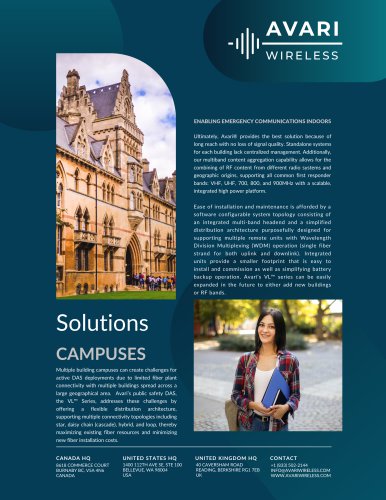 Solutions CAMPUSES
1 Page
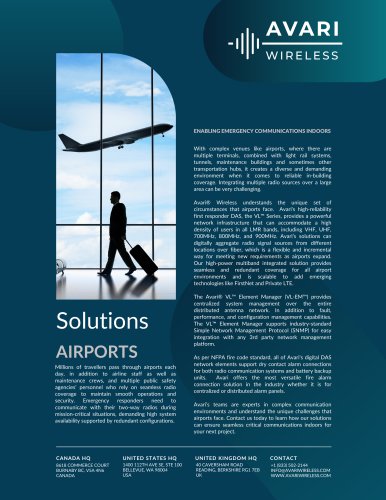 Solutions AIRPORTS
1 Page
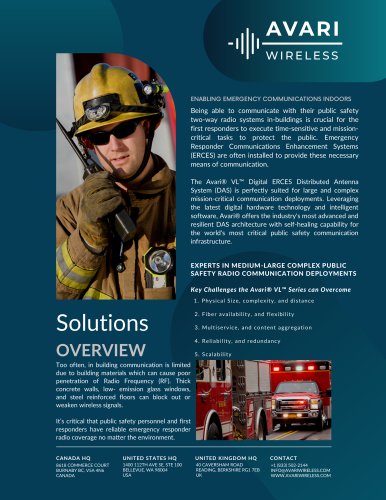 Solutions Overview
2 Pages
 Avari VL™ Series
12 Pages
 Key Deployment References
7 Pages