


Varius-Spectrometer-digital

1 / 8 PagesView full catalog
Varius-Spectrometer-digital
Product catalog summary
Optical Bench: The document describes a symmetrical Czerny-Turner design with a 75 mm focal length, known as the VRS bench, covering a wavelength range of 190 - 1100 nm.
Stray Light: The stray light is specified between 0.1 - 1%, with a typical value of less than 0.3% for a 300 l/mm grating with a blaze at 300 nm.
Detector: Two types of CMOS linear arrays are mentioned: the HAM S11639 with 2048 pixels (14x200 µm) and the HAM S13496 with 4096 pixels (7x200 µm).
Signal/Noise Ratio: The signal-to-noise ratio is 375:1 for the Varius 2K and 365:1 for the Varius 4K.
Dynamic Range and Dark Noise: The dynamic range is 4500, and the dark noise is 15 counts.
AD Converter: A 16-bit, 6 MHz AD converter is used.
Integration Time: The integration time ranges from 9 µs to 30 seconds.
Interface: The device supports USB 3.0 high speed (5Gbps) and Gigabit Ethernet (1 Gbps).
Sample and Data Transfer Speed: On-board averaging sample speed is 0.38 ms/scan for Varius 2K and 0.70 ms/scan for Varius 4K. Data transfer speed is 0.38 ms/scan via USB3.0 and 1.0 ms via Ethernet for Varius 2K, and 0.70 ms/scan via USB3.0 and 1.31 ms via Ethernet for Varius 4K.
Digital I/O: Features include an HD-26 connector with 2 analog inputs, 2 analog outputs, 13 digital bidirectional ports, trigger, sync, strobe, and laser capabilities.
Dimensions and Weight: The device measures 183 x 130 x 45.2 mm and weighs 1068 grams. Note that dimensions for the Varius OEM variant differ.
Power Supply: The default power supply is USB3 power at 500 mA or 12 VDC at 300 mA.
Temperature Range: The operational temperature range is 5-55 °C.
See more
Catalog excerpts
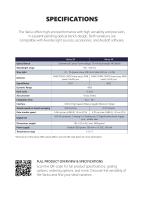
Varius 2K Optical Bench Symmetrical Czerny-Turner design, 75 mm focal length; VRS bench 190 - 1100 nm Wavelength range Stray light Detector Signal/Noise 0.1 - 1% (typical value 300 l/mm, blaze 300 nm < 0.3%) HAM S11639, CMOS linear array, 2048 pixels (14x200 µm) HAM S13496, CMOS linear array, 4096 pixels (7x200 µm) Dynamic Range Dark noise Integration time Interface USB 3.0 high speed (5Gbps), Gigabit Ethernet (1 Gbps) Sample speed on-board averaging Data transfer speed HD-26 connector, 2 Analog in, 2 Analog out, 13 Digital bidirectional, trigger, sync., strobe, laser Dimensions, weight Power...
Open the catalog to page 6All Avantes catalogs and technical brochures
 Avantes Product Catalog
53 Pages
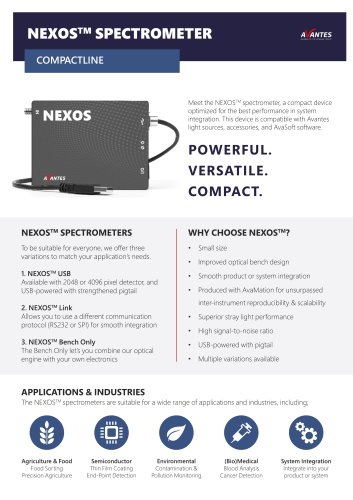 Datasheet AvaSpec-NEXOS
2 Pages
 Datasheet-Varius-OEM-
2 Pages

Related Searches
- Data connector
- Rectangular housing
- Ethernet switch
- Automation software solution
- Industrial network switch
- Analysis software solution
- Real-time software
- Windows software
- Control software
- Avantes spectrometer
- Metal box
- Monitoring software solution
- 3D software solution
- Industrial software
- Measurement software
- Interface software
- Straight connector
- PVC-sheathed cable
- Visualization software solution
*Prices are pre-tax. They exclude delivery charges and customs duties and do not include additional charges for installation or activation options. Prices are indicative only and may vary by country, with changes to the cost of raw materials and exchange rates.
About DirectIndustry
DirectIndustry is a marketplace that offers B2B players a complete experience, from product sourcing to purchase. DirectIndustry is an entity of VirtualExpo Group.
Are you a buyer?
Are you a supplier?