
- Catalogs
- Avago Technologies
- ASMB-UTF0-0D20B

ASMB-UTF0-0D20B

ASMB-UTF0-0D20B
The Broadcom ASMB-UTF0 series consists of tricolor LEDs in a compact PLCC-6 package, measuring 2.8 x 2.8 mm, optimized for small pitch displays. The black outer appearance enhances display contrast, and the LEDs are supplied in tape and reel format for easy assembly, ensuring uniformity with single intensity and color bin per reel.
- PLCC-6 package with black outer appearance
- Short leads for improved potting process
- Diffused encapsulation
- Compatible with reflow soldering process
- Moisture Sensitivity Level (MSL) 5a
- Outdoor full color display
Absolute Maximum Ratings
- DC Forward Current: Red 30 mA, Green 25 mA, Blue 25 mA
- Peak Forward Current: 100 mA for all colors
- Power Dissipation: Red 72 mW, Green 95 mW, Blue 90 mW
- Operating Temperature Range: -40 to +85 °C
- Storage Temperature Range: -40 to +100 °C
Optical Characteristics
- Luminous Intensity (mcd): Red 500-845, Green 1100-1855, Blue 280-465
- Dominant Wavelength (nm): Red 618-628, Green 519-529, Blue 464-474
- Viewing Angle: 110° for all colors
Electrical Characteristics
- Forward Voltage (V): Red 1.80-2.40, Green 2.60-3.80, Blue 2.60-3.60
- Thermal Resistance (°C/W): Red 314, Green 360, Blue 555
- ESD sensitive: Handle with care
- Reflow soldering recommended, do not exceed two cycles
- Moisture-sensitive: Follow JEDEC J-STD-020 guidelines
- Store in sealed moisture barrier bags with desiccant
- Do not exceed maximum drive current
- Ensure consistent performance with constant current driving
- Avoid reverse bias
- Protect from environmental factors in harsh conditions
- Maintain junction temperature below allowable limits
- Use provided formulas to calculate junction temperature
- Avoid direct eye exposure to operating LEDs
- Use appropriate shielding or protective equipment
Broadcom products are not designed for use in nuclear facilities or medical devices. Customers assume all risks associated with such use.
Catalog excerpts
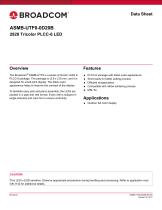
Data Sheet Overview The Broadcom® ASMB-UTF0 is a series of tricolor LEDs in PLCC-6 package. The package is (2.8 x 2.8) mm, and it is designed for small pitch display. The black outer appearance helps to improve the contrast of the display. To facilitate easy pick-and-place assembly, the LEDs are packed in a tape and reel format. Every reel is shipped in single intensity and color bin to ensure uniformity. Features ■ PLCC-6 package with black outer appearance ■ Short leads for better potting process ■ Diffused encapsulation ■ Compatible with reflow soldering process ■ MSL 5a Applications ■ Outdoor full color display CAUTION! This LED is ESD sensitive. Observe appropriate precautions during handling and processing. Refer to application note AN-1142 for additional details.
Open the catalog to page 1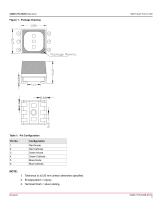
ASMB-UTF0-0D20B Data Sheet 2828 Tricolor PLCC-6 LED Figure 1: Package Drawing ASMB-UTF0-0D20B Data Sheet 2828 Tricolor PLCC-6 LED 1. Tolerance is ±0.20 mm unless otherwise specified. 3. Terminal finish = silver plating.
Open the catalog to page 2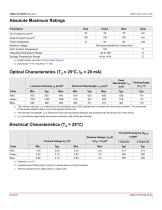
ASMB-UTF0-0D20B Data Sheet 2828 Tricolor PLCC-6 LED a. Tolerance =± 0.1V. b. Indicates product final testing. Long term reverse bias is not recommended. c. Thermal resistance from LED junction to solder point.
Open the catalog to page 3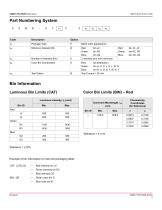
ASMB-UTF0-0D20B Data Sheet 2828 Tricolor PLCC-6 LED Tolerance = ±1 nm Tolerance = ±12% Example of bin information on reel and packaging label: CAT: J2 R2 G2 — Red intensity bin J2 — Green intensity bin R2 — Blue intensity G2 BIN: GB — Green color bin G
Open the catalog to page 4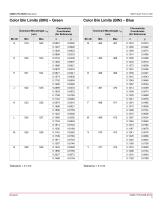
ASMB-UTF0-0D20B Data Sheet 2828 Tricolor PLCC-6 LED Tolerance = ±1 nm Tolerance = ±1 nm Broadcom
Open the catalog to page 5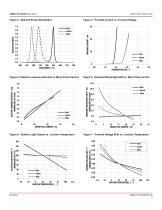
Figure 3: Forward Current vs. Forward Voltage RELATIVE INTENSITY Figure 2: Spectral Power Distribution Figure 4: Relative Luminous Intensity vs. Mono Pulse Current 10 20 30 MONO PULSE CURRENT- mA Figure 6: Relative Light Output vs. Junction Temperature 10 15 20 25 MONO PULSE CURRENT - mA FORWARD VOLTAGE SHIFT - V (NORMALIZED AT 25°C) Figure 7: Forward Voltage Shift vs. Junction Temperature 160 RELATIVE LIGHT OUTPUT - % (NORMALIZED AT 25°C) Figure 5: Dominant Wavelength Shift vs. Mono Pulse Current DOMINANT WAVELENGTH SHIFT - nm (NORMALIZED AT 20mA) 1.8 RELATIVE LUMINOUS INTENSITY - mcd (NORMALIZED...
Open the catalog to page 6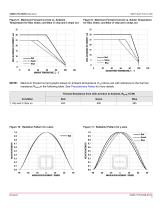
Figure 8: Maximum Forward Current vs. Ambient Temperature for Red, Green, and Blue (1 chip and 3 chips on) Figure 9: Maximum Forward Current vs. Solder Temperature for Red, Green, and Blue (1 chip and 3 chips on) 40 60 80 SOLDER POINT TEMPERATURE, Ts - °C Maximum forward current graphs based on ambient temperature (TA) above are with reference to the thermal resistance RθJ-A in the following table. See Precautionary Notes for more details. Thermal Resistance from LED Junction to Ambient, RθJ-A (°C/W) Condition Figure 10: Radiation Pattern for x-Axis Figure 11: Radiation Pattern for y-Axis -30...
Open the catalog to page 7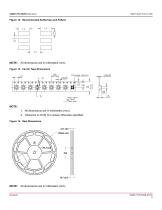
ASMB-UTF0-0D20B Data Sheet 2828 Tricolor PLCC-6 LED Figure 12: Recommended Soldering Land Pattern ASMB-UTF0-0D20B Data Sheet 2828 Tricolor PLCC-6 LED H 1-3 I— NOTE: All dimensions are in millimeters (mm). Figure 13: Carrier Tape Dimensions NOTE: 1. All dimensions are in millimeters (mm). 2. Tolerance is ±0.20 mm unless otherwise specified.
Open the catalog to page 8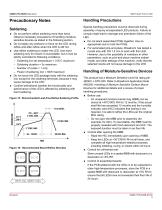
Precautionary Notes Handling Precautions Do not perform reflow soldering more than twice. Observe necessary precautions of handling moisturesensitive devices as stated in the following section. Do not apply any pressure or force on the LED during reflow and after reflow when the LED is still hot. Use reflow soldering to solder the LED. Use hand soldering only for rework if unavoidable, but it must be strictly controlled to following conditions: – Soldering iron tip temperature = 315°C maximum – Soldering duration = 3s maximum – Number of cycles = 1 only – Power of soldering iron = 50W maximum...
Open the catalog to page 9
ASMB-UTF0-0D20B Data Sheet 2828 Tricolor PLCC-6 LED ■ Baking is required if: - The HIC indicator indicates a change in color for 10% and 5%, as stated on the HIC. - The LEDs are exposed to conditions of >30°C/60% RH at any time. - The LED's floor life exceeded 24 hours. The recommended baking condition is: 65°C ± 5°C for 24 hours. Baking can only be done once. ■ Storage: The soldering terminals of these Broadcom LEDs are silver plated. If the LEDs are exposed in ambient environments for too long, the silver plating might be oxidized, thus affecting its solderability performance. As such, keep...
Open the catalog to page 10
Eye Safety Precautions LEDs may pose optical hazards when in operation. Do not look directly at operating LEDs because it might be harmful to the eyes. For safety reasons, use appropriate shielding or personal protective equipment.
Open the catalog to page 11
Disclaimer Broadcom's products and software are not specifically designed, manufactured, or authorized for sale as parts, components, or assemblies for the planning, construction, maintenance, or direct operation of a nuclear facility or for use in medical devices or applications. The customer is solely responsible, and waives all rights to make claims against Broadcom or its suppliers, for all loss, damage, expense, or liability in connection with such use. Broadcom, the pulse logo, Connecting everything, Avago Technologies, Avago, and the A logo are among the trademarks of Broadcom and/or its...
Open the catalog to page 12All Avago Technologies catalogs and technical brochures
 AFCD-V84LP
1 Page
 BCM4778
2 Pages
 AFBR-57H5MZ
29 Pages
 ASMT-YTD7-0AA02
15 Pages
 ASMT-YTC7-0AA02
15 Pages
 ASMT-RF45-AN002
8 Pages
 Optical Sensor
64 Pages


Archived catalogs
 WLAN Low-Noise Amplifier
10 Pages
 Optoisolation Products
58 Pages
 125 Megabaud Versatile Link
12 Pages
 LED Solutions
96 Pages


- Angular encoder
- Incremental encoder
- Incremental rotary encoder
- Switching relay
- Absolute rotary encoder
- Signal amplifying integrated circuit
- Optical rotary encoder
- Electronic display panel
- Transceiver module
- Magnetic rotary encoder
- Electronic filter
- Power amplifying integrated circuit
- Visible LED
- Diode
- Transistor module
- Solid state relay
- GNSS receiver
- Ethernet transceiver
- Rectifier diode