


- Products
- Catalogs
- News & Trends
- Exhibitions
DWG-Based Revit Architecture to Autodesk 3ds Max 9 Workflow

DWG-Based Revit Architecture to Autodesk 3ds Max 9 Workflow
This document is a white paper designed for professionals such as architects, designers, engineers, and visualization specialists. It focuses on transferring data from Revit Architecture to Autodesk 3ds Max for visualization, detailing the workflow for moving 3D scene meshes, material assignments, and layer control options.
The document stresses the importance of preparing data in Revit Architecture before transferring it to 3ds Max to minimize errors. It discusses workflows involving 3D elements, 2D symbols, and AutoCAD integration.
Revit Architecture is highlighted as a BIM tool ensuring coordinated designs. The document explains the need for a 3D view in Revit for exporting to a 3D DWG file and discusses layer management differences between Revit and 3ds Max.
A step-by-step guide is provided for controlling layer standards and settings in Revit Architecture for DWG export, including assigning AutoCAD layers and creating custom export standards.
Layer assignments are based on the AIA standard, but users can customize and save their own standards for project consistency.
Instructions for exporting files with chosen layer standards and settings are provided, with recommendations on DWG file types for optimal data transfer to 3ds Max.
The document discusses exporting as polymesh or ACIS solid, with ACIS solid offering better geometry construction. It addresses common issues like coplanar faces and rendering artifacts.
Details on how Revit model categories are assigned layers in AutoCAD DWG files and how object styles affect these assignments are provided, along with options for handling overrides during export.
Best practices for using Revit Architecture and 3ds Max include tips for performance improvement, material management, and addressing data transfer challenges.
Objects unchanged are exported to a predefined layer, while overridden objects get unique layers, which can increase DWG file layers. 'No Overrides' is suggested unless necessary.
Users can choose automatic or manual file naming, with identifiers like 'Revit2Max' for organization. Saving layers to DWG format is advised.
To enhance performance and reduce file size, limit exported information, use section boxes to crop models, adjust detail levels, and turn off non-essential object visibility.
Two methods are available: import and file link. File link maintains a connection for updates, recommended for projects with revisions, while import suits finalized projects.
Key options include geometry settings like Weld, Auto-Smooth, and Smooth-Angle, affecting object translation from Revit to 3ds Max.
These settings control object organization in 3ds Max, with options based on layer, entity, or color, depending on DWG file version and desired outcome.
When using file link, users can replace DWG materials with 3ds Max materials of the same name, requiring exact name matching.
Procedural textures are lost when importing from Revit to 3ds Max, while bitmap textures are retained. Sending bitmap maps with the DWG file is recommended for consistency.
Users can customize presets by selecting options like 'Derive Primitive By' and 'Use Scene Material Definitions'.
To link a DWG file, navigate to the Attach tab, select the file, and choose the correct preset. Avoid rescaling unless necessary.
Using the Layer Manager and Material Editor, users can explore and organize the scene, correct misplaced objects, and adjust materials.
Most design work should be done in Revit Architecture. Changes in Revit update in 3ds Max upon re-import, but not vice versa.
Decals, RPC objects, and lighting effects need adjustments in 3ds Max as they do not fully import from Revit.
Issues like missing materials and incorrect geometry appearance are common. Solutions include reassigning materials and adjusting viewport settings.
When importing models, issues like mesh collapse and missing textures can occur. Solutions include using Edit Poly and Edit Mesh modifiers.
Revit's polymesh geometry often splits into many objects upon import. Use the Layer toolbar or Layer Manager for selection, or link multiple DWG files using 'One Object' setting.
To prevent loss of material definitions on reload, select 'Use Scene Material Assignments on Reload' and 'Use Scene Material Definitions' before linking files.
Typical behaviors when exporting polymeshes include walls becoming multiple objects. Solutions include deleting duplicates and applying modifiers for UVW mapping control.
Enhancements include handling large scenes, interactive rendering workflows, and improved interoperability with Revit Architecture.
Catalog excerpts

Il iLlLlillklCUri .= ■:■:r rinMrlOi 7['jB.-vl 3: V\bwt 3: \ \ i, rjithj iiimJii. CIBL ut. sun u
Open the catalog to page 1
DWG-BASED REVIT ARCHITECTURE TO AUTODESK 3DS MAX 9 WORKFLOW
Open the catalog to page 2
DWG-BASED REVIT ARCHITECTURE TO AUTODESK 3DS MAX 9 WORKFLOW
Open the catalog to page 3
DWG-BASED REVIT ARCHITECTURE TO AUTODESK 3DS MAX 9 WORKFLOW Overview This white paper is for architects, designers, engineers, and visualization specialists who need to move data from Revit® Architecture software into Autodesk® 3ds Max® software for visualization. Revit Architecture has quickly become an industry leader for creating building information models, and 3ds Max software has been a leading application for architectural visualization for more than a decade. As architectural firms move from traditional 2D-based computer-aided design (CAD) drafting workflows to creating building information...
Open the catalog to page 4
DWG-BASED REVIT ARCHITECTURE TO AUTODESK 3DS MAX 9 WORKFLOW Foundation Revit Architecture is a design tool that brings intelligence to the 2D and 3D objects in a scene. Because it is purpose-built for building information modeling (BIM), any change you make—anytime, anywhere—is automatically coordinated throughout your project. Designs and documentation stay coordinated, consistent, and complete. This alone makes it easy for users to work as much as possible within a building information model.. Once a building has been modeled in Revit Architecture, it is important to establish a 3D view. The...
Open the catalog to page 5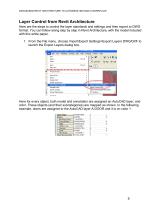
DWG-BASED REVIT ARCHITECTURE TO AUTODESK 3DS MAX 9 WORKFLOW Layer Control from Revit Architecture Here are the steps to control the layer standards and settings and then export to DWG format. You can follow along step by step in Revit Architecture, with the model included with this white paper. 1. From the File menu, choose Import/Export Settings>Export Layers DWG/DXF to launch the Export Layers dialog box. Here for every object, both model and annotation are assigned an AutoCAD layer, and color. These objects (and their subcategories) are mapped as shown. In the following example, doors are...
Open the catalog to page 6
Export Layers Standard 0 AIA - American Institute of Architects standard Layer name Layer name File name: Save as type: Export Layer Files Ceiling Tags
Open the catalog to page 7
DWG-BASED REVIT ARCHITECTURE TO AUTODESK 3DS MAX 9 WORKFLOW . This creates a text (.txt) file that can be reused to map the same settings later. If you have several users creating design visualizations, it is recommended that you save this text file to a central location, such as a common server, so everyone can have access to the export standards. Exporting Layers 3. To export the file after choosing the layer standard and settings, from the File menu, choose Export>CAD Formats. 4. In the Save as Type field, click the drop-down arrow, and choose the type of DWG file (2007, 2004, or 2000) you...
Open the catalog to page 8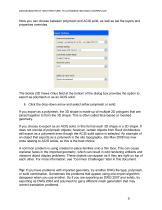
DWG-BASED REVIT ARCHITECTURE TO AUTODESK 3DS MAX 9 WORKFLOW Here you can choose between polymesh and ACIS solid, as well as set the layers and properties overrides. The Solids (3D Views Only) field at the bottom of the dialog box provides the option to export as polymesh or as an ACIS solid. 6. Click the drop-down arrow and select either polymesh or solid. If you export as a polymesh, the 3D shape is made up of multiple 2D polygons that are joined together to form the 3D shape. This is often called face-based or meshed geometry. If you choose to export as an ACIS solid, in this format each 3D...
Open the catalog to page 9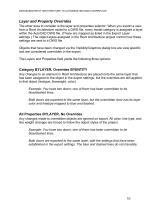
DWG-BASED REVIT ARCHITECTURE TO AUTODESK 3DS MAX 9 WORKFLOW Layer and Property Overrides The other area to consider is the layer and properties selector. When you export a view from a Revit Architecture model to a DWG file, every model category is assigned a layer within the AutoCAD DWG file. (These are mapped as listed in the Export Layer settings.) The object styles assigned in the Revit Architecture project control how these settings are sent to a DWG file. Objects that have been changed via the Visibility/Graphics dialog box are view specific and are considered overridden in the export. The...
Open the catalog to page 10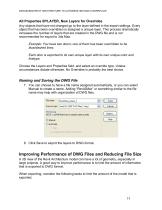
DWG-BASED REVIT ARCHITECTURE TO AUTODESK 3DS MAX 9 WORKFLOW All Properties BYLAYER, New Layers for Overrides Any objects that have not changed go to the layer defined in the export settings. Every object that has been overridden is assigned a unique layer. This process dramatically increases the number of layers that are created in the DWG file and is not recommended for export to 3ds Max. Example: You have two doors; one of them has been overridden to be blue/dashed lines. Each door is exported to its own unique layer with its own unique color and linetype. Choose the Layers and Properties field,...
Open the catalog to page 11
DWG-BASED REVIT ARCHITECTURE TO AUTODESK 3DS MAX 9 WORKFLOW Section Detail Section boxes can be turned on in a 3D view’s properties. By turning on a section box, you are cropping the model and reducing the amount of information that is sent. Objects that are outside the section box are ignored when the file is exported. This helps with especially large models when the desired scene is only a small part of the larger model. For example, if you are rendering the entry to a 20-story office building, you only need to send a view of the entry and not include the other 18 floors of the model. Note:...
Open the catalog to page 12
DWG-BASED REVIT ARCHITECTURE TO AUTODESK 3DS MAX 9 WORKFLOW Importing DWG Files into 3ds Max Two options are available for bringing in the DWG file from Revit Architecture. You can use import or you can use file link. Substantial improvements have been made to file link in 3ds Max 9 and 3ds Max 2008 to improve the reliability and accuracy of data import from Revit Architecture. File Link Versus Imort The difference between file link and import is simple: • Import brings the DWG file into 3ds Max as a scene file. This scene file has no connection with the DWG files once the import has been made....
Open the catalog to page 13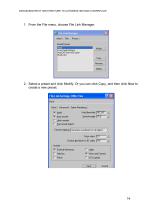
File LinkSettine^: DWG Files ? \ Basic | Advanced | Spline Rendering |7 Weld Weld threshold: |0'G 3/8" t Texture mapping: [Generate coordinates for all objects Surface deviation for 3D solids: |5'4"
Open the catalog to page 14All AUTODESK catalogs and technical brochures
 Autodesk ® Flame®
2576 Pages
 Autodesk® In Games
7 Pages
 Autodesk® DirectConnect
80 Pages
 AUTODESK ® 3DS MAX
1358 Pages
 CEIT-KE
2 Pages
 Novax DMA
2 Pages
 autocad_civil3d
6 Pages
 building_design_suite_2013
4 Pages
 autocad_design_suite_2013
2 Pages
 autocad_mep_brochure
4 Pages
 acade_jic_overview_broch_us
4 Pages
 alias_2013_
10 Pages
 Autodesk Utility Design
2 Pages
 Autodesk Toxik
4 Pages
 Autodesk Subcontractor
4 Pages
 Autodesk Smoke
2 Pages
 Autodesk Mudbox
4 Pages
 Autodesk MotionBuilder
4 Pages
 Autodesk Moldflow Adviser
4 Pages
 Autodesk Maya
4 Pages
 Autodesk Lustre
6 Pages
 Autodesk LandXplorer
4 Pages
 Autodesk Inferno
1 Page
 Autodesk Flare
1 Page
 Autodesk Flint
1 Page
 Autodesk Cleaner XL
2 Pages
 Autodesk Cleaner
2 Pages
 Autodesk Buzzsaw
4 Pages
 Autodesk Backdraft Conform
6 Pages
 AutoCAD Revit MEP Suite
4 Pages
 AutoCAD P&ID
4 Pages
 AutoCAD Inventor Suites
32 Pages
 AutoCAD Electrical
4 Pages
 Autodesk Quantity Takeoff
4 Pages
 Autodesk Revit Structure
8 Pages
 AutoCAD Civil
6 Pages


Archived catalogs
 AutoCAD Raster Design
2 Pages
 AutoCAD MEP
6 Pages
 Autodesk Navisworks Review
4 Pages
 AutoCAD Civil 3D
2 Pages
 factory_design_suite_2013
4 Pages
 Autodesk 3ds Max Design
4 Pages
 AutoCAD Map 3D
4 Pages
 AutoCAD Mechanical
4 Pages
 AutoCAD Structural Detailing
6 Pages
 Autodesk Alias Design
4 Pages
 Autodesk Alias Surface
4 Pages
 Autodesk Revit Structure
8 Pages
 AutoCAD LT
2 Pages
 Autodesk MapGuide Enterprise
4 Pages
 Autodesk Topobase
2 Pages
 Autodesk Ecotect Analysis
4 Pages
 AutoCAD Architecture
4 Pages
 acade_jic
4 Pages
 autocad_lt_2013
2 Pages
 3DS
3DS8 Pages
 map3D_2013
2 Pages
 BIM and Visualization
11 Pages


- AUTODESK automation software
- AUTODESK management software
- AUTODESK analysis software
- AUTODESK process software
- Real-time software
- Windows software
- AUTODESK CAD software
- AUTODESK cloud software
- AUTODESK control software
- AUTODESK design software
- Industrial software
- AUTODESK 3D software
- Measurement software
- Interface software
- AUTODESK visualization software
- AUTODESK quality software
- AUTODESK simulation software
- AUTODESK programming software
- AUTODESK automated software
- AUTODESK development software