


- Company
- Products
- Catalogs
- News & Trends
- Exhibitions
Carbon battery

Carbon battery
Carbon batteries, unlike lithium and standard lead-acid batteries, offer a significant improvement in discharge capacity and charging time. The addition of carbon additives reduces sulfatization, allowing faster charging compared to traditional lead-acid batteries. This makes them suitable for applications requiring partial state of charge (PSOC), enhancing cycle rates significantly.
Specifications
The document outlines the specifications of two carbon battery models, 12ET70PC and 12ET120PC. Both have a nominal voltage of 12V, with capacities of 60Ah and 100Ah respectively. They are designed to last over 3000 cycles at 70% depth of discharge (DoD) and have a design life of 15 years at 25°C. The batteries comply with standards IEC60896-21/22:2004, BS6290-4, and Eurobat, and are suitable for installation compliant with EN50272-2.
Performance and Design Life
The capacity test curve and temperature effect on battery design life are presented, showing the number of cycles and discharge capacity at various temperatures. The temperature range for optimal performance is between -20°C and 55°C.
Dimensions and Weight
The dimensions and weight for each model are provided: 12ET70PC measures 350x165.5x175 mm and weighs 25.5 kg, while 12ET120PC measures 350x172x275 mm and weighs 45 kg.
Constant Current Discharge Data
Data is provided for various end voltages and discharge times, illustrating the performance of the batteries under different conditions.
Advantages of Carbon Batteries
Carbon batteries are more cost-effective than lithium batteries, do not require special measures for transport or storage, and have a high recycling rate of 97%. They operate efficiently over a wide temperature range without needing a cooling system, making them a reliable and sustainable energy storage solution.
Catalog excerpts
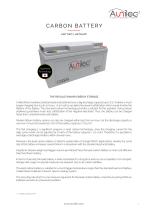
Japanese Technology THE REVOLUTIONARY ENERGY STORAGE Unlike lithium batteries standard lead acid batteries have a big discharge capacity (up to C3*). Indeed, a much longer charging time (up to 10 hours, =0,1) must be accepted to prevent sulfatization which would shorten the lifetime of the battery. The new lead carbon technology provides a solution for this problem: Using carbon additives guarantees much less sulfatization of the negative electrode. Thus, the battery can be charged faster than a standard lead acid battery. Modern lithium battery sytems can also be charged within less than an hour, but the discharge capacity is very low: It must not exceed 50-70% of the battery capacity (= C0,5-07). The fast charging is a significant progress in lead carbon technology, since the charging current for the daily cycle mode can be adjusted at 20-40% of the battery capacity (= 0,2-0,4C). Therefore, it is possible to recharge a discharged battery within several hours. Moreover, the lead carbon battery is ideal for partial state of charge (PSOC) applications. Hereby the cycle rate of the battery increases several times in comparison with the standard lead acid battery. Despite its heavier weight and bigger volume per kilowatt hour the lead carbon battery is more cost effective than the lithium battery. In terms of security the lead battery is tried and tested for a long time and has no competitors. For transport, storage and usage no special measures are required. Due to its carbon additive, The lead carbon battery is suitable for a much bigger temperature range than the standard lead acid battery. Unlike lithium batteries it doesn’t need a cooling system. The recycling rate of 97% is one more pro argument for the lead carbon battery, since the recycling of lithium batteries remains an unresolved problem.
Open the catalog to page 1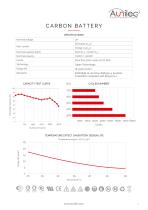
Onduleurs • Redresseurs * Batteries CAPACITY TEST CURVE DoD TEMPERATURE EFFECT ON BATTERY DESIGN LIFE 00® AAAO@9® iCAi/ftfli icrviorvn c Aonnn
Open the catalog to page 2
CARBON BATTERYDIMENSIONS & WEIGHT Battery type
Open the catalog to page 3All AUNILEC catalogs and technical brochures
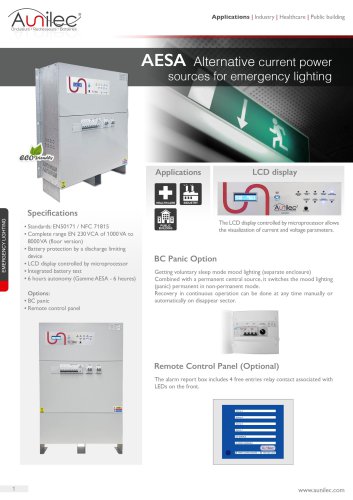 AESA Wall-Mounted And Floor
2 Pages
 Datasheet MULTI PLUS
5 Pages
 Datasheet IRIS+
2 Pages
 Datasheet IRIS-RT 6-10
2 Pages
 Datasheet IRIS-LFP 1-3
2 Pages
 Datasheet IRIS-LFP 6-10
4 Pages
 Datasheet IRIS+L
2 Pages
 Datasheet HELIOS TH
4 Pages
 Datasheet AUPUS HE 5U
5 Pages
 DAtasheet AUPUS HE Cabinet
6 Pages
 Datasheet AUPUS-OC0864
5 Pages
 Datasheet AUPUS WRS
4 Pages
 Datasheet VEGA HE
4 Pages
 Datasheet Multi Plus News
10 Pages
 Datasheet HELIOS MPW
8 Pages
 Datasheet MHE AUPUS C
4 Pages
 Datasheet AESB-R
2 Pages
 Aunilec Datasheet AESB EN
2 Pages
 ARES RT 1000-3000VA
2 Pages
 ARES 1000-3000VA
2 Pages
 EPC D 600/800VA
2 Pages
 Aunilec ARES
2 Pages
 Power solutions catalogue
48 Pages
 after-sales service
6 Pages
 Aunilec MLTDSP datasheet EN
2 Pages
 After-sales service Aunilec
6 Pages
 Inverters AUPUS EIM
3 Pages
 Controllers VIDI AUPUS C
4 Pages
 AESATM/TT 10-80kVA
3 Pages
 CRFw 12Vcc, 24Vcc and 48Vcc
2 Pages
 INV 48V/300VA
1 Page
 Active power filter 400V
2 Pages
 Aunilec Battery analyzer
1 Page
 Aunilec Batteries
1 Page
 Aunilec DSP Power Solutions
4 Pages
 Aunilec VEGA
6 Pages
 Aunilec ARFDin
2 Pages
 Power factor correction B50
4 Pages
 Power factor correction B35
4 Pages
 Power factor correction B25
4 Pages
 Série EOS|D 650-2200VA
2 Pages
 Série EOS 650-2200VA
2 Pages
 NET600 600VA
2 Pages
 Datasheet INV
3 Pages
 Datasheet DSP
4 Pages
 Datasheet MultiPlus
4 Pages
 Datasheet OP 5_10kVA
2 Pages
 Datasheet OP 1_3kVA
2 Pages
 Datasheet CRFw
2 Pages
 Datasheet ARFDin
2 Pages
 Datasheet helios modular
4 Pages
 Datasheet Helios 20S
2 Pages
 Datasheet Helios STR
2 Pages
 Datasheet MPTR
2 Pages
 Datasheet RDC
4 Pages


Archived catalogs
 Aunilec battery 12 years EN
2 Pages
 Lead Carbon battery
2 Pages
 Live&smart MLTDSP EN
2 Pages
 Datasheet RCRFn
2 Pages
 Datasheet AESA
2 Pages
 Protection and energy saving
61 Pages
 Aunilec MLTDSP Brochure EN
4 Pages
 Live&smart AUNISOL EN
2 Pages
 Charger CRFD
2 Pages
 Power solutions
48 Pages
 Gel batteries
2 Pages
 Datasheet ARES Rack
2 Pages
 HELIOS MPW
7 Pages
 UPS catalogue 2019-2020
60 Pages
 AUPUS HE Cabinet
6 Pages
 Datasheet charger AUPUS WRS
4 Pages
 Datasheet Aunisol 3-5-10
4 Pages
 Datasheet Aunisol 1-20
2 Pages
 Catalogue Power solutions
48 Pages


- Power supply unit
- DC power supply
- AC/DC power supply
- Transformer
- Monitoring analyzer
- Dry transformer
- CE power supply
- Single-output power supply
- Battery charger
- Compact power supply
- Encapsulated transformer
- Power transformer
- Electronic filter
- DIN rail power supply
- Isolation transformer
- Variable-output power supply
- Power supply with overload protection
- 12 V battery
- Single-phase power supply