

- Products
- Catalogs
- News & Trends
- Exhibitions
FUNCTIONAL SAFETY SIL

FUNCTIONAL SAFETY SIL
AUMA is a prominent manufacturer of electric actuators used in safety-related systems up to Safety Integrity Level (SIL) 3. These actuators are essential for managing the flow of substances in sectors such as water supply, power plants, and refineries, known for their reliability and precision.
Functional safety ensures systems perform safety functions reliably during failures, minimizing risks to people and the environment. It is governed by standards IEC 61508 and IEC 61511, which provide methods for risk assessment and reduction.
SIL measures risk reduction provided by safety functions, ranging from SIL 1 to SIL 4. AUMA's products are tested to determine their SIL capability, ensuring they meet necessary safety integrity demands.
IEC 61508 is an international standard for functional safety of electrical, electronic, or programmable electronic components, while IEC 61511 applies to the process industry. These standards are considered state-of-the-art for ensuring safety.
Achieving functional safety involves assessing risks, defining appropriate SIL requirements, selecting components based on these requirements, and verifying their safety figures to ensure compliance.
Safety functions are actions activated in case of failure to prevent damage. A Safety Instrumented System (SIS) implements these functions, typically consisting of sensors, safety PLCs, and actuators.
The Probability of dangerous Failure on Demand (PFDavg) is a critical measure, with lower values indicating higher safety integrity. SIL levels define allowable PFD ranges, with SIL 4 allowing the least probability of failure.
Devices are classified into simple type A and complex type B, with type B requiring higher safety requirements. Metrics such as Mean Time Between Failures (MTBF) indicate system reliability.
Methods to enhance SIL capability include redundancy, partial valve stroke tests (PVST), and proof tests. Redundant system architectures, such as 1oo2 and 2oo3 configurations, increase hardware fault tolerance.
AUMA actuators and controls are classified according to their SIL capability, with specific configurations for safe opening, closing, and stopping functions. The SIL module ensures safety functions overrule normal operations.
The document describes monitoring actuator operations and providing safe inputs and outputs by the SIL module to ensure system reliability.
The document outlines standards IEC 61508 and IEC 61511, guiding procedures for assessing SIL capability. AUMA uses the FMEDA method to calculate safety figures, including PFDavg, SFF, and diagnostic coverage.
The certification process by TÜV Nord and exida highlights the importance of a Functional Safety Management System to mitigate systematic faults, with system monitoring and redundancy managing random faults.
Regular proof tests are suggested to maintain device functionality and improve PFD values. A comprehensive understanding of safety figures and their impact on system safety is emphasized.
AUMA products have been rigorously assessed and certified for SIL classification, ensuring their reliability and safety in performing critical functions. The document serves as a guide for understanding the safety figures and certification process for AUMA products.
Catalog excerpts

Electric actuators for safety-related systems up to SIL 3
Open the catalog to page 1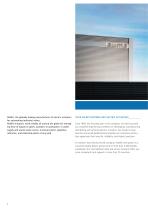
AUMA, the globally leading manufacturer of electric actuators for automating industrial valves. AUMA actuators work reliably all around the globe for managing ow of liquids or gases, powders or granulates: in water supply and waste water sector, in power plants, pipelines, re neries, and industrial plants of any kind. YOUR EXPERT PARTNER FOR ELECTRIC ACTUATORS Since 1964, the founding year of the company, we have focussed our complete engineering excellence on developing, manufacturing, distributing and servicing electric actuators. Our products have become renowned global brands whereby our...
Open the catalog to page 2
AUMA AUTOMATE VALVES FUNCTIONAL SAFETY_ CONTENTS AUMA's broad portfolio of electric actuators is qualified for AUMA automate valves 3 safety-related systems up to SIL 3. Our products contribute to Risk reduction by functional safety 4 safe operation of technical systems all around the globe. The standards IEC 61508 and IEC 61511 6 nternationally renowned test institutes have determined both How to achieve functional safety? 7 safety figures and SIL capability for our products. What is a safety function? 8 What is a safety instrumented system? 9 Besides a basic introduction to the functional safety...
Open the catalog to page 3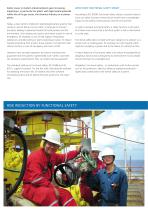
Safety issues in modern industrial plants gain increasing importance, in particular for plants with high hazard potential within the oil & gas sector, the chemical industry or in power plants. Today, a clear trend to implement sophisticated safety systems intervening in case of failure can be noted, in particular to monitor processes leading to potential hazards for both persons and the environment. Such systems are used to shut down a plant in case of emergency, for example, to cut off the supply of hazardous substances, provide cooling or open overpressure valves. To reduce hazards emanating...
Open the catalog to page 4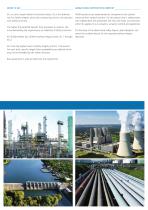
AUMA'S ROLE WITHIN THIS CONTEXT SIL is a term closely linked to functional safety. SIL is the abbreviation for Safety Integrity Level and a measuring unit for risk reduction with safety functions. AUMA products are implemented as components into systems which perform safety functions. For this reason and in collaboration with independent test authorities like TÜV and exida, we examined which SIL applies to our actuators, actuator controls and gearboxes. The higher the potential hazards from processes or systems, the more demanding the requirements on reliability of safety functions. IEC 61508...
Open the catalog to page 5
Industrial accidents with disastrous consequences like the Seveso dioxin disaster in 1976 or the Indian Bhopal gas tragedy in 1984 put the worldwide standardisation process relating to safety into gear. This standard includes the user specic implementation of IEC 61508 in particular for the process industry. It denes the requirements for safety-related systems used in the process industry for risk reduction. At EU level, rst the Seveso I and later the Seveso II directive 96/82/EC on the control of major accident hazards involving dangerous substances were issued. These directives aim at the protection...
Open the catalog to page 6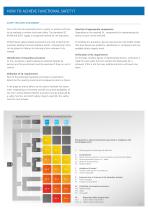
HOW TO ACHIEVE FUNCTIONAL SAFETY? SAFETY-RELATED ASSESSMENT First of all, the risks emanating from a system or process will have to be analysed to achieve functional safety. The standards IEC 61508 and 61511 supply a recognised method for risk evaluation. Selection of appropriate components Depending on the required SIL, components for implementing the safety function will be selected. Differentiated safety-related assessments are used to identify the processes leading to actual hazardous events. Consequently, focus can be placed on taking risk reducing actions wherever truly needed. To facilitate...
Open the catalog to page 7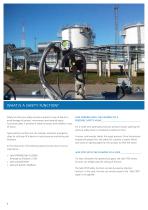
WHAT IS A SAFETY FUNCTION? Safety functions are safety actions activated in case of failure to avoid damage of persons, environment and material assets. Functional safety is achieved if safety functions work reliably in case of failure. Typical safety functions are, for example, automatic emergency stops for shutting off a device or vessel pressure monitoring and limitation. SAFE OPENING WITH THE EXAMPLE OF A PRESSURE SAFETY VALVE For a vessel with potentially excessive pressure hazard, opening the pressure safety valve is considered as safety function. A sensor continuously checks the vessel...
Open the catalog to page 8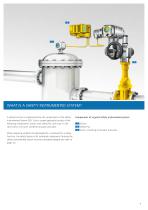
WHAT IS A SAFETY INSTRUMENTED SYSTEM? A safety function is implemented by the components of the Safety Instrumented System (SIS). Such a system generally consists of the following components: sensor, host safety PLC and actor. In the valve sector, the actor combines actuator and valve. Components of a typical safety instrumented system 1 2 3 Sensor Safety PLC Actor, consisting of actuator and valve When assessing whether the demanded SIL is achieved for a safety function, the safety gures of all individual components forming the safety instrumented system must be considered (please also refer...
Open the catalog to page 9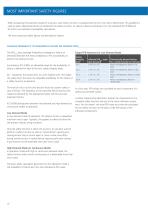
MOST IMPORTANT SAFETY FIGURES When evaluating the potential hazards of a process, each safety function is analysed and the SIL to be met is determined. This guideline is used to select appropriate device to implement the safety function. To classify a device according to SIL, the standards IEC 61508 and IEC 61511 use methods of probability calculations. The most important safety gures are described as follows. AVERAGE PROBABILITY OF DANGEROUS FAILURE ON DEMAND (PFD) The PFDavg value (average Probability of dangerous Failure on Demand) describes the mean probability of the unavailability to perform...
Open the catalog to page 10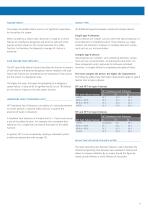
FAILURE RATES DEVICE TYPE The analysis of possible failure sources is of significant importance When considering X failure rates, distinction is made as to which failures are classified as dangerous and which as safe and conse- quently without impact on the correct execution of a safety function. Furthermore, the diagnostic coverage of a failure is SAFE FAILURE FRACTION (SFF) The SFF value (Safe Failure Fraction) describes the fraction in percent of safe failures and detected dangerous failures related to the total failure rate. Failures are considered as non-hazardous if they cannot put the...
Open the catalog to page 11All AUMA catalogs and technical brochures
 ELECTRIC ACTUATORS
6 Pages
 Multi-turn actuators
92 Pages
 Electric multi-turn actuators
40 Pages
 SAEx 07.2
1 Page
 AUMA Cloud + AUMA Assistant App
14 Pages
 FUNCTIONAL SAFETY – SIL
28 Pages
 Service Worldwide
8 Pages
 SIMA² Master Station
6 Pages
 AUMA Support App
4 Pages
 electric actuators
56 Pages
 Service world wide
12 Pages
 Explosions proof actuators
24 Pages
 The Actuator Specialist
32 Pages







Archived catalogs
 Electric multi-turn actuators
24 Pages
 Electric multi-turn actuators
28 Pages
 Master station SIMA
4 Pages
 Multi-turn gearbox GHT 360.1
4 Pages
 Electric part-turn actuators
4 Pages
 Service device PV 788 B
4 Pages
 Test bench PV 1405
24 Pages





- Planetary gearbox
- Coaxial gearhead
- Right angle gearhead
- Compact gearhead
- AUMA hollow-shaft gear reducer
- Gear train gear reducer
- AUMA valve actuator
- AUMA rotary valve actuator
- Shaft gearhead
- Low-noise gearhead
- High-torque gearhead
- Bevel gearhead
- AUMA electric valve actuator
- Parallel-shaft gearhead
- Drive gear reducer
- Compact valve actuator
- Linear valve actuator
- Aluminum valve actuator
- Spur gearhead
- AUMA modulating valve actuator