

- Products
- Catalogs
- News & Trends
- Exhibitions
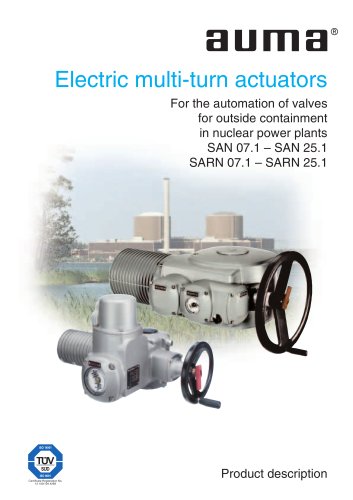
Electric multi-turn actuators

Electric multi-turn actuators
- Range of Application: AUMA actuators are intended for industrial valves such as globe, gate, butterfly, and ball valves. Usage beyond these applications is at the user's risk.
- Commissioning: Special regulations must be followed for hazardous areas, and electrical work should be performed by qualified personnel.
- Maintenance: Follow maintenance instructions to ensure safe operation.
- Warnings and Notes: Non-compliance can lead to injuries or damage. Qualified personnel should be familiar with all warnings.
The AUMA multi-turn actuators SAExC 07.1 – SAExC 16.1 are modular, driven by an electric motor, and controlled by AMBExC 01.1. They include limit switches for travel limitation and torque switches for the end position CLOSED.
- Explosion Protection: Various standards and options for flameproof enclosures.
- Type of Duty: Short-time duty S2 for 15 or 30 minutes.
- Motors: 3-phase AC asynchronous motor with insulation class F.
- Limit Switching: Options for single, tandem, or triple switches.
- Torque Switching: Adjustable for OPEN and CLOSE directions.
- Position Feedback: Options for potentiometer or 0/4 – 20 mA signals.
- Manual Operation: Manual drive available for emergency operation.
- Service Conditions: Enclosure protection IP 67 or IP 68, with options for corrosion protection.
- Transport in sturdy packaging and store in a dry, ventilated area.
- Protect against corrosion if stored for more than 6 months.
- Check for damage before mounting and replace damaged parts with original spares.
- Consult AUMA if temperatures above 40°C are expected at the valve flange or stem.
The multi-turn actuator is delivered in the CLOSED position with specific output drive types (B1, B2, B3, B4) featuring bore and keyway according to ISO 5210. Type A requires matching the internal thread of the stem nut with the valve stem thread. Fastening torque for bolts is specified in Table 3, with strength class 8.8.
Ensure the mounting flange fits the valve/gearbox. Degrease mounting faces and apply grease to the input shaft. Fasten the actuator using bolts of at least quality 8.8. For output drive type A, finish machining of the stem nut is required, including drilling, boring, and threading.
Manual operation is engaged via a change-over lever on the handwheel. Excessive force should be avoided to prevent damage. Manual operation disengages automatically when the motor starts.
Follow European Standards EN 60079-14 and EN 60079-17 for hazardous areas. Electrical connections are made using Ex-plug/socket connectors or Ex-plug-in terminal connections, ensuring enclosure protection IP 67 or IP 68. Technical data for connections are provided in Tables 5 and 6.
Thermoswitches protect against overheating. Bypassing motor protection voids explosion protection approval. Remote position transmitters require screened cables.
Opening the switch compartment requires ensuring no explosive gas or voltage is present. Removal of the cover and indicator disc is necessary for settings.
Settings for end positions CLOSED and OPEN involve turning the handwheel and adjusting setting spindles with a screwdriver. Intermediate position switches can be set for specific applications.
Figures illustrate various components and procedures, such as output drive types, connection methods, and control units. Tables provide torque specifications and technical data for electrical connections.
- Setting for Direction OPEN: Use a screwdriver to turn the setting spindle in the direction of the arrow to set the valve to an intermediate position.
- Setting of the Torque Switching: Adjust the torque dial to match the valve's requirements, ensuring changes are approved by the valve manufacturer.
- Test Run: Ensure no explosion risk exists before working on the actuator. Check the direction of rotation and verify limit switching settings.
- Setting of the Potentiometer: Adjust for remote indication by moving the valve to the CLOSED position and fine-tuning the zero point externally.
- Setting of Electronic Position Transmitter RWG: Connect the voltage and adjust the potentiometer to ensure the output current is within the specified range.
- Setting of the Mechanical Position Indicator: Install the indicator disc on the shaft and align it with the cover mark.
- Closing the Switch Compartment: Ensure sealing faces are clean and the O-ring is in good condition before replacing the cover.
- Controls AUMA MATIC BASIC ExC: Ensure no explosion risk exists before working on the actuator. Adjust the type of seating in the end position CLOSED as per the valve manufacturer's instructions.
- Push-to-Run Operation: Factory settings can be changed by adjusting jumpers on the control board for LOCAL and REMOTE operations.
- Settings on Relay Board: Assign functions to terminals using jumpers for potential-free feedback.
- Fuses: Ensure no explosive gas or voltage is present before accessing fuses. Replace fuses with identical values.
The document provides detailed specifications for fuses used in actuator controls AMBExC 01.1, including sizes and control voltages for power supply units at 115 V and 230 V.
Regular inspections and maintenance are required every three years by qualified personnel, following the European standard EN 60079-17. Key tasks include visual inspections for damage, checking cable integrity, and ensuring tightness of cable entries.
The gear housing is pre-filled with lubricant, with grease changes recommended every 10-12 years if operated seldom, or every 6-8 years if operated frequently.
AUMA actuators should be disassembled and sorted by material type for recycling when necessary. Greases and oils must be collected and disposed of according to environmental regulations.
AUMA offers extensive services for maintenance and inspection. A comprehensive spare parts list is provided, emphasizing the use of original parts to maintain warranty and liability coverage.
For seldom-used actuators, a test run every six months is advised. Bolts between actuator and valve/gearbox should be checked annually for tightness.
The document includes a declaration of conformity and incorporation, ensuring compliance with relevant standards.
Contact details for AUMA offices and service centers are provided for further assistance.
Catalog excerpts
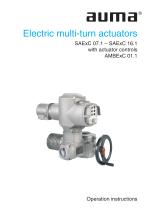
Electric multi-turn actuators SAExC 07.1 – SAExC 16.1 with actuator controls AMBExC 01.1 Operation instructions
Open the catalog to page 1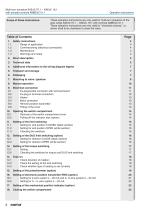
Multi-turn actuators SAExC 07.1 – SAExC 16.1 with actuator controls AMBExC 01.1 Scope of these instructions: Operation instructions These operation instructions are only valid for multi-turn actuators of the type range SAExC 07.1 – SAExC 16.1 with controls AMBExC 01.1. These operation instructions are only valid for ”clockwise closing”, i.e. driven shaft turns clockwise to close the valve. 1. Safety instructions 1.1 Range of application 1.2 Commissioning (electrical connection) 1.3 Maintenance 1.4 Warnings and notes Short description Technical data Additional information to the wiring diagram...
Open the catalog to page 2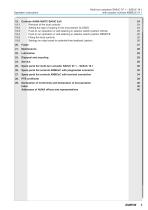
Operation instructions Multi-turn actuators SAExC 07.1 – SAExC 16.1 with actuator controls AMBExC 01.1 19. Controls AUMA MATIC BASIC ExC 19.1 Removal of the local controls 19.2 Setting the type of seating in the end position CLOSED 19.3 Push-to-run operation or self-retaining in selector switch position LOCAL 19.4 Push-to-run operation or self-retaining in selector switch position REMOTE 19.5 Fitting the local controls 19.6 Settings on relay board for potential-free feedback (option) Spare parts list multi-turn actuator SAExC 07.1 – SAExC 16.1 Spare parts list controls AMBExC with plug/socket...
Open the catalog to page 3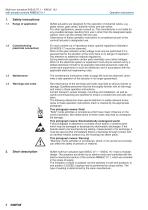
Multi-turn actuators SAExC 07.1 – SAExC 16.1 with actuator controls AMBExC 01.1 Operation instructions Safety instructions AUMA actuators are designed for the operation of industrial valves, e.g. globe valves, gate valves, butterfly valves and ball valves. For other applications, please consult us. The manufacturer is not liable for any possible damage resulting from use in other than the designated applications. Such risk lies entirely with the user. Observance of these operation instructions is considered as part of the controls'/actuator's designated use. Commissioning (electrical connection)...
Open the catalog to page 4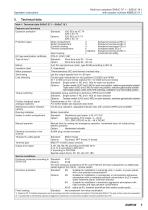
Multi-turn actuators SAExC 07.1 – SAExC 16.1 with actuator controls AMBExC 01.1 Operation instructions Technical data Table 1: Technical data SAExC 07.1 – SAExC 16.1 Features and functions Explosion protection Protection types EC type examination certificate Type of duty 1) Motors Insulation class Motor protection Self-locking Limit switching Torque switching Position feedback signal, analogue (options) Mechanical position indicator (option) Running indication Heater in switch compartment Manual operation Electrical connection to the controls Threads for cable glands Terminal plan Output drive...
Open the catalog to page 5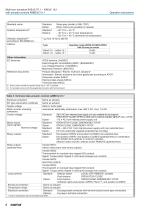
Multi-turn actuators SAExC 07.1 – SAExC 16.1 with actuator controls AMBExC 01.1 Standard colour Ambient temperature3) Vibration resistance4) according to EN 60068-2-6 Lifetime Silver-grey (similar to RAL 7037) Other colours are possible on request – 20 °C to + 40 °C – 40 °C to + 40 °C (low temperature) – 50 °C to + 40 °C (extreme low temperature) 1 g, from 10 Hz to 200 Hz Standard: Option: Standard: Options: Type SAExC 07.1 – SAExC 10.1 SAExC 14.1 – SAExC 16.1 Other information EC directives Reference documents Operation instructions Operating cycles (OPEN-CLOSED-OPEN) with 30 turns per stroke...
Open the catalog to page 6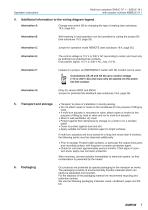
Multi-turn actuators SAExC 07.1 – SAExC 16.1 with actuator controls AMBExC 01.1 Operation instructions Additional information to the wiring diagram legend Information A: Change-over switch S9 for changing the type of seating (see subclause 19.2, page 24). Self-retaining in local operation can be cancelled by cutting the jumper B3 (see subclause 19.3, page 25). Jumper for operation mode REMOTE (see subclause 19.4, page 25). The control voltage is 115 V or 230 V AC (according to order) and must only be switched via potential-free contacts. End position signal: 115 V or 230 V AC, max. 2.5 W. Instead...
Open the catalog to page 7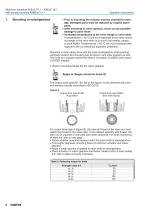
Multi-turn actuators SAExC 07.1 – SAExC 16.1 with actuator controls AMBExC 01.1 Operation instructions Prior to mounting the actuator must be checked for damage. Damaged parts must be replaced by original spare parts. After mounting to valve/ gearbox, touch up any possible damage to paint finish. Increased temperatures at the valve flange or valve stem: If temperatures > 40 °C are to be expected at the valve mounting flange or the valve stem (e.g. due to hot media), please consult AUMA. Temperatures > 40 °C are not considered with regards to the non-electrical explosion protection. Mounting is...
Open the catalog to page 8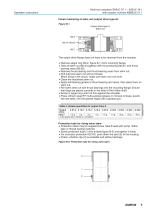
Multi-turn actuators SAExC 07.1 – SAExC 16.1 with actuator controls AMBExC 01.1 Operation instructions Finish machining of stem nut (output drive type A): Figure B-1 Output drive type A Stem nut The output drive flange does not have to be removed from the actuator. Remove spigot ring (80.2, figure B-1) from mounting flange. Take off stem nut (80.3) together with thrust bearing (80.01) and thrust bearing races (80.02). Remove thrust bearing and thrust bearing races from stem nut. Drill and bore stem nut and cut thread. When fixing in the chuck, make sure stem nut runs true! Clean the machined...
Open the catalog to page 9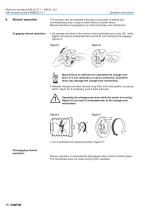
Multi-turn actuators SAExC 07.1 – SAExC 16.1 with actuator controls AMBExC 01.1 Manual operation Engaging manual operation: Operation instructions The actuator may be operated manually for purposes of setting and commissioning, and in case of motor failure or power failure. Manual operation is engaged by an internal change-over mechanism. Lift change-over lever in the centre of the handwheel up to max. 85°, while slightly turning the handwheel back and forth until manual drive engages (figure C). Manual force is sufficient for operating the change-over lever. It is not necessary to use an extension....
Open the catalog to page 10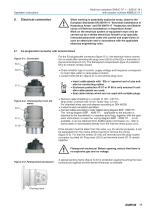
Multi-turn actuators SAExC 07.1 – SAExC 16.1 with actuator controls AMBExC 01.1 Operation instructions Electrical connection Ex-plug/socket connector with terminal board When working in potentially explosive areas, observe the European Standards EN 60079-14 “Electrical Installations in Hazardous Areas” and EN 60079-17 “Inspection and Maintenance of Electrical Installations in Hazardous Areas”. Work on the electrical system or equipment must only be carried out by a skilled electrician himself or by specially instructed personnel under the control and supervision of such an electrician and in...
Open the catalog to page 11All AUMA catalogs and technical brochures
 ELECTRIC ACTUATORS
6 Pages
 Multi-turn actuators
92 Pages
 SAEx 07.2
1 Page
 AUMA Cloud + AUMA Assistant App
14 Pages
 FUNCTIONAL SAFETY – SIL
28 Pages
 Service Worldwide
8 Pages
 SIMA² Master Station
6 Pages
 AUMA Support App
4 Pages
 electric actuators
56 Pages
 FUNCTIONAL SAFETY SIL
28 Pages
 Service world wide
12 Pages
 Explosions proof actuators
24 Pages
 The Actuator Specialist
32 Pages







Archived catalogs
 Electric multi-turn actuators
24 Pages
 Electric multi-turn actuators
28 Pages
 Master station SIMA
4 Pages
 Multi-turn gearbox GHT 360.1
4 Pages
 Electric part-turn actuators
4 Pages
 Service device PV 788 B
4 Pages
 Test bench PV 1405
24 Pages





- Planetary gearbox
- Coaxial gearhead
- Right angle gearhead
- Compact gearhead
- AUMA hollow-shaft gear reducer
- Gear train gear reducer
- AUMA valve actuator
- AUMA rotary valve actuator
- Shaft gearhead
- Low-noise gearhead
- Bevel gearhead
- High-torque gearhead
- AUMA electric valve actuator
- Parallel-shaft gearhead
- Drive gear reducer
- Compact valve actuator
- Linear valve actuator
- Aluminum valve actuator
- Spur gearhead
- AUMA modulating valve actuator