

- Products
- Catalogs
- News & Trends
- Exhibitions
Electric actuators for valve automation in nuclear power plants

Electric actuators for valve automation in nuclear power plants
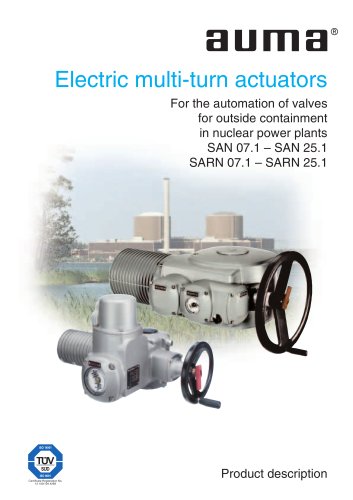
This document provides an overview of AUMA electric actuators used for valve automation in nuclear power plants. It includes information on multi-turn actuators for both inside and outside containment areas, along with complementary gearbox series. The brochure offers technical data for initial product selection and directs readers to further resources for detailed specifications.
AUMA is a leading manufacturer of electric actuators for industrial valve automation, particularly in the nuclear industry. Since 1964, AUMA has developed actuators that meet stringent safety and regulatory standards required in nuclear power plants. Their modular product concept allows for customer-specific configurations, ensuring high quality and easy maintenance.
AUMA actuators are used globally in nuclear power plants, with certifications from national and international bodies. They comply with standards such as IEEE 382-2006 and RCC-E, ensuring reliability and safety in demanding environments. AUMA's global network supports customers with sales, service, and product training.
Electric actuators automate industrial valves, enabling remote operation from control rooms. They consist of an electric motor and gearbox, providing the necessary torque for valve operation. AUMA actuators are designed to operate under extreme conditions, with certifications confirming their quality and reliability.
Multi-turn actuators are used for gate valves requiring multiple revolutions, while part-turn actuators are suitable for butterfly and ball valves with movements up to 90 degrees. AUMA offers various combinations of actuators and gearboxes to meet specific application needs.
AUMA actuators are designed for different service conditions, including normal operation and Design Basis Event (DBE) conditions. They offer high enclosure protection (IP68) and are suitable for a wide range of ambient temperatures. Radiation resistance is also a key feature, with specific models qualified for use inside and outside containment areas.
The brochure provides technical data for various actuator models, including torque and thrust specifications. AUMA actuators are certified for use in nuclear power plants, ensuring compliance with international standards and customer requirements.
The document outlines various protection levels for different applications, with the standard colour being silver-grey (similar to RAL 7037). Other colours are available upon request.
The AUMA powder coating is certified for its excellent decontamination properties, allowing radioactive deposits to be removed without impairing the coating.
SAI multi-turn actuators and GSI/GSTI gearboxes are free of aluminium, enhancing their suitability for specific environments.
The AUMA corrosion protection system is certified and adheres to atmospheric corrosivity categories according to EN ISO 12944-2, with varying film thicknesses for different environmental classifications.
The coating consists of a conversion layer, an epoxy resin-based first powder layer for adherence, and a polyurethane-based second powder layer for resistance against chemicals, weathering, and UV radiation.
SAI actuators are tested under LOCA/DBE conditions, complying with IEEE 382-2006 standards. The document details the test sequence, including radiation exposure, pressure, temperature, and vibration resistance.
Actuators are categorized into three classes based on their operation modes: OPEN-CLOSE duty (Class A), positioning duty (Class B), and modulating duty (Class C). Each class is designed to handle different mechanical loads.
Actuators feature limit and torque seating mechanisms for switching off in end positions, overload protection, and thermal motor protection to prevent damage during operation.
SAI and SAN actuators share a uniform design principle, with components such as motors, worm gearing, control units, and handwheels for emergency operation. Differences include material composition, with SAI actuators being aluminium-free.
The control unit includes a sensor system for monitoring valve position and torque, with options for remote position transmitters and intermediate position switches.
The mechanical interface to the valve is standardized, with flange dimensions and output drive types complying with EN ISO 5210 or DIN 3210.
The document describes various components and specifications of multi-turn actuators and gearboxes used in valve automation, particularly in nuclear power plants. Key components include stem nuts, axial bearings, plug-in electrical connectors, and various types of covers for electrical connections.
The AUMA plug/socket connector is highlighted as a crucial element for modular actuator design, allowing for quick disconnection and reconnection during maintenance. Different covers for electrical connections are available, offering varying space and protection levels.
Combining multi-turn actuators with part-turn or multi-turn gearboxes allows for high output torques, suitable for automation in nuclear power plants. The document specifies torque values, reduction ratios, and the design of components like worm wheels and hollow shafts.
The document provides detailed specifications for SAI, SARI, SAN, and SARN multi-turn actuators, including output speeds, torque settings, and mounting flanges. It also outlines the lifetime and operational cycles for these actuators, both inside and outside containment.
Limit and torque switches are described, with options for single, tandem, and triple switches. The control unit records turns per stroke, with options for different ranges. Remote position transmitters and supply voltage specifications are also included.
The document details motor protection features, including thermoswitches, and specifies the type of duty according to IEC standards. It also provides information on supply voltages, mounting positions, and noise levels.
Technical data sheets provide detailed information on actuator performance, including maximum valve torque, reduction ratios, and suitable multi-turn actuators for specific applications. Terminal plans and electrical connection diagrams are available for download.
The document outlines the specifications of SAI/GSI and SAN/GSI part-turn actuators, which combine GSI part-turn gearboxes with SAI or SAN multi-turn actuators to achieve nominal torques up to 24,000 Nm. The document also details the modulating duty types, maximum valve torque, modulating torque, output mounting flange, total reduction ratio, and suitable multi-turn actuators.
The document provides a table listing various GSI models with their maximum valve torque, modulating torque, output mounting flange, reduction ratios, and suitable multi-turn actuators. It specifies the operating time range for a 50 Hz and 90° swing angle.
GSI part-turn gearboxes are qualified for a plant lifetime of 40 years at +40 °C ambient temperature, corresponding to 5,000 operation cycles. The document also mentions the lifetime of GSTI gearboxes and LEN linear thrust units, which are similarly qualified for 40 years and 5,000 cycles.
The document describes the mounting positions of actuators and gearboxes, which can be rotated in four different positions marked A-D. It also explains the variants of GSI part-turn gearbox, detailing the position of the worm shaft and the direction of rotation at the output drive.
AUMA emphasizes the importance of reliability and quality in actuator production, highlighting their certifications and compliance with EU directives. The document mentions the Declaration of Incorporation and Conformity, inspection certificates, and the CE mark labeling.
The document provides contact details for AUMA Riester GmbH & Co. KG and mentions that AUMA subsidiaries and representatives are present in over 70 countries.
Catalog excerpts

ELECTRIC ACTUATORS for valve automation in nuclear power plants
Open the catalog to page 1
ABOUT THIS BROCHURE This brochure intends to describe functions and possible applications for AUMA actuators qualified for use in nuclear power plants. They include multi-turn actuators for use Outside Containment and Inside Containment and their complementary gearbox series. The document provides an introduction into the issue, an overview on products and well-founded explanations regarding design and function of the devices. In the rear section of this brochure you will find a comprehensive chapter including technical data for simple, initial product selection. For device selection, further...
Open the catalog to page 2
Who are AUMA? About this brochure 2 AUMA - the specialist for electric actuators 4 Basics What is an electric actuator? 8 Multi-turn actuators and part-turn actuators 10 AUMA actuators and valve gearboxes for use in nuclear power plants 12 Service conditions during normal operation 14 Service conditions under DBE conditions - Inside Containment 16 Service conditions under DBE conditions - Outside Containment 18 Basic actuator functions 20 Design SAI and SAN Uniform design principle across all sizes 22 Combinations Multi-turn actuator - Part-turn gearbox combinations...
Open the catalog to page 3
AUMA - THE SPECIALIST FOR ELECTRIC ACTUATORS Armaturen- Und MaschinenAntriebe - AUMA - are one of the leading manufacturers worldwide of electric actuators for automating industrial valves. Since 1964, the founding year of the company, AUMA have focussed on development, manufacture, sales and service of electric actuators. The brand AUMA is synonym to long-standing experience and knowledge. Thousands of AUMA actuators are used in safety relevant areas in about 100 nuclear power plants around the globe. As an independent partner of the international valve industry, AUMA supply customer-specific...
Open the catalog to page 4
Innovation on a day-to-day-business As specialist for electric actuators, AUMA set the market standard for innovation and sustainability. Within the framework of continual improvement, their own in-house vertical range of manufacture guarantee implementation on both product or sub-assembly level. Selecting AUMA: >> provides valve automation in compliance with submitted specifications >> assures safety for design and implementation for plant engineering on the basis of certified interfaces >> guarantees the operator global service on site including commissioning, comprehensive support, and product...
Open the catalog to page 5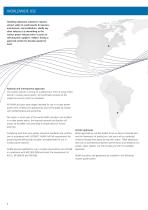
WORLDWIDE USE Handling radioactive substances requires utmost safety to avoid hazards for persons, environment, and installations. Hardly any other industry is as demanding as the nuclear power industry when it comes to selecting their suppliers. AUMA's listing as approved vendor for decades speaks for itself. National and international approvals The nuclear industry is acting on a global scale. Prior to using a field device in nuclear power plants, the certification process of the respective country must be completed. All AUMA actuator type ranges intended for use in nuclear power plants were...
Open the catalog to page 6
Argentina > Atucha 2 Belgium > Doel > Tihange Bulgaria > Kozloduy China > Fangjiashan > Fuquing > Hainan > Tianwan > Qinshan > Taishan Finland > Loviisa 1 + 2 > Olkiluoto 1 + 2 > Olkiluoto 3 France > Flamanville 3 Germany > Biblis > Grafenrheinfeld > Gundremmingen > Krummel > Munchen-Garching > Neckarwestheim > Philippsburg > Unterweser Canada > Darlington Lithuania > Ignalina The Netherlands > Borssele > Petten Research Center Nuclear Russia > Beloyarsk > Kalinin > Kola > Leningrad > Nowoworonesch > Rostow Sweden > Barseback > Forsmark I/II/III > Oskarshamn > Ringhals Switzerland > Beznau >...
Open the catalog to page 7
WHAT IS AN ELECTRIC ACTUATOR? In nuclear power plants, water - as liquid or vapour - is transported through pipework at high pressure. Industrial valves are used to inhibit or release medium flow as well as to control the resulting flow rate by opening or closing the valves. AUMA actuators are remotely controlled from the control room to operate valves. Automating industrial valves Modern industrial applications are based on a high level of valve automation. This is the requirement for managing complex processes. The actuator positions the valve in compliance with operation commands issued by...
Open the catalog to page 8
Requirement for diversity Process engineering plants with pipe systems and valve automation are required all around the globe. Not only types of plants and valves are crucial factors for electric actuators but also the specific conditions in which they are operated. AUMA actuators guarantee reliable and safe service under the most extreme conditions. International test authorities confirm the quality of AUMA actuators designed, manufactured, and tested to customer specifications by issuing product certificates. Requirement for reliability Process engineering plants are only efficient, economic...
Open the catalog to page 9
MULTI-TURN ACTUATORS AND PART-TURN ACTUATORS The actuation mode is considered a significant distinction factor between the different valve types. A typical example of multi-turn valves are gate valves. They require a defined number of turns at valve input for a complete valve stroke from CLOSED to OPEN and vice versa. Butterfly valves or ball valves are typically used for part-turn movements up to 90°. Globe valves are normally operated via linear movement. Furthermore, certain valves are operated via lever arrangements. In this case, we are talking about lever movement. Specific types of motion...
Open the catalog to page 10
SAI and SAN multi-turn actuators In compliance with EN ISO 5210, a multi-turn actuator is capable of withstanding thrust applied to the valve and transmits torque to the valve for at least one revolution. In general, multi-turn actuators are required to perform more than one revolution. Consequently gate valves are often equipped with rising valve stems. Therefore, the SAI and SAN multi-turn actuator is equipped with a hollow shaft housing the gate valve stem for these applications. SAI or SAN multi-turn actuators with mounted GSTI multi-turn gearboxes Multi-turn actuators with higher output...
Open the catalog to page 11All AUMA catalogs and technical brochures
 ELECTRIC ACTUATORS
6 Pages
 Multi-turn actuators
92 Pages
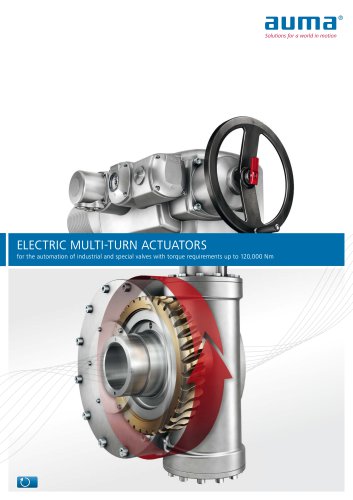
 Electric multi-turn actuators
40 Pages
 SAEx 07.2
1 Page
 AUMA Cloud + AUMA Assistant App
14 Pages
 FUNCTIONAL SAFETY – SIL
28 Pages
 Service Worldwide
8 Pages
 SIMA² Master Station
6 Pages
 AUMA Support App
4 Pages
 electric actuators
56 Pages
 FUNCTIONAL SAFETY SIL
28 Pages
 Service world wide
12 Pages
 Explosions proof actuators
24 Pages
 The Actuator Specialist
32 Pages







Archived catalogs
 Electric multi-turn actuators
24 Pages
 Electric multi-turn actuators
28 Pages
 Master station SIMA
4 Pages
 Multi-turn gearbox GHT 360.1
4 Pages
 Electric part-turn actuators
4 Pages
 Service device PV 788 B
4 Pages
 Test bench PV 1405
24 Pages





- Planetary gearbox
- Coaxial gearhead
- Right angle gearhead
- Compact gearhead
- AUMA hollow-shaft gear reducer
- Gear train gear reducer
- AUMA valve actuator
- AUMA rotary valve actuator
- Shaft gearhead
- Low-noise gearhead
- High-torque gearhead
- Bevel gearhead
- AUMA electric valve actuator
- Parallel-shaft gearhead
- Drive gear reducer
- Compact valve actuator
- Linear valve actuator
- Aluminum valve actuator
- Spur gearhead
- AUMA modulating valve actuator