
- Catalogs
- Atlas Copco Industrial Technique
- Pocket guide toAirmotors

- Products
- Catalogs
- News & Trends
- Exhibitions
Pocket guide toAirmotors
Pocket guide toAirmotors
Air motors are compact, lightweight power units ideal for industrial applications. They offer high power relative to size, torque increase with load, stepless power adjustment, and resilience to overloads. Their non-sparking nature makes them suitable for hazardous environments, and they can operate in any position.
The document focuses on vane motors, which have a slotted rotor within a cylinder. The rotor's off-center position creates variable-sized chambers sealed by vanes. Efficiency is influenced by internal leakage. Vane motors can be reversible, with specific ports for different rotational directions.
Air motors have a linear torque/speed relationship, with performance dependent on inlet pressure. They can operate across the entire torque curve without damage, with maximum power at about 50% of free speed. Air consumption increases with speed, and starting torque varies with vane position.
Gear units like planetary and helical gears adjust output characteristics, altering torque and speed without significantly changing power output.
Shaft loading affects bearing life, with maximum load combinations provided for specific working life expectations.
Performance can be modified through throttling or pressure regulation. Throttling affects speed more than torque, while pressure regulation controls stall torque.
Performance data is provided for air motors at an inlet pressure of 6.3 bar. For other pressures, performance must be recalculated using correction factors. The Atlas Copco Air Motor Selection Program assists in pressure regulation and motor selection.
Performance data in the Atlas Copco catalogues is valid for 6.3 bar air supply pressure. Key indicators include maximum power, speed, torque, and air consumption. Starting torque varies with vane position and can be estimated.
When selecting a motor, consider the operating range and efficiency at the working point on the torque-speed curve. Motors should ideally operate at maximum power speed for efficiency. Considerations include starting torque, stall torque, free speed, service life, air consumption, and shaft loading.
Examples illustrate motor selection based on specific requirements such as torque, speed, and starting characteristics. Adjustments can be made through air pressure or flow restrictions to meet specific working points.
Service life depends on working conditions, with lubricated vanes typically lasting longer. Regular inspections and vane replacements are recommended based on wear limits specified in product instructions.
Noise from air motors is primarily due to exhaust air. Silencers and hoses can reduce noise levels, but incorrect sizing may cause power losses.
Proper air supply and exhaust hose dimensions are crucial to avoid pressure drops and power losses. The exhaust line should be larger than the supply line to accommodate increased air volume.
The air preparation package is crucial for maintaining desired working pressure and can be adjusted to meet specific application needs. For optimal performance and longevity, air motors require 50 mm3 of oil per cubic meter of air consumed. Insufficient lubrication can lead to accelerated wear and reduced performance.
These valves are essential for starting, stopping, or changing the direction of a motor. A 5/3 valve is typically used for reversible motors, while a 3/2 valve is used for non-reversible motors. The valve's flow capacity must meet the motor's requirements.
Diagrams illustrate typical installations for LZB and LZL air motors, including components like filters, regulators, lubricators, and silencers. The direction of rotation is controlled manually by a lever-operated 5/3 valve. For LZL motors, an inlet restrictor is necessary and must be positioned correctly to avoid affecting exhaust during reversible running.
Planetary gears are compact and offer high torque capacity, consisting of a sun wheel, planet wheels, gear rim, and planet shaft. The gear ratio is calculated using the formula i = 1 + Z3 / Z1. Helical gears, used with LZL motors, have a primary high-speed wheel and a secondary low-speed wheel. The gear ratio is determined by the number of teeth on these wheels, and higher ratios may require multi-step designs.
Catalog excerpts
Pocket guide to Air motors
Open the catalog to page 1
POCKET GUIDE TO AIR MOTORS
Open the catalog to page 2
POCKET GUIDE TO AIR MOTORS
Open the catalog to page 3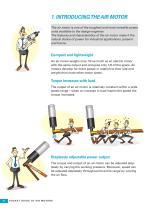
1. INTRODUCING THE AIR MOTOR The air motor is one of the toughest and most versatile power units available to the design engineer. The features and characteristics of the air motor make it the natural choice of power for industrial applications, present and future. Compact and lightweight An air motor weighs only 1/4 as much as an electric motor with the same output and occupies only 1/6 of the space. Air motors develop far more power in relation to their size and weight than most other motor types. Torque increases with load The output of an air motor is relatively constant within a wide speed...
Open the catalog to page 4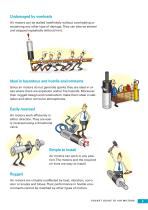
Undamaged by overloads Air motors can be stalled indefinitely without overheating or sustaining any other type of damage. They can also be started and stopped repeatedly without limit. Ideal in hazardous and hostile environments Since air motors do not generate sparks they are ideal in areas where there are explosion and/or fire hazards. Moreover, their rugged design and construction make them ideal in saltladen and other corrosive atmospheres. Easily reversed Air motors work efficiently in either direction. They are easily reversed using a directional valve. Simple to install Air motors can...
Open the catalog to page 5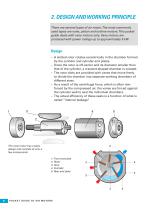
There are several types of air motor. The most commonly used types are vane, piston and turbine motors. This pocket guide deals with vane motors only. Vane motors are produced with power ratings up to approximately 5 kW. - A slotted rotor rotates eccentrically in the chamber formed by the cylinder and cylinder end plates. - Since the rotor is off-center and its diameter smaller than that of the cylinder, a crescent-shaped chamber is created. - The rotor slots are provided with vanes that move freely to divide the chamber into separate working chambers of different sizes. - As a result of the...
Open the catalog to page 6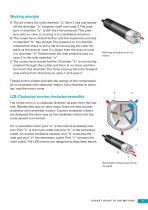
Working principle A. The air enters the inlet chamber “a”. Vane 2 has just sealed off the chamber “b” between itself and vane 3. The pressure in chamber “b” is still the inlet pressure. This pressure acts on vane 3, moving it in a clockwise direction. B. The vanes have rotated further and the expansion process in chamber “b” has started. The pressure in it is thereby reduced but there is still a net force moving the rotor forward as the area of vane 3 is larger than the area of vane 2 in chamber “b”. Furthermore the inlet pressure acts on vane 2 in the inlet chamber “a” C. The vanes have moved...
Open the catalog to page 7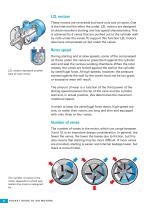
LZL motors These motors are reversible but have only two air ports. One is the inlet and the other the outlet. LZL motors are designed to obtain excellent starting and low speed characteristics. This is achieved by 6 vanes that are pushed out to the cylinder wall by rods under the vanes. To support this function LZL motors also have compressed air fed under the vanes. Rotor speed LZL motors represent another type of vane motor. During starting and at slow speeds, some of the compressed air flows under the vanes to press them against the cylinder wall and seal the various working chambers. When...
Open the catalog to page 8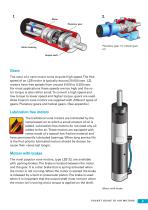
Motor Planetary gear Planetary gear (1), helical gear (2). Motor housing Output shaft Gears The rotor of a vane motor turns at quite high speed. The free speed of an LZB motor is typically around 20 000 rpm. LZL motors have free speeds from around 6 000 to 9 300 rpm. For most applications these speeds are too high and the rotor torque is also rather small. To convert a high speed and low torque to lower speed and higher torque, gears are used. Atlas Copco’s vane motors are supplied with different types of gears: Planetary gears and helical gears. (See appendix.) Lubrication free motors The traditional...
Open the catalog to page 9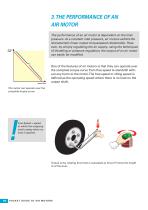
3. THE PERFORMANCE OF AN AIR MOTOR The performance of an air motor is dependent on the inlet pressure. At a constant inlet pressure, air motors exhibit the characteristic linear output torque/speed relationship. However, by simply regulating the air supply, using the techniques of throttling or pressure regulation, the output of an air motor can easily be modified. One of the features of air motors is that they can operate over the complete torque curve from free speed to standstill without any harm to the motor. The free speed or idling speed is defined as the operating speed where there is...
Open the catalog to page 10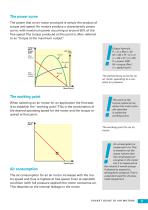
The power curve The power that an air motor produces is simply the product of torque and speed. Air motors produce a characteristic power curve, with maximum power occurring at around 50% of the free speed. The torque produced at this point is often referred to as “torque at the maximum output.” Torque [Nm] Power [kW] Max output Output formula P = (π x Mxn) / 30 M = (30 x P) / (π x n) n = (30 x P) / (π x M) P = power [kW] M = torque [Nm] n = speed [rpm] The performance curve for an air motor operating at a constant air pressure. Speed [rpm] The working point When selecting an air motor for an...
Open the catalog to page 11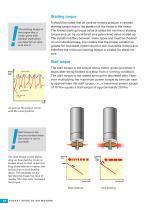
Starting torque The starting torque is the torque that a motor gives with blocked shaft when you feed full air pressure into it. It should be noted that all vane air motors produce a variable starting torque due to the position of the vanes in the motor. The lowest starting torque value is called the minimum starting torque and can be considered as a guaranteed value at start up. The variation differs between motor types and must be checked on an individual basis. It is notable that the torque variation is greater for reversible motors than for non-reversible motors and therefore the minimum...
Open the catalog to page 12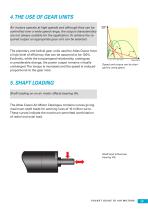
4. THE USE OF GEAR UNITS Air motors operate at high speeds and although they can be controlled over a wide speed range, the output c haracteristics are not always suitable for the application. To achieve the required output an appropriate gear unit can be selected. The planetary and helical gear units used by Atlas Copco have a high level of efficiency that can be assumed to be 100%. Evidently, while the torque/speed relationship undergoes a considerable change, the power output remains virtually unchanged. The torque is increased and the speed is reduced proportional to the gear ratio. Speed...
Open the catalog to page 13All Atlas Copco Industrial Technique catalogs and technical brochures
 Food industry
7 Pages
 Industrial air motors catalog
130 Pages
 TZB Turbine motors
8 Pages
 Agitator motors
16 Pages
 Pipe processing
8 Pages
 PZB piston motors
4 Pages
 Transportation leaflet
8 Pages
 Industrial air motors leaflet
10 Pages

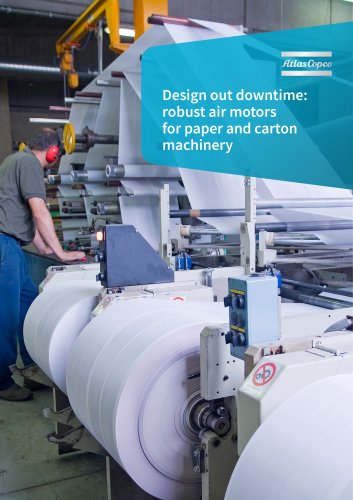
Archived catalogs
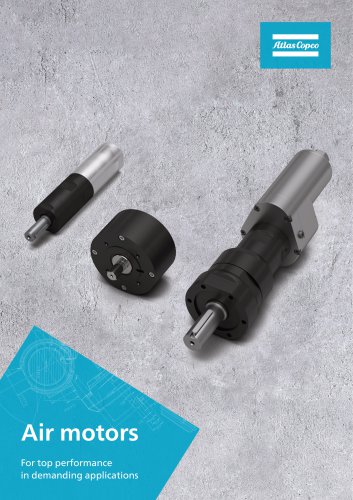 Industrial air motors catalog
110 Pages
- Atlas Copco ATEX air motor
- Atlas Copco lubricated air motor
- Atlas Copco standard air motor
- Compact air motor
- Atlas Copco reversible air motor
- Gear air motor
- Atlas Copco steel air motor
- Atlas Copco aluminum air motor
- High-torque air motor
- Atlas Copco stainless steel air motor
- Piston air motor
- Flange air motor
- Non-lubricated air motor
- Air motor for heavy-duty applications
- Air motor for the food industry
- Pump air motor
- Deburring air motor
- Air motor for mining applications