
- Catalogs
- Atlas Copco Industrial Technique
- Industrial air motors catalog

- Products
- Catalogs
- News & Trends
- Exhibitions
Industrial air motors catalog
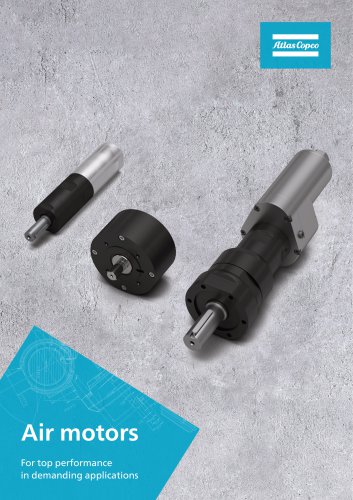
Industrial air motors catalog
Atlas Copco air motors are compact, lightweight, and offer high power relative to their size and weight. They can be stalled indefinitely without damage, and their torque, speed, and direction can be easily adjusted. These motors are suitable for hostile environments and are ATEX certified for explosive environments.
- Air motors are significantly lighter and smaller than equivalent electric motors.
- They can be stalled and restarted without overheating.
- Torque and speed are easily adjustable.
- They operate smoothly, minimizing shock loading on transmission components.
Selecting the right motor involves determining the "working point," which is the desired operating speed and torque. The Atlas Copco selection tool aids in choosing the appropriate motor. Installation requires attention to air line dimensions, air preparation, and the use of appropriate control valves.
- LZB Vane Motors: Known for their versatility and efficiency, with various mounting and connection options.
- LZL Vane Motors: Offer combinations with gear units for enhanced performance.
- TZB Turbine Motors: Provide high-speed operation with specific performance curves.
- PZB Piston Motors: Suitable for applications requiring specific torque and speed characteristics.
Performance curves illustrate the relationship between power, torque, and speed. Air motors can be controlled using throttling or pressure regulation to adjust output. Gear units can be used to modify output characteristics.
Atlas Copco air motors are designed to operate in various hostile environments, including acidic, explosive, and high-temperature conditions. They can also function with different types of compressed gases.
For optimal performance, air motors require proper air preparation, including filtration and lubrication. Lubrication-free vane motors are available, but performance may vary based on lubrication levels.
Atlas Copco air motors are a reliable choice for demanding applications, offering flexibility, durability, and efficiency. Their design and performance make them suitable for a wide range of industrial uses.
The document provides detailed specifications for various models of Atlas Copco air motors, including LZB33, LZB34, LZB42-L, LZB46-L, LZB77-L, and others. Each model is described with parameters such as power output, speed, torque, air consumption, and weight. The motors are available in foot mount and flange mount configurations.
Performance curves for each motor model are provided, showing the relationship between torque, power, speed, and air consumption at an air pressure of 6.3 bar (91 psi). These curves help in understanding the motor's efficiency and operational capabilities under different load conditions.
The document includes conversion factors for power, torque, and air consumption, facilitating the conversion between metric and imperial units.
Guidelines for explosion-protected air motors are outlined, emphasizing the maximum surrounding temperature and the importance of maintaining air quality and pressure limits to prevent the motor from becoming an ignition source.
The motors are available in stainless steel versions, which are 100% silicon-free and use food-grade grease, making them suitable for applications in sensitive environments. The EX certification ensures safe operation in hazardous areas.
For applications requiring low speed and high torque, specific models are recommended. The document advises using lubricated air to optimize the lifespan of lubrication-free motors, although performance may decrease when using 100% dry air.
Optional accessories include stainless steel motor cells, vane kits, and various mounting options. Detailed ordering information is provided for each model and configuration.
Atlas Copco offers customization options for air motors to meet specific OEM requirements, including unique casing, mounting arrangements, and non-standard materials.
Atlas Copco's air motors are designed for high efficiency and safety in industrial applications, with comprehensive technical support and customization options available to meet diverse customer needs.
Catalog excerpts
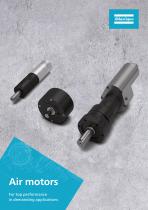
Air motorsFor top performance in demanding applications i ' ’!*/( H .V
Open the catalog to page 1
2 | Atlas Copco Air Motors
Open the catalog to page 2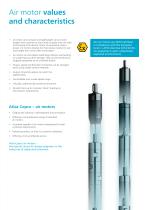
Air motor values and characteristics • Air motors are compact and lightweight. An air motor weighs only a quarter as much and occupies only one sixth of the space of an electric motor of equivalent output power. Air motors develop far more power relative to size and weight than most other motor types. Air motors can be stalled indefinitely without overheating or sustaining any other damage. They can be started and stopped repeatedly to an unlimited extent. Torque, speed and direction of rotation can be changed easily using simple control methods. Output inherently adjusts to match the applied...
Open the catalog to page 3
Select the right motor and download 3D drawings Download the dimensional drawings in 2D or 3D available at https://webbox.atlascopco.com/webbox/dimdrw/index.html Available formats: PDF - DXF - IGS - STP Selecting the right motor has never been easier! Just enter the required working point for the application and the most suitable motor will automatically be selected. For the selection use the Atlas Copco selection tool. Air motor selection program, available at www.atlascopco.com./en-uk/itba/industry-solutions/airmotors/air-motor-selection-tool 4 | Atlas Copco Air Motors
Open the catalog to page 4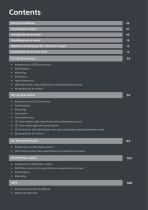
Choosing your motor 07 Installing your air motor 10 Methods of modifying LZB - LZL motor output 12 Introduction to Air Drive Units 13 • Introduction to LZB Vane motors • Shaft loading • Hose dimensions • LZB Vane motors: data, specification and performance curves • Introduction to LZL Vane motors • Shaft loading • Hose dimensions • LZL Vane motors: data, specification and performance curves • LZL Vane motor/gear unit combinations • LZL Air motors: with helical gear units data, specification and performance curves • Introduction to TZB Turbine motors • TZB Turbine motors: data, specification and...
Open the catalog to page 5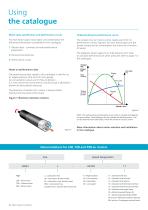
Using the catalogue Motor data, specification and performance curves Understanding the performance curves For each Atlas Copco motor/gear unit combination the following information is presented in this catalogue. The output of an air motor is most clearly seen from its performance curves, Figure 8. For each motor/gear unit the power, torque and air consumption are shown as a function of speed. 1. Tabular data – summary of main performance parameters. The diagrams shown apply to an inlet pressure of 6.3 bar, to calculate performance at other pressures refer to page 7 in this catalogue. 2. Dimensional...
Open the catalog to page 6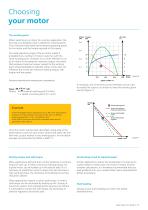
Choosing your motor The working point When selecting an air motor for a certain application, the first step is to establish what is called the “working point”. This is the point described by the desired operating speed for the motor and the torque required at that speed. The wide operating range of the air motor makes it probable that a number of motors could run with the same working point. However as it is most efficient to run an air motor at the speed at maximum output, the motor that produces maximum power nearest to the working point should probably be selected. Other criteria that can...
Open the catalog to page 7
Hostile environments The noise generated by an air motor is mainly caused by the exhaust air of the motor. The noise level increases with speed and is greatest at the free speed. Atlas Copco air motors are found in use in many hostile environments, often with little or no modification. These environments are typified as being: Acidic – Explosive – Radioactive – High temperature – Moist – Dusty – Intense electric fields – Underwater – High humidity. It is also possible to power an air motor with many types of compressed gas, for example nitrogen or natural gas. However, to ensure safe and reliable...
Open the catalog to page 8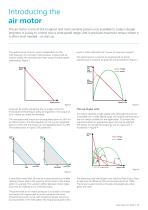
The air motor is one of the toughest and most versatile power units available to today’s design engineer. It is easy to control over a wide speed range, and it produces maximum torque where it is often most needed – at start up. The performance of an air motor is dependent on the inlet pressure. At a constant inlet pressure, ungoverned air motors exhibit the characteristic linear output torque/speed relationship. Figure 1. point is often referred to as ”torque at maximum output.” The performance curves for an ungoverned air motor operating at a constant air pressure are illustrated in Figure...
Open the catalog to page 9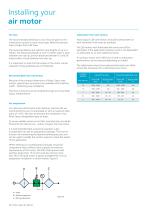
Installing your The recommended dimensions of air lines are given in the introductory section to each motor type. Note that exhaust hose is larger than inlet hose. The recommendations are valid for hose lengths of up to 3 meters. For distances between 3 and 15 meters select a hose diameter one size up, and for distances between 15 and 50 meters select a hose diameter two sizes up. It is important to note that the output of the motor will be reduced if these guidelines are not followed. Because of the compact dimensions of Atlas Copco vane motors, special hose connectors are available with small...
Open the catalog to page 10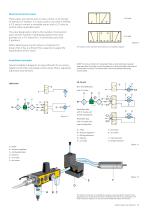
Directional control valves 3/2 valve These valves are used to start or stop a motor, or to change its direction of rotation. It is most usual to use what is termed a 5/3 valve to control a reversible motor, and a 3/2 valve to control a Non-reversible motor. The valve designations refer to the number of connection ports and the number of operating positions the valve provides, for a 5/3 valve this is 5-connection ports and 3 positions. When selecting any control valve it is important to ensure that it has a sufficient flow capacity to supply the requirements of the motor. 5/3 valve Figure 6 The...
Open the catalog to page 11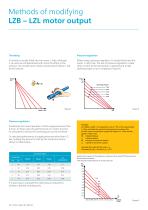
Methods of modifying LZB – LZL motor output Pressure regulation A throttle is usually fitted into the motor´s inlet, although it can also be complemented with some throttling at the exhaust. You should never create a back pressure above 1 bar at the exhaust. When using a pressure regulator it is mostly fitted into the motor´s inlet hose. The use of pressure regulation is ideal when control of the stall torque is required and a high starting torque is not so important, Figure 6. Operating pressure Velocidad [r/min] Speed r/min Pressure regulation Sometimes the motor operates at other supply pressures...
Open the catalog to page 12All Atlas Copco Industrial Technique catalogs and technical brochures
 Food industry
7 Pages
 Industrial air motors catalog
130 Pages
 TZB Turbine motors
8 Pages
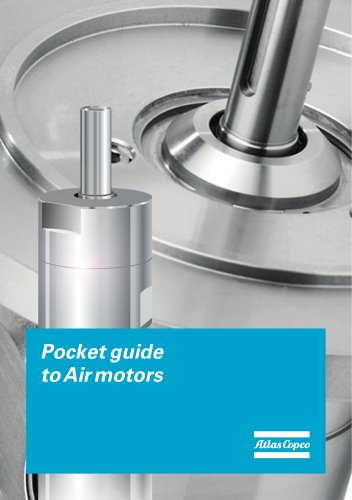 Pocket guide toAirmotors
28 Pages
 Agitator motors
16 Pages
 Pipe processing
8 Pages
 PZB piston motors
4 Pages
 Transportation leaflet
8 Pages
 Industrial air motors leaflet
10 Pages


- Atlas Copco vane air motor
- Atlas Copco ATEX air motor
- Atlas Copco lubricated air motor
- Atlas Copco standard air motor
- Compact air motor
- Atlas Copco reversible air motor
- Gear air motor
- Atlas Copco steel air motor
- Atlas Copco aluminum air motor
- High-torque air motor
- Atlas Copco stainless steel air motor
- Piston air motor
- Flange air motor
- Non-lubricated air motor
- Air motor for heavy-duty applications
- Air motor for the food industry
- Pump air motor
- Deburring air motor
- Air motor for mining applications