
- Catalogs
- Atlanta Drive Systems
- Linear Guideway

Linear Guideway

Linear Guideway
- High Positioning Accuracy and Repeatability: The PMI linear guideway features a rolling motion design that minimizes friction, preventing stick-slip during submicron feeding.
- Low Frictional Resistance: Compared to slide guides, these guideways have significantly lower frictional resistance, maintaining high precision with proper lubrication.
- High Rigidity: The design supports loads in four directions, enhancing rigidity through preloading and additional carriages.
- High-Speed Suitability: Low friction reduces driving force and power consumption, minimizing temperature rise during high-speed operations.
- Easy Installation and Interchangeability: Offers high precision with less demanding installation processes and allows for convenient maintenance.
- Full Ball, Heavy Load Type: Models like MSA-A and MSA-LA are designed for heavy loads and high rigidity, suitable for machine centers and NC lathes.
- Full Ball, Compact Type: Models such as MSB-TE and MSB-E offer compact design with high load capacity, ideal for precision equipment.
- Full Roller, Heavy Load Type: MSR-E and MSR-LE models provide ultra-heavy load capacity and high rigidity, used in machine centers and milling machines.
- Ball Chain, Heavy Load Type: SME-E and SME-LE models feature ball chain design for smooth movement and are used in heavy cutting machine tools.
- Static Load Rating (C0): Defines the permissible static load to prevent deformation that could hinder motion.
- Dynamic Load Rating (C): Used to calculate service life, indicating the load a guideway can handle under repeated stress.
- Nominal Life Calculation: Considers factors like hardness, temperature, and load to determine the guideway's service life.
- Static Safety Factor (fs): Accounts for unexpected forces due to impact and vibration, ensuring operational safety.
- Factors Affecting Load: Includes installation space, load magnitude and direction, frequency of use, and environmental conditions.
- Friction Coefficient: The frictional resistance is influenced by load, preload, and lubricant viscosity, with specific coefficients for ball and roller types.
- Model Specifications: Each model, such as SME 15 EA, SME 20 EA, etc., is detailed with dimensions including height, width, length, and other critical measurements. The specifications also cover the type of grease nipple and bolt sizes required.
- Rail Dimensions and Load Ratings: This section outlines the rail dimensions, basic load ratings, static moment ratings, and weight for each model. It provides dynamic and static load capacities, which are crucial for determining the suitability of the guideway for specific applications.
- Construction and Characteristics: The SMR series is highlighted for its use of rollers instead of balls, offering higher rigidity and load capacity. The design is optimized for smooth movement and low noise, making it suitable for high accuracy and heavy load applications.
- Carriage and Rail Types: Different carriage types (E, S, LE, LS) and rail types (R, T) are described, indicating their load capacities and installation options. The document also discusses dust protection options and preload levels.
- Accuracy Grades: The document specifies accuracy grades (H, P, SP, UP) for running parallelism and tolerances for height and distance, which are critical for precision applications.
- Height and Distance Tolerances: The document specifies tolerances for height (H) and distance (W2) with variations depending on the model and accuracy grade. For example, for model 25, the tolerance for height H is ±0.04 mm, and for distance W2 is ±0.04 mm.
- Parallelism: Running parallelism of surfaces C with A and D with B is noted, with specific values referenced in Table 1.
- Preload grades are categorized as Medium (F0), Heavy (F1), and Ultra Heavy (F2) with specific ranges for each model, such as SMR25 having a range of 0.04~0.06C for medium preload.
- Dimensional tolerances for mounting surfaces are provided, with parallel deviation (e1) and level difference (e2) between two axes specified in micrometers.
- Details on rail dimensions, including width, height, and pitch, are provided for various models, such as SMR 25 with a width of 23 mm and height of 23.5 mm.
- Carriage dimensions include height, width, and length, with specific values for each model, such as SMR 25 E having a height of 36 mm.
- The MSG series features a 45° contact angle for equal load distribution in radial and lateral directions, enhancing rigidity and precision.
- Self-alignment capability allows for compensation of installation errors, ensuring smooth linear motion.
- Accuracy grades range from Normal (N) to Ultra Precision (UP), with running parallelism values provided for different rail lengths.
- Avoid tilting the linear guideway to prevent the carriage from falling.
- Do not beat or drop the guideway to avoid damage.
- Refrain from disassembling the carriage to prevent contamination and maintain installation accuracy.
- Use appropriate handling methods to avoid personal injury or damage when carrying excessive weight.
- Prevent foreign materials from causing slider failure or damage.
- Remove anti-rust oil and lubricate before use.
- Do not mix different lubricants.
- Ensure even distribution of oil in the ball groove, especially depending on mounting orientation.
- Move the carriage back and forth with a minimum stroke length of three carriages to distribute grease evenly.
- Maintain usage temperature below 80℃ to prevent damage to the plastic end cap.
- Use a dummy rail when removing or remounting the carriage.
- Contact PMI for usage under special conditions like constant vibration or high dust.
Catalog excerpts
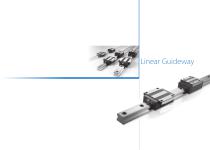
Linear Guideway
Open the catalog to page 1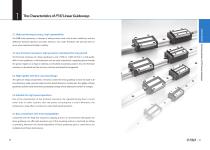
The Characteristics of PMI Linear Guideways LINEAR GUIDEWAY (1) High positioning accuracy, high repeatability The PMI linear guideway is a design of rolling motion with a low friction coeffcient, and the difference between dynamic and static friction is very small. Therefore, the stick-slip will not (2) Low frictional resistance, high precision maintained for long period The frictional resistance of a linear guideway is only 1/20th to 1/40th of that in a slide guide. With a linear guideway, a well lubrication can be easily achieved by supplying grease through the grease nipple on carriage or...
Open the catalog to page 2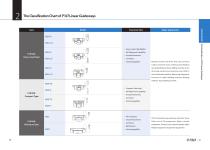
The Classification Chart of PMI Linear Guideways Type Major Application Full Ball, Heavy Load Type Full Ball, Compact Type Full Ball, Miniature Type MSA-A MSA-LA MSA-E MSB-TE MSB-E MSB-TS MSB-S • Heavy Load, High Rigidity • Self Alignment Capability • Smooth Movement • Low Noise • Interchangeability Machine Center, NC lathe, XYZ axes of heavy cutting machine tools, Grinding head feeding axis of grinding machines, Milling machine, Z axis of boring machine and machine tools, EDM, Z axis of industrial machine, Measuring equipment, Precision XY table, Welding machine, Binding machine, Auto packing...
Open the catalog to page 3
LINEAR GUIDEWAY Major Application MSR-E • Ultra Heavy Load • Ultra High Rigidity • Smooth Movement • Low Noise • Good lubricant Effect Machine Center, NC lathe, Grinding machine, Five axes milling machine, Jig borer, Drilling machine, Horizontal milling machine, Mold processing machine, EDM MSR-LS SME-E Ball Chain, Heavy Load Type SME-LE SME-S SME-LS SMR-E Roller Chain, Heavy Load Type SMR-LE SMR-S SMR-LS MSG-E Full Ball Wide Rail type • Heavy Load, High Rigidity • Self Alignment Capability • Ball Chain Design • Smooth Movement • Low Noise, Good Lubricant Effect • Interchangeability axis of grinding...
Open the catalog to page 4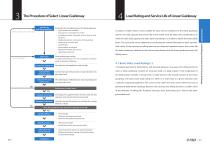
The Procedure of Select Linear Guideway span, No. of carriages, No. of rails change Load Rating and Service Life of Linear Guideway Parameters for calculating load on the linear guideway • Space available for installation • Size (span, No. of carriages, No. of rails) • Installation position (horizontal, vertical, tilted, or wallhung, etc.) • Magnitude, direction, and location of imposed load • Frequency of use (duty cycle) • Moving speed , acceleration • Required service life, and accuracy • Operating environment system, the load capacity and service life of the model must be taken into consideration....
Open the catalog to page 5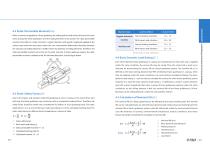
4.2 Static Permissible MomentMo) When a moment is applied to a linear guideway, the rolling balls on both ends will receive the most stress among the stress distribution over the rolling elements in the system. The static permissible moment (Mo) refers to a static moment in a given direction with specific magnitude applied at the contact area under the most stress where the sum of permanent deformation develops between the raceway and rolling elements is 0.0001 times the diameter of rolling elements. Therefore, the static permissible moment sets a limit on the static moment. In linear guideway...
Open the catalog to page 6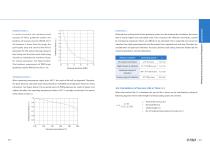
Hardness factor fH In order to ensure the optimum load capacity of linear guideway system, the hardness of raceway must be HRC58~64. If the hardness is lower than this range, the permissible load and nominal life will be decreased. For this reason, the basic dynamic load rating and the basic static load rating should be multiplied by hardness factor for rating calculation. See figure below. The hardness requirement of PMI linear guideway is above HRC58, thus the f=1.0. Load factor fw Although the working load of liner guideway system can be obtained by calculation, the actual load is mostly higher...
Open the catalog to page 7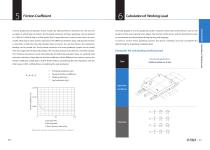
Friction Coefficient Calculation of Working Load A linear guideway manipulates linear motion by rolling elements between the rail and the carriage. In which type of motion, the frictional resistance of linear guideway can be reduced to 1/20th to 1/40th of that in a slide guide. This is especially true in static friction which is much smaller than that in other systems. Moreover, the difference between static and dynamic friction is very little, so that the stick-slip situation does not occur. As such low friction, the submicron feeding can be carried out. The frictional resistance of a linear...
Open the catalog to page 8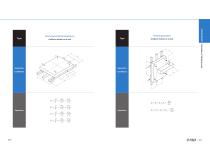
Type Operation Conditions Overhung horizontal application: Uniform motion or at rest Type Vertical application: Uniform motion or at rest Operation Conditions
Open the catalog to page 9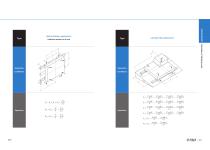
Type Operation Conditions Equations Wall installation application: Uniform motion or at rest Type Laterally tilted application z 5 73 C\ C o Equations FcosQ F cosQ l3 FcosQ14 FsinQhj FcosQ F cosQ l3 FcosQ l4 FsinQhj F cosQ F-cosQ l3 F cosQ 14 FsinQ-hj FcosQ FcosQ l3 FcosQ l4 _ Fsind hj
Open the catalog to page 10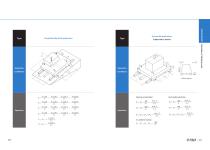
Type Operation Conditions Equations Longitudinally tilted application Type Horizontal application: Subjected to inertia z 5 73 cn c o F cosQ F cosQ l3 F cosQ -14 F-cosQ FcosQlj FsinQhj 2li FsinQhj FsinQhj 2-Ti FsinQh, 2-l} Equations During acceleration _ mg ma,l3 During deceleration
Open the catalog to page 11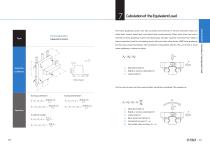
Operation Conditions Equations Vertical application: Subjected to inertia an= Velocity diagram During deceleration mg l, 21, Calculation of the Equivalent Load The linear guideway system can take up loads and moments in all four directions those are radial load, reverse-radial load, and lateral load simultaneously. When more than one load is exerted on linear guideway system simultaneously, all loads could be converted into radial or lateral equivalent load for calculating service life and static safety factor. PMI linear guideway has four-way equal load design. The calculation of equivalent...
Open the catalog to page 12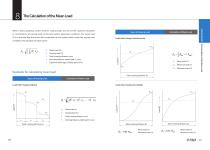
The Calculation of the Mean Load Types of Varying Load in consideration of varying loads of the host-system operation conditions. The mean load (Pm) is the load that the service life is equivalent to the system which under the varying load Calculation of Mean Load Loads that change monotonously conditions. The equation of mean load is: Total running distance (mm) Running distance under load Pn (mm) Exponent (Ball type:3, Roller type:10/3) Mean load (N) Minimum load (N) Examples for calculating mean load The Calculation of the Mean Load LINEAR GUIDEWAY When a linear guideway system receives varying...
Open the catalog to page 13All Atlanta Drive Systems catalogs and technical brochures
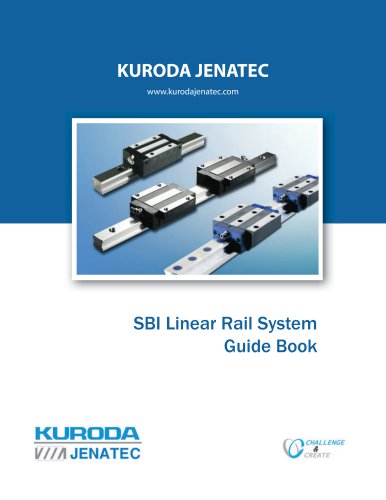 Linear Rail Systems
63 Pages
 Right-Angle Bevel Gearboxes
18 Pages
 ATLANTA Product Overview
12 Pages
 ATLANTA BG Servo-Bevel Reducers
13 Pages
 ATLANTA B Servo-Worm Reducers
16 Pages
 ATLANTA E Servo-Worm Reducers
18 Pages
 ATLANTA HP Servo-Worm Reducers
17 Pages
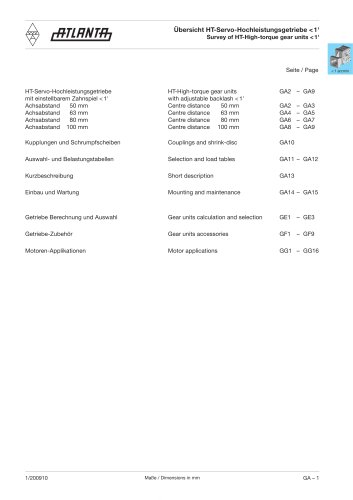 ATLANTA HT Servo-Worm Reducers
15 Pages
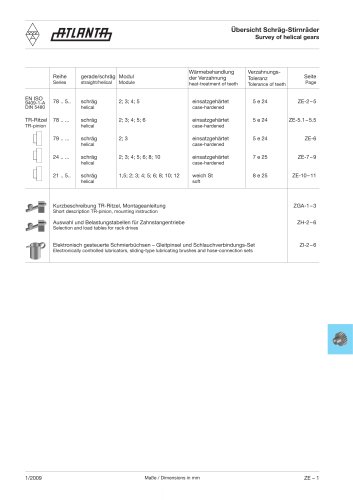 ATLANTA Pinion Range
40 Pages
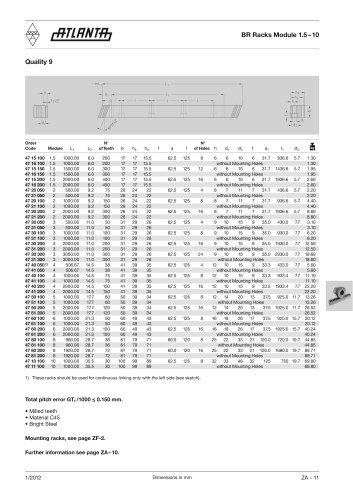
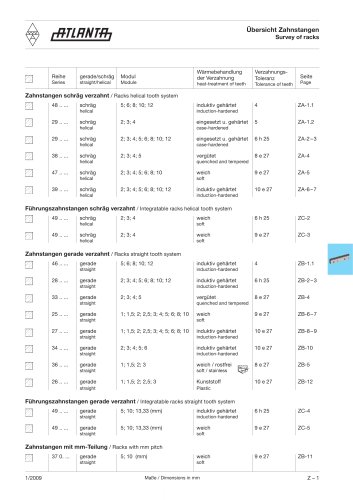 ATLANTA Rack Range
39 Pages



- Cylinder
- Planetary gearbox
- Coaxial gearhead
- Precision gearhead
- Right angle gearhead
- Compact gearhead
- Gear train gear reducer
- Transmission gearhead
- Shaft gearhead
- Machines gearbox
- Clamp gearbox
- Bevel gearhead
- Electric motor gearhead
- Modular gearhead
- Electric cylinder
- Greasing system
- Screw jack
- Servo motor gearhead
- Rack and pinion
- Straight-toothed sprocket wheel