1. Catalogs
  2. Atexxo B.V.
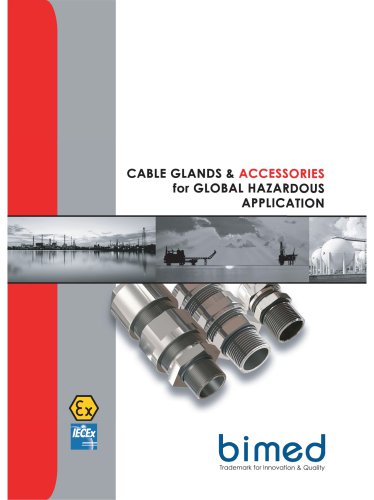
  3. CABLE GLANDS & ACCESSORIES

CABLE GLANDS & ACCESSORIES

CABLE GLANDS & ACCESSORIES
1 / 114 PagesView full catalog

CABLE GLANDS & ACCESSORIES

Product catalog summary
Company Overview: Bimed, founded in 1978, is a family-owned manufacturer based in Istanbul, Turkey. It operates a 20,000 square meter facility with over 300 employees and has expanded globally with offices in North America, Germany, and Egypt, and distribution partners in over 30 countries.
Product Range: Bimed offers a variety of products including cable glands, conduit fittings, pressure balance elements, connectors for appliances and automotive industries, gas springs for automotive and furniture industries, and disposable medical products. All products comply with national and international standards, such as EN ISO 9001:2008.
Quality and Certifications: Bimed is known for high-quality production, supported by a certified laboratory and over 30 years of experience. The company holds ATEX 100 and IEC Ex factory approvals and has a laboratory certified by IMQ for hazardous areas.
Customer Satisfaction and Innovation: Bimed prioritizes customer satisfaction by offering standard and customized products. The R&D department develops new items based on client demands, enhancing customer loyalty.
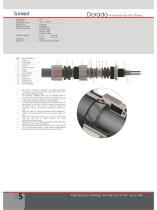
Product Specifications: The document details specifications for cable glands designed for mining and gas & dust environments, with certifications like ATEX Group I and Group II-III. Products are explosion-proof, deluge-proof, and provide high strain relief and IP ratings.
Technical Details: Specifications include dimensions, clamping ranges, materials, and operating temperatures for cable glands. Design features enhance safety and functionality, such as O-rings and grounding cones.
Conclusion: Bimed emphasizes its commitment to quality and innovation, establishing its leadership in the cable gland and connector sector.
Technical Document Summary
1. Specifications and Product Details: Detailed specifications for cable glands include thread types (Metric and NPT), material options (Brass, Stainless Steel, Galvanized Steel, Aluminium), and sealing options (Chloroprene, Silicone). Dimensions, clamping ranges, and order encoding examples are provided.
2. Auto Ignition Temperatures: Lists auto ignition temperatures for gases and dusts, such as Methane (580°C) and Sugar (460°C).
3. Safety and Certification: Details safety requirements and certifications, including ATEX and IECEx. Equipment marking for explosive atmospheres is specified.
4. Equipment Marking and Protection: Equipment is marked for use in explosive atmospheres, suitable for Gas Group IIC and Dust Group IIIC, with protection rated IP66 – IP68.
5. Material and Construction: Specifies materials like Brass, Stainless Steel, and Aluminium, and thread types available.
6. Additional Information: Operating temperature ranges for seals are provided, with options for customized high-temperature applications.
Overview: The document provides specifications and guidelines for Ex e and Ex d/e conduit fittings and cable glands for explosive atmospheres.
Specifications: Lists components like O-rings, lower bodies, seals, and cables, with clamping range and sealing combinations.
Certifications and Standards: Fittings comply with ATEX and IECEx standards, suitable for Gas Group IIC and Dust Group IIIC.
Order Encoding: Provides a coding system for ordering, with examples.
Temperature and Material Specifications: Specifies operating temperature range for seals and materials used.
Installation and Usage: Explains use of fittings for watertight connections and electrical bonding.
Additional Features: Mentions availability of customized applications and multihole seals.
Overview: Provides specifications and guidelines for cable glands in explosive atmospheres, covering materials, thread types, and protection standards.
Specifications: Suitable for Group II and III environments, with protection rated IP66 to IP68.
Materials and Construction: Available in materials like brass, stainless steel, and aluminum.
Thread Types: Lists various thread types with dimensions and clamping ranges.
Certification and Standards: Certified by IMQ, complying with IECEx and ATEX standards.
Applications: Used for connecting cables to electrical sources, suitable for armored and unarmored cables.
Key Features: Highlights impact and UV resistance.
Overview: Provides specifications and certifications for plugs and enlargers in explosive atmospheres.
Specifications: Designed for Group II and III environments, with protection types Ex e, Ex tb, and Ex i.
Procedures and Standards: Certified by IMQ and CESI, with safety requirements according to EN 60079 and IEC 60079.
Recommendations: For intrinsically safe circuits, specific cable glands are recommended.
Key Data from Tables: Includes thread types and operating temperature ranges.
Overview: Provides specifications for metal fittings, focusing on explosive atmospheres.
Specifications: Outlines specifications for thread types and code generation.
Certification and Safety: Mentions IECEx and ATEX certifications.
Materials and Construction: Made from materials like brass and stainless steel.
Applications: Suitable for Group II and III environments.
Dimensional Data: Provides detailed dimensions for configurations.
Equipment Marking and Standards: Compliance with IEC standards for hazardous areas is outlined.
Drain Plug Functionality: Designed to remove moisture while allowing air exchange.
Order Encoding and Material Specifications: Provides detailed order encoding for components.
Protection and Safety Features: Emphasizes explosion prevention measures.
Accessories and Components: Specifications for accessories like earth tags and gaskets are provided.
Materials and Operating Temperatures: Discusses materials like NBR and silicone with specific temperature ranges.
Explosion Proof Information: Explains design and testing for hazardous locations.
International Standards and Compliance: Highlights convergence of international standards for hazardous area equipment.
Area Classification and Equipment Ratings: Outlines process for identifying equipment ratings and installation techniques.
Historical Context: Discusses early electrical systems in coal mines and the need for safer systems.
Abbreviations: Includes terms like SWA and AWA for cable types.
Explosion Proof Information: Defines gas divisions and zones, and types of protection.
Gas Groups: Classifies gases based on volatility and ignition energy.
Equipment Protection Level (EPL): Specifies protection levels for equipment based on zone usage.
Temperature Classification: Equipment must not exceed 80% of auto-ignition temperature.
Auto-Ignition Temperatures: Lists temperatures for substances to ignite without external heat.
Types of Protection: Categorizes equipment by protection methods.
Multiple Protection: Equipment may use multiple protection methods.
ANSI/NFPA Area Descriptions: Defines classes and divisions based on presence of flammable substances.
Classification of Hazardous Areas: Divides Class II and III areas based on dust types.
Equipment Categories: Categorizes equipment based on protection level.
Labeling Requirements: Specifies labeling requirements in Europe and North America.
IP Classification Codes: Defines protection levels against foreign objects and moisture.
Explosion Proof Information: Discusses explosion prevention measures.
Types of Explosion Protection: Lists various types of explosion protection.
Potentially Explosive Atmospheres: Defined as mixtures of flammable substances with air.
Area Classification: Ensures correct selection and installation of equipment.
Area Classification (Zones): Divides facilities into hazardous and non-hazardous areas.
Classification Society: Societies may impose additional design requirements.
Design and Installation of Electrical Systems: Equipment must comply with specific codes and standards.
Apparatus Selection According to Zones: Different protections required for apparatus in various zones.
Apparatus Selection According to Ignition Temperature: Equipment must not exceed ignition temperature of gases or vapors.
Apparatus Grouping: Classifies gases and vapors into groups.
Device Category: Categories determined by zone of use.
Equipment Protection Level (EPL): Divides devices into protection levels for gas and dust areas.
See more

Catalog excerpts

CABLE GLANDS & ACCESSORIES-2

Bimed begun in 1978 as a manufacturer of medical and mechanical components. Today Bimed is a family owned organization with more than 300 people and a 20,000 square meter facility. The Istanbul, Turkey-based company has offices in North America, Germany and Egypt. In many other countries Bimed is represented through local distribution partners. Our product range consists of the following groups: • Cable glands and conduit fittings • Pressure balance elements • Connectors for the appliance and automotive industries • Gas springs for the automotive and furniture industries • Disposable medical...

 Open the catalog to page 2
CABLE GLANDS & ACCESSORIES-3

Mining - Group I Ex I M2 Ex d I Mb Ex e I Mb Dorado M-BA 4 Function Glands 05-06 Gas & Dust - Group II-III Ex II GD Ex d IIC Gb Ex e IIC Gb Ex tb III Db Dorado BA 4 Function Glands 11-12 Gas & Dust - Group II-III Orion Universal KBAU 4 Function Glands Orion Offshore KBAO 4 Function Glands E-Carina EBM Rigid Conduit Fittings E-Cygnus EBMC Rigid Conduit Fittings Phoenix SV Swivel Rigid Conduit Fittings E-Hydrus EBLS Liquidtight Conduit Fittings E-Scorpius EBLQ 45° Liquidtight Conduit Fittings E-Lupus EBLN 90° Liquidtight...

 Open the catalog to page 3
CABLE GLANDS & ACCESSORIES-4

When miners worked an 8-hour shitt pattern, the mined coal would be left in the shaft until the next day. during which time the methane would start to be evolved into the air in the shaft. The methane would collect in pockets at the roof of the mine and form an explosive layer. The mines returning for the next shift would carry with them the means of igniting the gas. hat mounted candles, and hand carried oil lanterns. The resulting ignition of the methane would in itself not necessarily be fatal for the miners. It was the secondary ignition of coal dust, throw up into a cloud by the methane...

 Open the catalog to page 4
CABLE GLANDS & ACCESSORIES-6

ATEX Group I / Mining / Ex I M2 / Ex d I Mb - Ex e I Mb

 Open the catalog to page 6
CABLE GLANDS & ACCESSORIES-7

UPPER SEAL CABLE OUTER DIAMETERS D1 <-► LOWER SEAL CABLE INNER DIAMETERS ATEX Group I / Mining / Ex I M2 / Ex d I Mb - Ex e I Mb

 Open the catalog to page 7
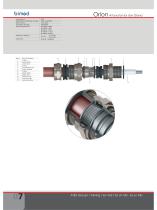
CABLE GLANDS & ACCESSORIES-8

Orion 4 Function Ex d/e Gland Approved by ATEX Group I / Mining / Ex I M2 / Ex d I Mb - Ex e I Mb

 Open the catalog to page 8
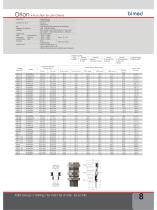
CABLE GLANDS & ACCESSORIES-9

ATEX Group I / Mining / Ex I M2 / Ex d I Mb - Ex e I Mb

 Open the catalog to page 9
CABLE GLANDS & ACCESSORIES-10

Groups II & III are further sub-divided depending upon the hazard.Group II gases are grouped together based upon the amount of energyrequired to ignite the most explosive mixture of the gas with air. Group III dusts are subdivided according to the nature of the explosive atmosphere for which it is intended. Ex d Flameproof The equipment that may cause an explosion is contained within an enclosure which can withstand the force of an explosion and prevent transmission to the outside hazardous atmosphere. This method of protection also prevents the hazardous atmosphere from entering the enclosure...

 Open the catalog to page 10
CABLE GLANDS & ACCESSORIES-12

11 ATEX Group / Gas & Dust / Ex II 2 GD / Ex d IIC Gb - Ex e IIC Gb - Ex tb III Db

 Open the catalog to page 12
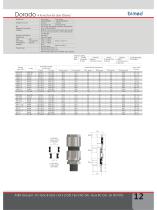
CABLE GLANDS & ACCESSORIES-13

UPPER SEAL CABLE OUTER DIAMETERS D1 <-► LOWER SEAL CABLE INNER DIAMETERS ATEX Group / Gas & Dust / Ex II 2 GD / Ex d IIC Gb - Ex e IIC Gb - Ex tb III Db

 Open the catalog to page 13
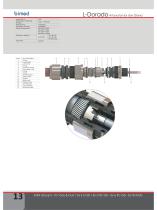
CABLE GLANDS & ACCESSORIES-14

13 ATEX Group / Gas & Dust / Ex II 2 GD / Ex d IIC Gb - Ex e IIC Gb - Ex tb III Db

 Open the catalog to page 14
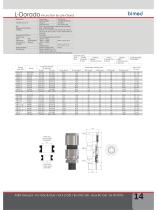
CABLE GLANDS & ACCESSORIES-15

UPPER SEAL CABLE OUTER DIAMETERS LOWER SEAL CABLE INNER DIAMETERS ATEX Group / Gas & Dust / Ex II 2 GD / Ex d IIC Gb - Ex e IIC Gb - Ex tb III Db

 Open the catalog to page 15
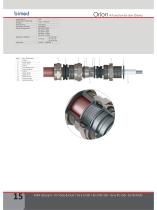
CABLE GLANDS & ACCESSORIES-16

15 ATEX Group / Gas & Dust / Ex II 2 GD / Ex d IIC Gb - Ex e IIC Gb - Ex tb III Db

 Open the catalog to page 16
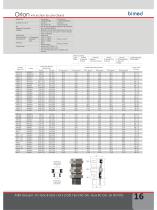
CABLE GLANDS & ACCESSORIES-17

UPPER SEAL CABLE OUTER DIAMETERS D1 ATEX Group II - III / Gas & Dust / Ex II 2 GD / Ex d IIC Gb - Ex e IIC Gb - Ex tb III Db

 Open the catalog to page 17
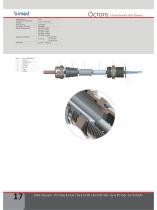
CABLE GLANDS & ACCESSORIES-18

17 ATEX Group / Gas & Dust / Ex II 2 GD / Ex d IIC Gb - Ex e IIC Gb - Ex tb III Db

 Open the catalog to page 18
CABLE GLANDS & ACCESSORIES-19

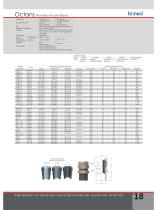
ATEX Group II - III / Gas & Dust / Ex II 2 GD / Ex d IIC Gb - Ex e IIC Gb - Ex tb III Db

 Open the catalog to page 19
CABLE GLANDS & ACCESSORIES-20

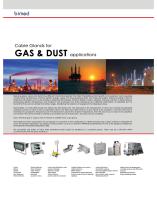
Explosive gases, vapors and dusts have different chemical properties that affect the likelihood and severity of an explosion. Such properties include flame temperature, minimum ignition energy, upper and lower explosive limits, and molecular weight. Empirical testing is done to determine parameters such as the maximum experimental safe gap. minimum ignition current, explosion pressure and time to peak pressure, spontaneous ignition temperature, and maximum rate of pressure rise. Every substance has a differing combination of properties but it is found that they can be ranked into similar ranges,...

 Open the catalog to page 20
CABLE GLANDS & ACCESSORIES-22

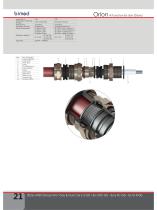
IECEx ATEX Group II-III / Gas & Dust / Ex II 2 GD / Ex d IIC Gb - Ex e IIC Gb - Ex tb III Db

 Open the catalog to page 22
CABLE GLANDS & ACCESSORIES-23

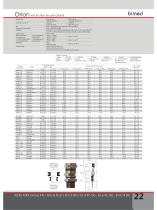
Orion 4 Function Ex d/e Gland Equipment Order Encoding UPPER SEAL CABLE OUTER DIAMETERS LOWER SEAL CABLE INNER DIAMETERS IECEx ATEX Group II-III / Gas & Dust / Ex II 2 GD / Ex d IIC Gb - Ex e IIC Gb - Ex tb III Db

 Open the catalog to page 23
CABLE GLANDS & ACCESSORIES-24

IECEx ATEX Group II-III / Gas & Dust / Ex II 2 GD / Ex d IIC Gb - Ex e IIC Gb - Ex tb III Db

 Open the catalog to page 24
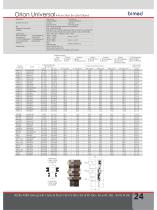
CABLE GLANDS & ACCESSORIES-25

UPPER SEAL CABLE OUTER DIAMETERS LOWER SEAL CABLE INNER DIAMETERS IECEx ATEX Group II-III / Gas & Dust / Ex II 2 GD / Ex d IIC Gb - Ex e IIC Gb - Ex tb III Db

 Open the catalog to page 25
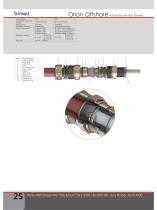
CABLE GLANDS & ACCESSORIES-26

IECEx ATEX Group II-III / Gas & Dust / Ex II 2 GD / Ex d IIC Gb - Ex e IIC Gb - Ex tb III Db

 Open the catalog to page 26
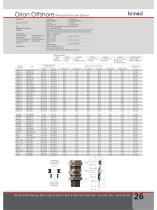
CABLE GLANDS & ACCESSORIES-27

UPPER SEAL CABLE OUTER DIAMETERS LOWER SEAL CABLE INNER DIAMETERS IECEx ATEX Group II-III / Gas & Dust / Ex II 2 GD / Ex d IIC Gb - Ex e IIC Gb - Ex tb III Db

 Open the catalog to page 27
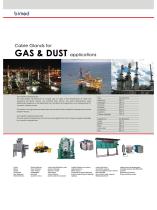
CABLE GLANDS & ACCESSORIES-28

Auto ignition temperatures The auto ignition temperature of a liquid, gas or vapor is the temperature at which the substance will ignite without any external heat source. The exact temperature value determined depends on the laboratory test conditions and apparatus. Such temperatures fo common substances are: The surface of a high pressure steam pipe may be above the autoignition temperature of some fuel/air mixtures. Auto ignition temperatures (dust) The auto ignition temperature of a dust is usually higher than that of vapours & gases. Examples for common materials are: Substance Sugar Wood Flour Grain...

 Open the catalog to page 28
CABLE GLANDS & ACCESSORIES-30

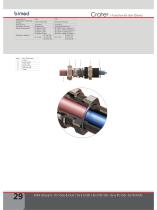
29 ATEX Group / Gas & Dust / Ex II 2 GD / Ex d IIC Gb - Ex e IIC Gb - Ex tb III Db

 Open the catalog to page 30
CABLE GLANDS & ACCESSORIES-31

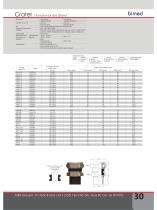
Seal and Pressure ring CABLE OUTER DIAMETERS , D1 , <-► ATEX Group II - III / Gas & Dust / Ex II 2 GD / Ex d IIC Gb - Ex e IIC Gb - Ex tb III Db

 Open the catalog to page 31
CABLE GLANDS & ACCESSORIES-32

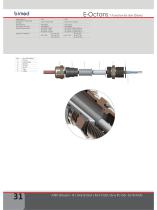
31 ATEX Group / Gas & Dust / Ex II 2 GD / Ex e IIC Gb - Ex tb III Db

 Open the catalog to page 32

All Atexxo B.V. catalogs and technical brochures
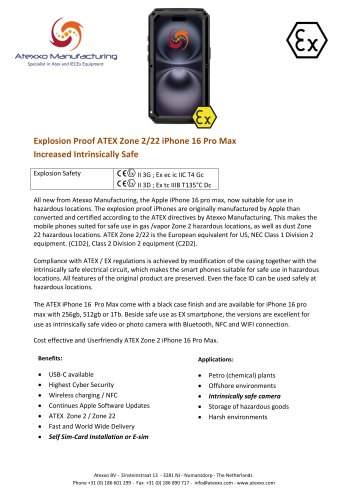
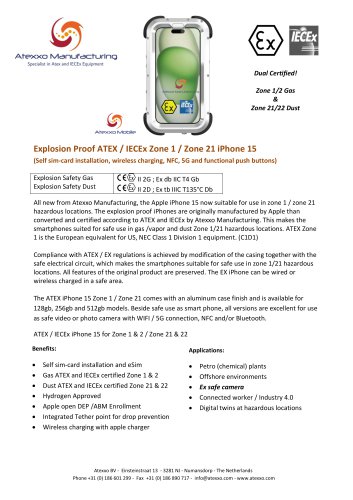
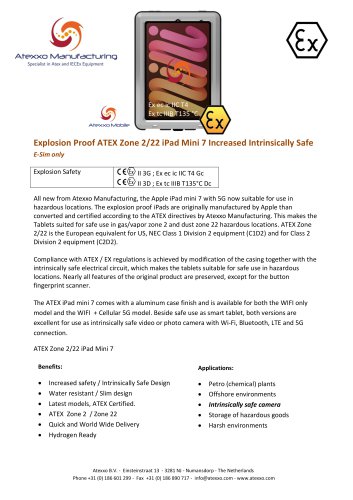
  1. ATEX Watch S5

    2  Pages

*Prices are pre-tax. They exclude delivery charges and customs duties and do not include additional charges for installation or activation options. Prices are indicative only and may vary by country, with changes to the cost of raw materials and exchange rates.