
- Catalogs
- Ashworth Bros
- Advantage 120

Advantage 120

Advantage 120
The Advantage 120 is a versatile 1.2” pitch hybrid belt suitable for straight runs, turn-curve, and spiral applications. It features a combination of plastic links, plastic body modules, and stainless steel rods, providing up to 67% open area for optimal airflow and sanitation. The belt can handle tension loads up to 1000 lbs and operates effectively in temperatures up to 180°F.
The belt is constructed from Acetal (POM) links and modules with stainless steel rods. It is available in widths ranging from 8" to 60" and has a thickness of 9/16". It supports bi-directional turning and weighs 2 lbs/ft².
For straight runs, the allowable tension is 400 lbs, while for curves and spirals, it is 200 lbs. The belt maintains full strength between -50°F and 110°F, with reduced strength at higher temperatures.
Optional features include guard edges in ½” and 1” heights. Turn ratios range from 1.4 to 2.5, and the appropriate ratio should be selected based on system requirements.
Drive sprockets should be keyed to the shaft with at least 180º belt wrap. Support idlers should be evenly spaced, and flanged idlers are recommended for guiding belt edges.
Wear strips should be adjusted based on speed, with increased distance recommended at speeds above 75 ft/min.
Formulas are provided for turn ratio and radius weight calculations, considering system radius, belt weight, and friction coefficients.
Minimum straight runs are specified for turns, with recommendations for spiral cage applications. Grounding devices are suggested to prevent static charge, and lubrication is advised to enhance performance.
Clearance between modules and cross rods must be maintained to prevent load issues, and belt stoppage should be minimized to avoid ice accumulation.
Use stainless steel cage bars or drums for belt systems. Adjust the overdrive setting to prevent belt surging, noting motor amperage and take-up roll location.
Maximum wash water temperature is 150°F (66°C), and maximum module temperature change is 160°F (71°C). Ensure water is removed before freezing applications. Clean support rails with non-abrasive towels and avoid caustic washes; use mild dish soap and water instead. Rinse belts with clear water after using stronger detergents and review chemical compatibility.
Flip the belt when one edge is 0.5% longer than the opposite edge.
Plastic belting contains thermoplastic components that can burn and emit toxic fumes if exposed to open flames or extreme temperatures. Avoid using plastic belts in processes where products could ignite. Refer to the MSDS for additional precautions and emergency response information.
Ashworth Bros., Inc., Winchester, VA, USA. Tel: 540.662.3494, Email: [email protected]
Ashworth BV, Enschede, The Netherlands. Tel: +31.53.4816500, Email: [email protected]
Ashworth Europe Ltd., Kingswinford, UK. Tel: +44.1384.355000, Email: [email protected]
Information is provided as a service without warranty of accuracy or applicability.
Catalog excerpts
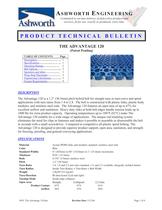
TABLE OF CONTENTSPage Description ŅŅŅŅ 1122 3558 Specifications ŅŅ... ... Ņ Operating Ratings .. Ņ... ... Ņ Belt Options ŅŅŅŅ... Sprockets andIdlers ŅŅ Wear Strip Placement ŅŅŅ > Engineering Calculations Ņ... System Requirements ŅŅŅ > Material Acetal (POM) links and modules standard, stainless steel rods Color Blue Standard Widths 8" (203mm) to 60" (1524mm) in 1" (25.4mm) increments Thickness 9/16" (14.3mm) Rods 0.192" (4.9mm) stainless steel Pitch 1.2" (30.5mm) Turn Ratio 1.6, 1.9 and 2.2 turn ratio standard, 1.4, and 2.5 available, integrally molded limiter Turn Radius Inside Turn Radius = Turn Ratio x Belt Width Weight 2 lbs/ftв (9.5 kg/m) Turn Direction Bi-directional (Left and right) Turning Mode Inside edge collapses Open Area Straight Collapsed 2.2 Turn Product Contact 67% 47% 61% Airflow 58% 32% 50% > 093C The Advantage 120.doc Revision Date: 5/12/06Page 1 of 9 size="-1">
Open the catalog to page 1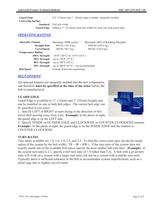
Ashworth Product Technical Bulletin THE ADVANTAGE120 Guard Edge 1/2" (12mm) and 1" (25mm) high available, integrally molded Conveying Surface Standard Full belt width Guard Edge Subtract 1 (25.4mm) from belt width for each side with guard edge > Allowable Tension Operating (100K cycles ) Maximum (40% of Breaking Strength) Straight Run 400 lbs (181.4 kg) 1000 lbs (453.6 kg) Curve/Spiral 200 lbs (90.7 kg) 500 lbs (226.8 kg) Temperature Rating 100% Strength -50F (-46C) to 110аF (43C) 90% Strength up to 170аF (77C) 80% Strength up to 180аF (82C) 50% Strength up to 200аF (93C) - not recommended Belt...
Open the catalog to page 2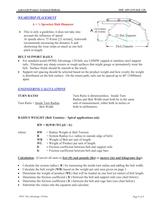
Ashworth Product Technical Bulletin THE ADVANTAGE120 WEARSTRIP PLACEMENT A = Sprocket Hub Diameter This is only a guideline; it does not take into account the influence of speed. At speeds above 75 ft/min [23 m/min], Ashworth recommends increasing the distance A and shortening the wear strips as much as one belt pitch in length. BELT SUPPORT RAILS For standard acetal (POM) Advantage 120 belt, use UHMW capped or stainless steel support rails. Eliminate any sharp corners or rough surfaces that might gouge or prematurely wear the belt. Surface finish should be smooth to the touch. Support rail spacing...
Open the catalog to page 5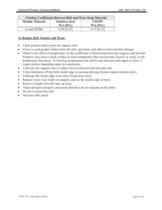
Ashworth Product Technical Bulletin THE ADVANTAGE 120 Friction Coefficients Between Belt and Wear Strip Material Module Material Stainless Steel Wet [Dry] UHMWWet [Dry] Acetal (POM) 0.20 [0.25] 0.15 [0.15] To Reduce Belt Tension and Wear: Clean product debris from the support rails. Clean ice and product debris from the belt, sprockets, and idlers to prevent belt damage. Observe the effect of temperature on the coefficient of friction between the supports and the belt. Products may leave a slick residue at room temperature that can become viscous or sticky as the temperature decreases. At freezing...
Open the catalog to page 6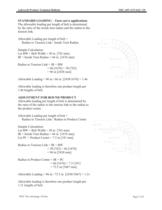
Ashworth Product Technical Bulletin THE ADVANTAGE120 STANDARD LOADING Turn curve applications The allowable loading per length of belt is determinedby the ratio of the inside turn radius and the radius to the tension link. Allowable Loading per length of belt = Radius to Tension Link / Inside Turn Radius Sample Calculation: Let BW = Belt Width = 30 in [762 mm] IR = Inside Turn Radius = 66 in [1676 mm] Radius to Tension Link = IR + BW = 66 [1676] + 30 [762] = 96 in [2438 mm] Allowable Loading = 96 in / 66 in [2438/1676] = 1.46 Allowable loading is therefore one product length per 1.46 lengths...
Open the catalog to page 7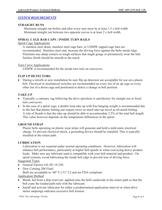
Ashworth Product Technical Bulletin THE ADVANTAGE 120 SYSTEM REQUIREMENTS STRAIGHT RUNS Minimum straight run before and after every turn must be at least 1.5 x belt width. Minimum straight run between two opposite curves is at least 2 x belt width. SPIRAL CAGE BAR CAPS / INSIDE TURN RAILS Spiral Cage Applications A stainless steel drum, stainless steel cage bars, or UHMW capped cage bars are recommended. Stainless steel may increase the driving force against the belts inside edge. Eliminate any sharp corners or rough surfaces that might gouge or prematurely wear the belt. Surface finish should...
Open the catalog to page 8All Ashworth Bros catalogs and technical brochures
 ExactaStack Standard Belt
5 Pages
 Advantage RL 75
9 Pages
Archived catalogs
 Advantage 200
9 Pages
- Conveying belt
- Plastic conveyor belt
- Industrial conveyor belt
- Flush grid conveyor belt
- Modular conveyor belt
- Conveyor belt for the food industry
- Metal belt for conveyor
- Flexible conveyor belt
- High-resistance conveyor belt
- POM conveyor belt
- Heat-resistant conveyor belt
- Stainless steel conveyor belt
- Wire mesh conveyor belt
- Wear-resistant conveyor belt
- Curved conveyor belt
- Acid-resistant conveyor belt
- Raised-rib conveyor belt
- Fatigue-resistant conveyor belt