- Catalogs
- asecos GmbH
- LITHIUM BATTERIES NOT AS HARMLESS AS THEY SEEM


LITHIUM BATTERIES NOT AS HARMLESS AS THEY SEEM
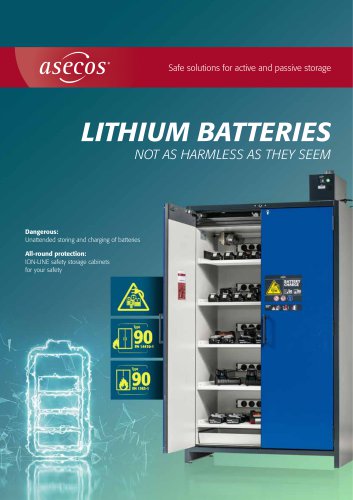
LITHIUM BATTERIES NOT AS HARMLESS AS THEY SEEM
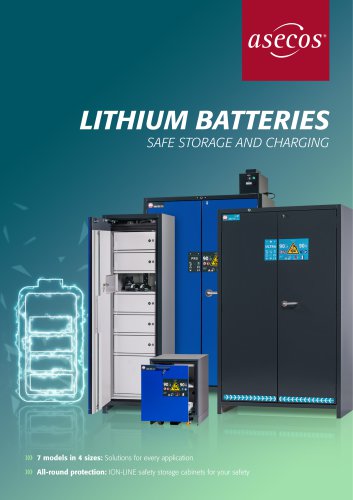
Lithium-ion batteries are widely used but present significant fire and safety risks, especially during storage and charging. This document outlines these dangers and provides guidelines for safe storage and handling.
Specifications and Safety Requirements
- Insurance and Liability: Proper storage and charging solutions are necessary to maintain insurance coverage and comply with the Occupational Health and Safety Act. Inadequate fire protection can lead to personal liability and financial losses.
- Storage Solutions: Type 90 safety storage cabinets from the asecos ION-LINE series are recommended to meet insurer and association requirements, providing secure storage and charging solutions without costly facility modifications.
Risks and Hazards
- Fire and Explosion Risks: Lithium-ion batteries can ignite or explode if damaged or improperly handled, requiring appropriate handling as they are classified as hazardous materials.
- Thermal Runaway: This occurs when a battery discharges energy uncontrollably, leading to a chain reaction and potential explosion.
Recommendations and Best Practices
- Storage Guidelines: Batteries should be stored in fire-resistant areas or with a safety distance of at least 5 meters from other flammable materials. Damaged batteries should be removed immediately.
- Active vs. Passive Storage: Active storage involves charging batteries in safety cabinets, while passive storage involves storing batteries separately. Both require specific safety measures.
Safety Features of ION-LINE Cabinets
- Fire Protection: Cabinets offer fire protection from both inside and outside, with integrated warning and fire suppression systems.
- Alarm Systems: Cabinets are equipped with multi-level alarm systems to detect temperature increases and smoke, allowing for quick response and evacuation.
Conclusion
Proper storage and handling of lithium-ion batteries are crucial to prevent accidents and ensure safety. The use of specialized safety cabinets and adherence to recommended guidelines can significantly reduce risks.
This document provides detailed information on lithium-ion batteries, safety storage cabinets, and maintenance services offered by asecos GmbH. It includes a white paper on lithium-ion batteries, specifications for safety storage cabinets, and maintenance service details.
White Paper on Lithium-Ion Batteries
The white paper, authored by Dr. Friedhelm Kring, offers essential information on lithium-ion batteries, focusing on environmental protection and occupational safety. It includes tips, practical examples, and checklists for handling these batteries. The white paper is available for order at www.asecos.global.
Safety Storage Cabinets
The document details two models of safety storage cabinets:
- Model IO90.195.120.K1.WDC: External dimensions are 1193 x 615 x 1953 mm, with a maximum load of 600 kg. It includes options for 3 to 6 perforated shelves and a bottom collecting sump.
- Model IO90.195.060.K1.WDC: External dimensions are 599 x 615 x 1953 mm, also with a maximum load of 600 kg. It offers similar shelving options.
Maintenance and Service
Regular maintenance is emphasized to ensure operational safety and compliance with EC-directives 89/391/EEC. Services include visual inspections, error analysis, and immediate repairs. The BASICPlus service offers a one-year warranty for services provided.
Contact Information
Contact details for asecos offices in various countries, including Germany, UK, Spain, Netherlands, USA, Switzerland, and France, are provided for further inquiries and services.
Catalog excerpts
Safe solutions for active and passive storage LITHIUM BATTERIES NOT AS HARMLESS AS THEY SEEM Dangerous: Unattended storing and charging of batteries All-round protection: ION-LINE safety storage cabinets for your safety
Open the catalog to page 1
Technical expertise — Lithium-ion batteries Frequent, sometimes weekly accidents and countless damages prove: the unattended charging and storing of batteries, for example overnight, poses great risks and dangers. People admitted to hospitals with smoke inhalation and burns. High property damages of up to 500,000 €, leading to the financial ruin of companies and other organisations. These are the sad and distressing consequences of improper storage and charging of batteries. Lithium-ion batteries pose major fire and eruption hazards. Damaged batteries can, under certain circumstances spontaneously...
Open the catalog to page 2
Technical expertise — Lithium-ion batteries
Open the catalog to page 3
Technical expertise — Lithium-ion batteries LITHIUM-ION BATTERIES – NOT AS HARMLESS AS THEY SEEM With the increasing use of lithium-ion batteries, the dangers related to storing and in particular charging these batteries increase in both commercial and private environments. Property insurers, therefore, are highly interested in ensuring available protective equipment (such as type 90 safety storage cabinets) are used to minimise risks and avoid damage claims. The recommendations of the property insurers, for example in Germany, for the use of safety cabinets are clear: „In order to effectively...
Open the catalog to page 4
Technical expertise — Lithium-ion batteries For more incidents related to lithium-ion batteries, please visit:
Open the catalog to page 5
Technical expertise — Lithium-ion batteries THE HAZARDS - THE THERMAL RUNAWAY Lithium-ion batteries can cause a fire. Causes include: MECHANICAL DAMAGE DEEP DISCHARGE THERMAL OVERLOAD ELECTRICAL OVERLOAD In combination with the high energy density of the battery Unstable cell Caused by external heat or energy sources During charging and discharging In normal operation, using lithium batteries is considered safe. However, according to the VDE this is true only if they are handled properly. If there is a technical defect or a battery is damaged, the situation can quickly become critical. The German...
Open the catalog to page 6
Technical expertise — Safety regulations SAFETY REGULATIONS FOR MEDIUM POWER CLASS BATTERIES according to VdS 3103:2019-06 (03) (Publication of German insurers for loss prevention) SAFETY REGULATIONS XX Compliance with manufacturer specifications (technical product data sheets) XX Avoidance of mixed storage with other products which are fire accelerants XX Protection against battery pole short circuits XX Monitoring the storage area with a suitable fire alarm system wired to a constantly occupied office XX Protection against mechanical damages XX Do not expose to high temperatures or heat sources...
Open the catalog to page 7
THE CABINETS AND THEIR FEATURES When storing lithiumion batteries, we can differentiate between passive and active storage: ACTIVE STORAGE In active storage, lithium-ion batteries or battery packs are charged in a cabinet with a charger or partially discharged (60 - 70%). Heat is generated when a lithium-ion battery charges. If this heat output is too high, a fire may occur, for instance if the lithium battery, the charger or the connection cable is defective. Another major danger is the risk of thermal runaway of lithium-ion batteries, for instance caused by internal short circuits. CONCLUSION:...
Open the catalog to page 8
PASSIVE STORAGE In passive storage, new or used lithium-ion batteries are stored over a certain time period. TIP: We recommend that new and used lithium-ion batteries are stored separately (different storage levels) in the BATTERY STORE or BATTERY STORE PRO safety storage cabinets. BATTERY STORE incl. warning and fire suppression system 3 3 Models from page 20 Model from page 24 Models from page 24
Open the catalog to page 9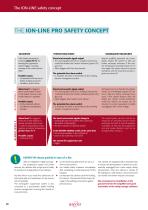
The ION-LINE safety concept THE ION-LINE PRO SAFETY CONCEPT WARNING MESSAGE SYSTEM REACTIONS If the interior temperature increases above 50 °C, the warning/fire suppression system triggers a warning message to the central control office. Visual and acoustic signal output • The warning light (red LED) is activated and permanently illuminated, the function indicator (green LED) goes out • Alarm triggers with slow tone interval Possible causes: • Temperature build-up due to battery charging processes • Ventilation system failure Alarm level 1 is triggered when smoke begins to form in the cabinet,...
Open the catalog to page 10
The ION-LINE safety concept FORWARDING ALARMS IS EASY WITH OUR OPTIONAL MODULES Whenever the cabinet is unattended, e.g. at night or on weekends, alarm forwarding is indispensable in an emergency. It is the only way to quickly detect the damage and initiate countermeasures. MODULE FOR REMOTE SIGNALLING RELAY MODULE The module offers an alarm forwarding via the mobile phone network (SMS/call) and is therefore especially suitable for companies and facilities without a central building management system. In an emergency, the immediate alerting of one or several defined persons is triggered. By choosing...
Open the catalog to page 11
ION-LINE | ION-CHARGE-90 Safe and approved passive and active storage of lithium-ion batteries in working areas Charging lithium-ion batteries safely in cabinets with 90 minutes fire resistance and outlet strips with earthed sockets ready to use. Cabinet can easily and quickly be evacuated in case of an emergency due to an integrated transport base. PRO model incl. LED display with visual and audible alarm for a quick indication of emergencies without opening the cabinet doors. PRO model with integrated fire suppression system, which automatically triggers in the event of a fire. PRO model incl....
Open the catalog to page 12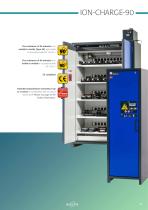
Fire resistance of 90 minutes from outside to inside (Type 90), type-tested in accordance with EN 14470-1 Fire resistance of 90 minutes from inside to outside in accordance with EN 1363-1 Extended manufacturer warranty of up to 10 years in combination with an asecos service tariff. Please see page 30 for further information.
Open the catalog to page 13