The new reference for continuous nitrogen analysis
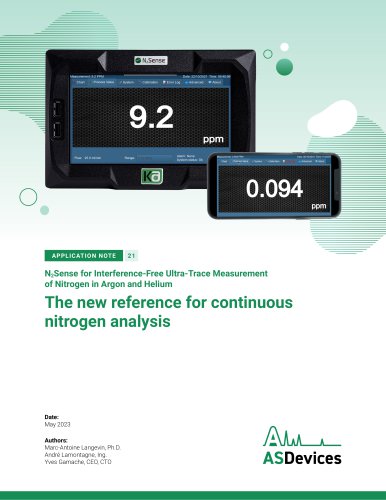
The new reference for continuous nitrogen analysis
The document discusses the critical role of ultra-high purity (UHP) argon and helium in industrial processes, particularly in semiconductor fabrication. It emphasizes the necessity of precise nitrogen impurity monitoring due to potential damage from low-ppb levels of impurities. The N2Sense analyzer, developed by ASDevices, is introduced as a new standard for nitrogen analysis, offering improved sensitivity and accuracy through Enhanced Plasma Discharge (Epd) technology.
The introduction highlights the importance of UHP argon and helium across various industries and the need for monitoring nitrogen impurities. It provides historical context with the development of the K2001 analyzer by Yves Gamache in the 1990s and outlines the evolution to the N2Sense analyzer, which addresses previous interference issues through spectral compensation.
This section details the impact of contamination and interfering impurities on analytical systems. It explains the calibration process of the N2Sense and the challenges posed by impurities such as moisture, oxygen, and organic compounds. The Enhanced Plasma Discharge (Epd) technology's ability to perform spectral compensation is described, reducing interference and improving measurement accuracy.
The document identifies various sources of moisture contamination, including atmospheric exposure during sampling and calibration cylinders. It discusses the challenges of purging moisture from sampling lines and the impact of different materials on contamination levels.
Aside from moisture, other contaminants like H2, O2, and CH4 are discussed. The document explains how the Epd technology's spectral compensation algorithm helps achieve stable results despite these impurities. It also highlights the importance of material selection in detector fabrication to minimize contamination.
The document explains how moisture affects system performance, causing longer response times and signal drift. It presents data showing the impact of moisture on N2 readings and emphasizes the limitations of older technologies without adequate compensation methods.
The N2Sense analyzer is described as a compact, user-friendly device with IIoT capabilities for remote access. The document highlights the importance of leak integrity and the use of high-quality materials in the gas flow path. The purged Electronic Pressure Controller (EPC) is noted for its role in maintaining system integrity.
The document provides an overview of the SePdd detector based on Epd technology, which enhances sensitivity and stability. It explains the spectral compensation algorithm's role in reducing noise and improving measurement accuracy. The document contrasts traditional plasma technologies with the advanced features of the N2Sense.
A demonstration is presented showing the effectiveness of spectral compensation in maintaining accurate N2 measurements despite moisture interference. The results highlight the superiority of the N2Sense over older technologies.
The N2Sense technology is designed for ultra-trace analysis, capable of detecting nitrogen concentrations as low as 1 ppb. It employs spectral compensation to mitigate the effects of impurities such as moisture, hydrogen, methane, and oxygen, ensuring accurate readings.
Figures in the document illustrate the effectiveness of spectral compensation in correcting baseline offsets caused by impurities. The N2Sense demonstrates a standard deviation of 0.150 ppb and a detection limit of 0.750 ppb, as per IEC 61207-1:2010 standards. The technology also shows minimal drift over 24 hours and a rapid response time of less than 5 seconds when switching samples.
The document emphasizes the importance of using high-quality components and the EPD technology's unique features to achieve the highest stability and accuracy in nitrogen quantification.
The N2Sense technology represents over 30 years of development in ultra-trace analysis, offering unprecedented detection limits and stability. Its spectral compensation capability is highlighted as a key advantage in maintaining accurate measurements despite the presence of impurities.
The document includes references to related studies and a legal disclaimer regarding the proprietary nature of the technology and its potential patent protections.
Catalog excerpts
N2Sense for Interference-Free Ultra-Trace Measurement of Nitrogen in Argon and Helium The new reference for continuous nitrogen analysis Date: May 2023 Authors: Marc-Antoine Langevin, Ph.D. André Lamontagne, Ing. Yves Gamache, CEO, CTO
Open the catalog to page 1
A B S T RACT Continuous measurement of ultra-trace level nitrogen in UHP argon and helium is a key application that requires highly sensitive and accurate instrumentation, especially in the semiconductor and air separation industries. 30 years ago, Yves Gamache, CEO of ASDevices, introduced the first plasma-based trace N2 in argon analyzer named K2001, which was considered as a standard in the industry. In 2017, ASDevices released new technologies, including the enhanced plasma discharge (Epd), an improved plasma-based detection technology that is now used in the N2Sense, leading to unprecedented...
Open the catalog to page 2
plasma discharge technology. Plasma discharges are highly reactive and impurities can lead to unexpected chemical reactions that might have negative effects on the system performance. The Enhanced Plasma Discharge (Epd) technology, which is used in the N2Sense, is capable of ‘’spectral compensation’’, a unique feature that prevents such interference. More details about this feature will be presented below. Sources of moisture contamination When monitoring argon coming directly from an air separation process, the level of moisture is well below 1 ppm and will generally not interfere with the N2...
Open the catalog to page 3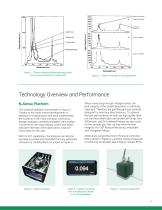
Moisture line cluster 0.1 ppm H2O added Figure 1 – Plasma baseline (Bremsstrahlung) offset due to various amounts of moisture [4] Figure 2 – Effect of moisture on N2 response [4] Technology Overview and Performance N2Sense Platform The N2Sense analyzer is presented in Figure 3. Thanks to the most recent developments in electronics miniaturization that were implemented, the N2Sense is the most compact continuous nitrogen analyzer currenwtly available on the market. Furthermore, the large display screen and latest software interface were optimized to improve conviviality for the user. When measuring...
Open the catalog to page 4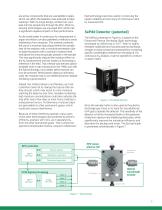
are active components that are susceptible to leaks, which can affect the baseline noise and lead to false readings. With its purge design, ambient air can’t leak into the sample line through the EPC. Other N2 sensing technologies use unpurged EPC, which has a significant negative impact on their performance. As the world leader in continuous N2 measurement in argon and helium, we also patented a method to avoid interference from moisture. This method combines the use of a moisture trap, placed before the sample inlet of the analyzer, with a moisture permeation tube to dope the plasma with a...
Open the catalog to page 5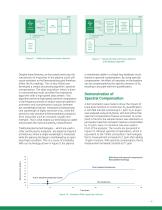
Plasma discharge Data acquisition Plasma discharge Synchronous measurement with over sampling and phase shift processing algorithm Advanced signal processing unit with spectral compensation Plasma discharge Electrodes Plasma discharge Electrodes EPD Plasma source power supply Plasma source power supply Feedback algorithm Figure 8 – Traditional plasma emission detector Figure 9 – Enhanced Plasma Emission detector with feedback algorithm Despite these features, as discussed previously, the introduction of impurities in the plasma could still cause variations in the Bremsstrahlung and therefore...
Open the catalog to page 6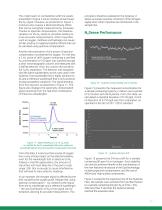
This might seem in contradiction with the results presented in Figure 2 since moisture should lower the N2 signal. However, as presented in Figure 1, moisture also causes a Bremsstrahlung offset that can be wrongfully measured as N2 increases. Thanks to spectral compensation, this baseline variation on the N2 signal is canceled, leading to more accurate measurements. Other impurities such as oxygen, methane and hydrogen can cause similar positive or negative baseline offsets that can be canceled using spectral compensation. Another demonstration of the power of spectral compensation is presented...
Open the catalog to page 7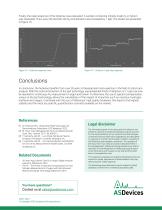
Finally, the step-response of the N2Sense was evaluated. A sample containing initially 4 ppb N2 in helium was measured. Then, every 30 seconds, the N2 concentration was increased by 1 ppb. The results are presented in Figure 15. Figure 14 – N2Sense response time Figure 15 – N2Sense 1 ppb step response Conclusions In conclusion, the N2Sense benefits from over 30 years of development and expertise in the field of ultra-trace analysis. With the recent introduction of the Epd technology, unprecedented limits of detection of >1 ppb can now be reached for continuous N2 measurement in argon and helium....
Open the catalog to page 8All ASDevices catalogs and technical brochures
 15 years ago
3 Pages
 TN-05
TN-058 Pages
 30 years ago
1 Page