


Trends in Patient Data and Alarm Management
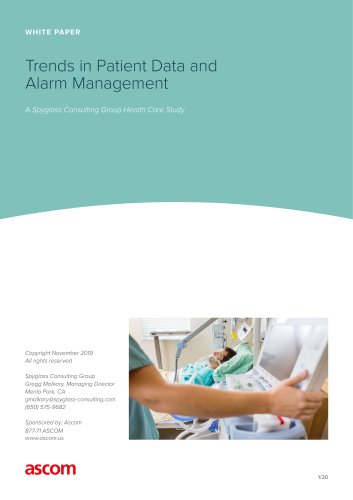
Trends in Patient Data and Alarm Management
- Purpose: The study by Spyglass Consulting Group focuses on identifying challenges and opportunities in Patient Data and Alarm Management solutions in high-acuity hospital environments.
- Target Audience: Aimed at clinical informatics and business decision-makers in hospitals and healthcare systems.
- Methodology: Conducted in May 2019, involving 30 clinical informatics and hospital IT leaders from North America, Europe, and Asia-Pacific.
- Hospitals are transitioning to patient-centered care, facing challenges such as sicker patients, complex care environments, labor shortages, and an increase in patient health data.
- Nurses face alert/alarm fatigue due to non-actionable alarms.
- Manual and delayed documentation frustrates healthcare providers.
- Information overload and communication inefficiencies affect care quality.
- 47% of hospitals have a Patient Data and Alarm Management strategy, with 70% making initial investments and 90% planning further investments.
- Solutions should integrate, orchestrate, and enable data management and alarm systems to improve patient care.
- Integrating medical devices and clinical systems is crucial for improving workflow, reducing errors, and enhancing patient safety.
- Data management, alarm management, and predictive analytics are essential for informed clinical decision-making and improving care provider efficiency.
- 60% of hospitals see high value in predictive analytics for early intervention in high-risk patients, focusing on sepsis detection, hospital-acquired infections, and more.
- Located in Toronto, it serves over 850,000 people and is one of the first fully digital hospitals in North America.
- Implemented Ascom Myco smartphones and Unite software to improve communication and reduce alarm fatigue.
- Developed a digital Command Center with GE Healthcare for predictive analytics to improve clinical and operational outcomes.
- Results include improved patient satisfaction, reduced cardiac arrest incidents, and optimized nursing workflows.
- Provide real-time patient data and alerts, helping staff prioritize care and respond efficiently to critical situations.
- Smartphones and unified communication tools are crucial for real-time notifications and efficient clinical workflows.
- Essential for deploying and managing patient data and alarm management solutions, optimizing clinical workflows, and improving care quality.
- Implemented a comprehensive digital solution integrating various systems to enhance patient safety and satisfaction.
- Exploring the concept of a 'Silent ICU' to reduce noise levels and improve patient outcomes by redirecting alarms to centralized monitoring stations.
- Hospitals are increasingly focusing on patient-centered care, investing in technologies to manage patient data and alarms effectively.
- Emphasizes the integration of medical devices for real-time data collection and orchestration of data management, alarm management, and predictive analytics.
- A market advisory firm specializing in disruptive technologies and growth opportunities in healthcare and life sciences.
- Founder of Spyglass, with over 30 years of experience in strategic planning and digital transformation.
- References various studies and reports, including those from the World Health Organization and GE Healthcare.
Catalog excerpts
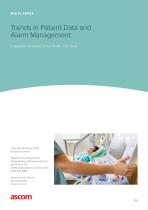
WHITE PAPER Trends in Patient Data and Alarm Management A Spyglass Consulting Group Health Care Study Copyright November 2019 All rights reserved Spyglass Consulting Group Gregg Malkary, Managing Director Menlo Park, CA [email protected] (650) 575-9682 Sponsored by: Ascom 877-71 ASCOM www.ascom.us
Open the catalog to page 1
Introduction Purpose Spyglass Consulting Group conducted a primary research study to identify challenges and opportunities for hospitals who are developing strategies and/or considering investments in Patient Data and Alarm Management solutions. These solutions are targeted at physicians, nurses, allied professionals, and support staff who are responsible for monitoring, managing and coordinating patient care within highacuity environments leveraging telemetry within the hospital including critical care, telemetry and step-down units. Target audience This Spyglass research study was targeted...
Open the catalog to page 2
Market opportunity Hospitals around the world are migrating toward patient-centered care. Physicians, nurses, allied professionals and support staff are under increased pressure to monitor, manage and coordinate patient care more effectively with a wider array of team members within the hospital and across the care continuum. Hospitals surveyed report several underlying market factors influencing investments in people, processes and technologies within critical care environments that include: Hospital patients are sicker Increasing healthcare costs are increasingly driven by a global aging population...
Open the catalog to page 3
Problem Hospitals surveyed expressed concerns that physicians, nurses, allied professionals, and support staff working in critical care environments are faced with a multifaceted and complex combination of people, process, and technology challenges that include: Nurses are experiencing alert/alarm fatigue Caused by an increased number of medical devices at the patient’s bedside, more than 90% of medical device alarms are considered clinically insignificant and nonactionable. Some nurses now deal with alarm distraction by ignoring the alarms and/or turning off the device acoustics which could...
Open the catalog to page 4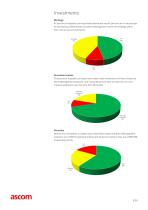
Investments Strategy 47 percent of hospitals surveyed have developed and 43 percent are in the process of developing a Patient Data and Alarm Management vision and strategy within their critical care environments. Investment plans 70 percent of hospitals surveyed have made initial investments in Patient Data and Alarm Management solutions, and nearly 90 percent plan to make new or incremental investments over the next 12 to 18 months. Priorities 60 percent of hospitals surveyed report that Patient Data and Alarm Management solutions are a HIGH investment priority and 23 percent believe they are...
Open the catalog to page 5
Solution Hospitals surveyed identified the value proposition for a Patient Data and Alarm Management solution and specific capabilities required by the care team to enhance the monitoring, management, and coordination of patient care within a critical care environment. Patient Data and Alarm Management solutions must support the ability to: ■■ Integrate. Medical device integration can integrate and collect near real-time data from medical devices and retrospective data from the EHR and other hospital legacy systems. ■■ Orchestrate. Data management, alarm management and predictive analytics tools...
Open the catalog to page 6
Integrate: Medical device and clinical systems integration Medical device and clinical systems integration can integrate and collect near real-time data and alarms from medical devices, creating an automated and standardized patient data stream to the EHR and the alarm management system. Hospitals surveyed report that the highest priorities for clinical workflow improvement include: ■■ Improving nursing staff efficiency and productivity ■■ Reducing the risk of transcription errors ■■ Enhancing patient safety and reducing risk of sentinel events ■■ Spending additional time with patients at the...
Open the catalog to page 7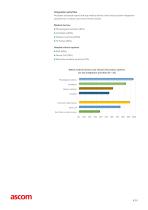
Hospitals surveyed report that top medical device and clinical system integration priorities for a critical care environment include: ■ Real-time location services (37%)
Open the catalog to page 8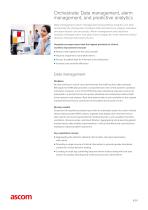
Orchestrate: Data management, alarm management, and predictive analytics Data management, alarm management and predictive analytics can help orchestrate the introduction of patient data and alarms to support individual and team-based care processes. Alarm management and predictive analytics leverage event- and data-driven insights for more informed clinical decision making at the point-of-care. Hospitals surveyed report that the highest priorities for clinical workflow improvement include: ■■ Reduce interruptions for the care provider ■■ Improve response to actionable alarms ■■ Access to patient...
Open the catalog to page 9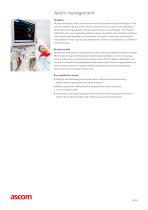
Alarm management Problem Nurses working in critical care environments are experiencing alarm fatigue. They are overwhelmed by the sheer volume of device alarms, events, and notifications which often lack appropriate clinical context and are not actionable. This makes it difficult for the nurse to prioritize patients’ needs, coordinate care with team members, and respond appropriately to critical events. A typical critical care nurse may be responsible for three high acuity patients each of which is connected to six different medical devices. Survey results 90 percent of hospitals surveyed believe...
Open the catalog to page 10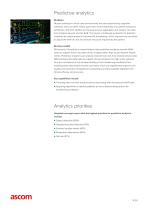
Problem Nurses working in critical care environments are also experiencing cognitive overload. They are often reliant upon their clinical expertise, the patient’s physical symptoms, and their abilities to manually access, aggregate, and analyze raw data from medical devices and the EHR. This poses a challenge to identify if a patient’s condition has deteriorated or become life threatening, which requires the care team to adjust the level of care and clinical resources required by the patient. 60 percent of hospitals surveyed believe that predictive analytics provide HIGH value to support event-...
Open the catalog to page 11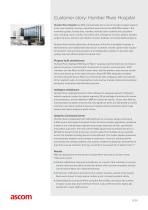
Customer story: Humber River Hospital Humber River Hospital has 656-licensed beds and is one of Canada's largest regional acute care hospitals, serving a catchment area of more than 850,000 people in the northwest greater Toronto area. Humber provides both in-patient and out-patient care, including cancer, cardiac and critical care, emergency services, dialysis, bariatric surgical services, women's and children services, diabetes and mental health programs. Humber River has the distinction of being one of the first fully digital hospitals in North America and collaborated with Ascom to deliver...
Open the catalog to page 12All ASCOM catalogs and technical brochures
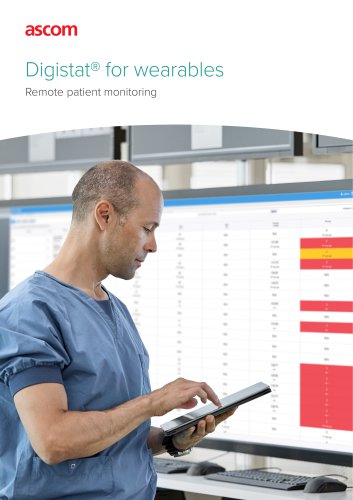 Digistat® for wearables
4 Pages
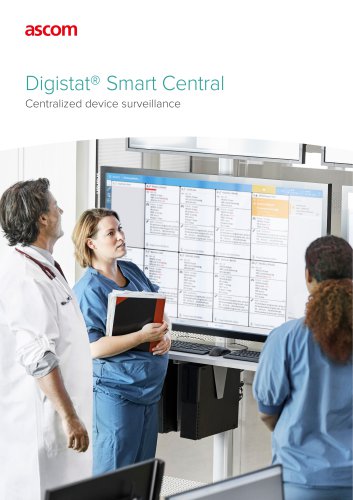 Digistat® Smart Central
6 Pages
 Ascom Ofelia
4 Pages
- Industrial telephone
- Remote monitoring module
- Wireless monitoring module
- Online monitoring module
- Alarm monitoring module
- Software suite
- Industrial smartphone
- Smart monitoring module
- Android industrial smartphone
- WiFi industrial smartphone
- 4G LTE industrial smartphone
- Operating system industrial smartphone
- Networked monitoring system
- Monitoring system with data logging
- IoT monitoring system
- IP68 industrial smartphone
- Internet monitoring system
- Rugged industrial smartphone
- IP monitoring module
- Industrial industrial smartphone