- Catalogs
- ASCO CARBON DIOXIDE
- Company Brochure

- Company
- Products
- Catalogs
- News & Trends
- Exhibitions
Company Brochure

Company Brochure
Carbon dioxide (CO2) is a colorless, inert gas essential for life, playing a crucial role in photosynthesis. It exists in gaseous, liquid, and solid forms, with applications in the beverage, food, and industrial sectors.
ASCO offers systems like Stack Gas Recovery, By-Product Recovery, and Gas Revert Recovery to capture and purify CO2 for commercial use.
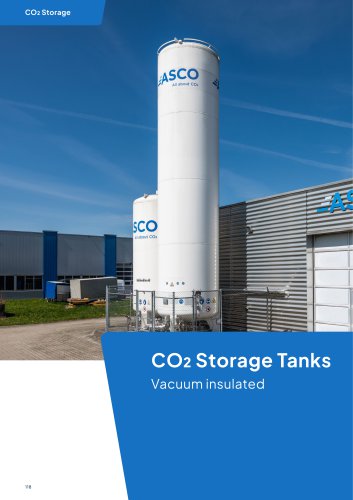
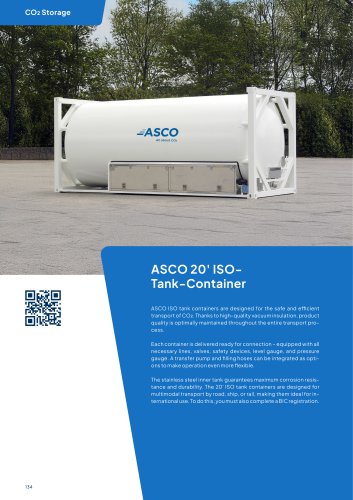
ASCO provides vacuum-insulated and polyurethane-insulated storage tanks, ISO tank containers, and transportable CO2 tanks to maintain CO2 in its liquid state.
ASCO offers systems for water neutralization and atmospheric vaporisers to convert liquid CO2 back into gas.
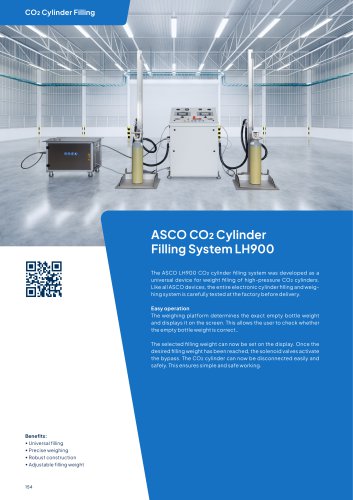
The ASCO LH900 system and transfer pumps ensure efficient CO2 cylinder filling and transfer.
ASCO provides equipment like the CO2 Gas Purity Tester to ensure CO2 quality and purity.
ASCO offers flowmeters, cylinder valves, and safety equipment like CO2 gas detectors for safe handling.
ASCO manufactures dry ice production equipment and storage solutions for industrial applications.
ASCO provides dry ice blasting technology for cleaning and surface preparation.
ASCO Carbon Dioxide Ltd offers CO2 recovery technologies to transform vented flue gas into usable CO2, reducing costs and environmental impact.
This technology captures CO2 from flue gas, offering benefits like reduced energy usage and high-quality CO2 production.
- Durable stainless steel construction.
- Low energy consumption.
- High CO2 extraction efficiency.
- Flexible layout for installation.
- Environmental friendliness with water recirculation.
- Oil-free CO2 compressor.
The process involves cooling and treating flue gas to remove impurities before CO2 extraction using the ASCOSORB solvent.
These systems recover CO2 from sources like fermentation, offering low costs and high purity.
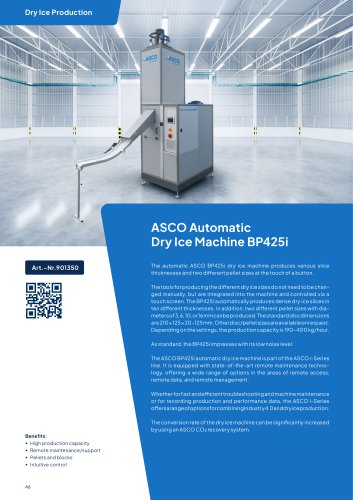
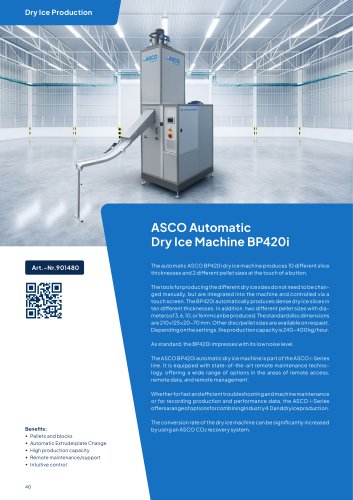
Designed to recover CO2 from dry ice production, reducing costs with automatic operation and remote control.
ASCO's technologies provide efficient CO2 extraction and purification solutions with economic and environmental benefits.
Available in capacities like RRS 320i, these systems recover CO2 gas from dry ice production, featuring modular design and remote maintenance.
Includes Remote PanelView, spare parts packages, and various water cooling systems.
ASCO offers vacuum insulated tanks with capacities from 6.4 to 28.0 tons, compliant with PED 2014/68/EU and AD2000 standards.
Storage tanks are available in horizontal and vertical configurations, adaptable for other cryogenic gases.
Capacities range from 32.0 t to 100.0 t, with specific dimensions and pressure settings.
Capacities range from 11.0 t to 50.0 t, with specific dimensions and pressure settings.
Available in vertical and horizontal configurations, with capacities from 10 t to 100 t.
Designed for easy installation and operation, with safety features and compliance with international standards.
Available in capacities from 10 to 100 tons, with specific features and construction materials.
Similar to vertical tanks, with specific dimensions and features.
Includes refrigeration units, heating units, and monitoring options.
Designed for multipurpose transportation of CO2 and other gases, compliant with international codes.
Details on ISO tank containers, including dimensions, weight, and insulation type.
Includes flow diagrams and handling instructions for CO2 containers.
Containers comply with ISO 668 and other national standards.
ASCO recommends their tanks for efficient logistics and easy maintenance.
Short loading times, high capacity, and special insulation.
Lists standard capacities for ISO tank containers and transportable tanks.
Designed for precise CO2 dosing, customizable for each installation.
Designed to reduce vaporisation costs, available in various capacities.
Details on vaporiser models, including dimensions and power consumption.
Designed for high-pressure cylinder filling, with options for simultaneous filling.
Details on ASCO CO2 equipment, including transfer pumps, testing equipment, and valves.
- Specifications for low pressure applications.
- Models with specific features.
- Gas Purity Tester for CO2 purity.
- Carbonation Tester for detecting odors.
- Dew Point Tester for moisture content.
- Accurate measurement with no moving parts.
- Models with specific ranges.
- Regulate CO2 supply in cylinders.
- High-flow valves for stable operation.
- Models with specific pressure ratings.
Specifications and features for dry ice production, including remote access and control system.
Specifications for higher production capacity and control features.
Specifications for even higher production capacity and control features.
Specifications for producing slices and pellets with advanced control features.
Details on ASCO BP420i and BP425i machines for dry ice production.
Production capacity, voltage, dimensions, and other technical details.
Advanced control systems and remote management capabilities.
Includes upgrades and spare parts for maintenance.
Suitable for various industries, producing high-quality dry ice.
ASCO machines offer versatile solutions for dry ice production.
Details on ASCO Dry Ice Reformer R70i and other equipment.
Converts dry ice pellets into blocks with continuous monitoring.
Advanced control systems and remote capabilities.
Includes podiums, conveyor belts, and spare parts.
Designed for cutting dry ice slices.
Wraps dry ice slices efficiently.
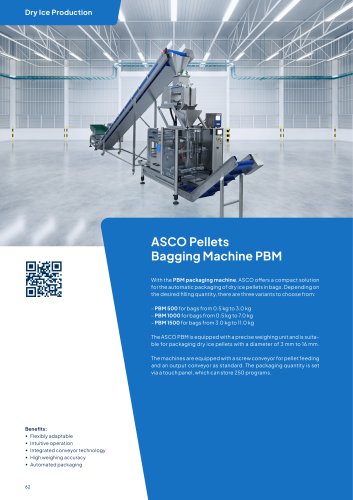
Automated bagging of dry ice pellets.
Includes rotary tables and packaging films.
Efficient refilling of dry ice pellets for various industries.
Maintains cold chains for cryogenic conditions.
Advanced control systems and safety features.
Non-abrasive cleaning method using CO2 pellets.
- Increased productivity and cost savings.
- Environmentally friendly with no toxic residues.
Enhances dry ice production efficiency by recovering CO2 gas.
Details on ASCO's dry ice blasting technology and models.
- Applicable in numerous industries for cleaning.
- Modern design with safety features.
- Compact and mobile unit for industrial use.
- Various nozzles and protective accessories.
ASCO's dry ice blasting technology offers versatile cleaning solutions.
Catalog excerpts

Product Catalogue The Complete CO2 Solution Version 5.0
Open the catalog to page 1
TableofofContents Contents Table General Information about CO2 CO2 Gas Dosing for Water Neutralisation • ASCO CARBON DIOXIDE LTD | Hofenstrasse 19 | CH–9300 Wittenbach | T +41 71 4
Open the catalog to page 2
ASCO Dry Ice Blasting Technology • • • • ASCO reserves the right to modify all specifications without prior notice. All photos and drawings are used for marketing purposes only. ASCO CARBON DIOXIDE LTD | Hofenstrasse 19 | CH–9300 Wittenbach | T +41 71 466 80 80 | ascoc
Open the catalog to page 3
General Information about CO2 What is CO2? Carbon dioxide is the combination of two atoms of oxygen joined with a single atom of carbon. Its chemical formula CO2, is almost as well known as that of water, H2O and it is frequently referred to by its formula rather than its name. In nature’s chain of life, the mutual dependence of plant and animal life is maintained though the link of carbon dioxide. Every time we breathe we release this gas, which plants need for life. Though the process of photosynthesis, the plants separate the carbon from the oxygen. In turn, plants release the pure oxygen,...
Open the catalog to page 4
General Information about CO2 Low pressure liquid CO2 (sometimes referred to as “bulk”) is transported to one place from another in insulated road tankers or trailers (or, in some countries, by rail tank wagons), the liquid being simply transferred from mobile to static tank by pumping or gravity feed. Unlike water, carbon dioxide cannot exist in the open air in liquid form. It must be held under pressure or refrigeration (or a combination of both) to remain in the liquid state. SOLID CO2 (customarily known as “DRY ICE”) Dry ice is the product of processing liquid CO2. If the pressure of liquid...
Open the catalog to page 5
General Information about CO2 From Liquid CO2 into Dry Ice Carbon Dioxide has 3 physical states of gas, liquid and solid which depend on temperature and pressure. The relationship between the 3 states is shown on the pressure-temperature phase diagram beside. Where does CO2 come from? CO2 is derived from a number of sources including combustion of carbonaceous fuels, fermentation, natural wells, and as a by-product of industrial processes such as ethylene oxide and bioethanol production and ammonia synthesis. CO2 phase diagram Below the triple point (5.2 bar (75 psi) , - 56.6 °C) CO2 can only...
Open the catalog to page 6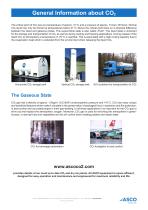
General Information about CO2 The critical point of CO2 lies at a temperature of approx. 31 °C and a pressure of approx. 74 bar (1073 psi). Normal CO2 liquid can only be formed at temperatures below 31 °C. Above the critical point there is no physical difference between the liquid and gaseous phase. This supercritical state is also called „Fluid“. The liquid state is important for the storage and transportation of CO2 as well as during cooling and freezing applications. During release of the liquid CO2 to atmosphere a temperature of -79 °C is reached. This is associated with a high cooling capacity...
Open the catalog to page 7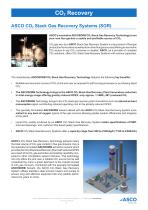
CO2 Recovery ASCO CO2 Stack Gas Recovery Systems (SGR) ASCO’s innovative ASCOSORB CO2 Stack Gas Recovery Technology turns your vent flue gas into a usable and profitable source of CO2. CO2 gas won by a ASCO Stack Gas Recovery System is a by-product of flue gas production from boilers as well as from other flue gas sources offering an economic CO2 source to any CO2 consumer or reseller. ASCO, as a provider of complete CO2 solutions, offers CO2 Stack Gas Recovery Systems with various capacities. The revolutionary ASCOSORB CO2 Stack Gas Recovery Technology features the following key benefits: •...
Open the catalog to page 8
ASCO CO2 Stack Gas Recovery Systems: Features Stainless steel construction Long plant longevity Integrated amine recovery Contributing to the already reduced OPEX Low carbon foot print Retrofits easily to existing CO2 production plants Modernize your existing plant by eliminating fuel burning and saving up to 70 % production costs. Flexible layout Compact, modular component design means fast and easy installation and provides an economical use of available space, covering a variety of different layouts. Inline scrubber water recirculation and treatment system Designed to handle all the process...
Open the catalog to page 9
ASCO CO2 Stack Gas Recovery Systems General process description Flue gas from boiler exhausts (be it existing, new or even power generators) contain combustion products like CO2, water vapor, N2, O2, CO, and possibly SO2 depending on the fuel being used. This flue gas, under the ASCOSORB process, is first cooled and treated for SO2 effectively rendering a flue gas to a proper operating temperature and reaching an acceptable level of SO2 prior to entering the ASCOSORB process of CO2 Gas extraction. Once cooled and treated the flue gas enters the CO2 stack gas recovery system for extraction of...
Open the catalog to page 10
ASCO CO2 Stack Gas Recovery Systems Standard Layout Proposal dimensions in mm (in) Capacity Subject to technical changes / improvements ASCO CARBON DIOXIDE LTD | Hofenstrasse 19 | CH–9300 Wittenbach | T +41 71 466 80 80 | ascoco2.com Version 5.0 (05/24)
Open the catalog to page 11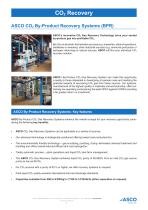
CO2 Recovery ASCO CO2 By-Product Recovery Systems (BPR) ASCO’s innovative CO2 Gas Recovery Technology turns your vented by-product gas into profitable CO2. Be it for an alcoholic fermentation process (e.g. breweries, ethanol operations, distilleries or wineries), other industrial sources (e.g. ammonia production or hydrogen reforming) or natural sources, ASCO will find your individual CO2 recovery solution. ASCO’s By-Product CO2 Gas Recovery System can make this opportunity a reality to those interested in developing a business case and realizing the potential rewards of recovering CO2 gas from...
Open the catalog to page 12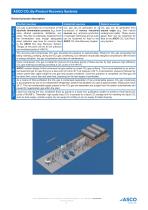
ASCO CO2 By-Product Recovery Systems General process description Alcohol sources Industrial sources Natural sources CO2 gas is generated as a by-product of the alcoholic fermentation process (e.g. brew eries, ethanol operations, distilleries, win eries). This then is collectively reclaimed from the fermentation area though adequately sized collection pipe lines for common feed to the ASCO CO2 Gas Recovery System. The gas at this point will be at low pressure and combined purity of >98.5 %. CO2 gas can be generated as a by-product of various industrial sources (e.g. ammonia production or hydrogen...
Open the catalog to page 13All ASCO CARBON DIOXIDE catalogs and technical brochures
 20' ISO-Tank Container
4 Pages
 Dry Ice Machine BP425i
5 Pages
 Dry Ice Machine BP420i
5 Pages
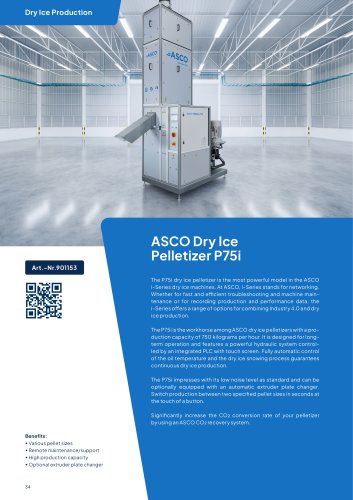 Dry Ice Pelletizer P75i
6 Pages
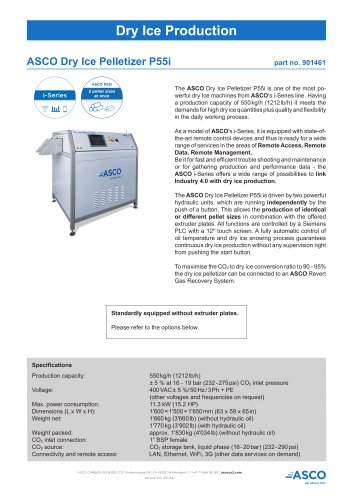 Dry Ice Pelletizer P55i
3 Pages
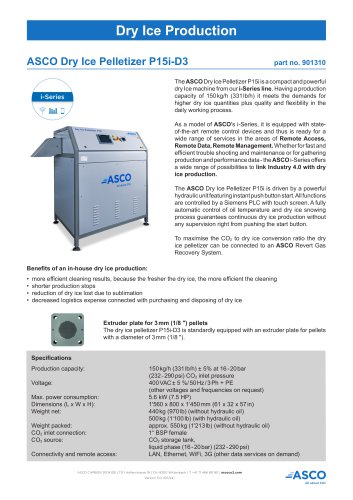 Dry Ice Pelletizer P15(i)
3 Pages
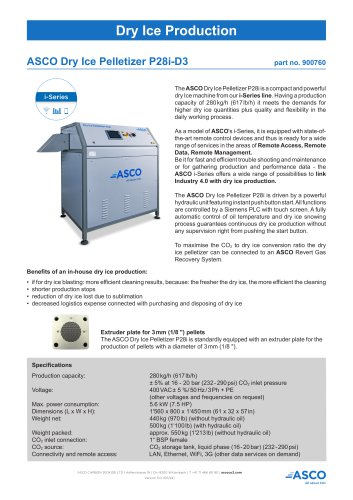 Dry Ice Pelletizer P28(i)
3 Pages
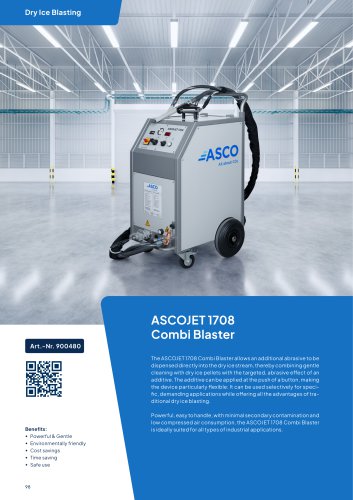 Dry Ice Blasting Unit 1708
8 Pages
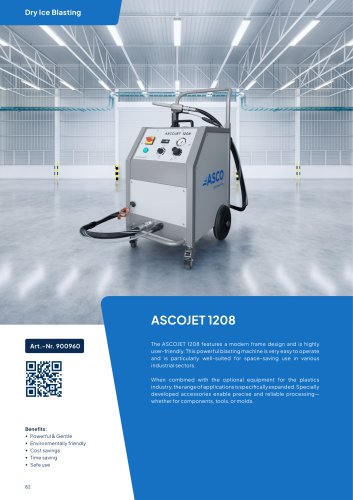 Dry Ice Blasting Unit 1208
7 Pages
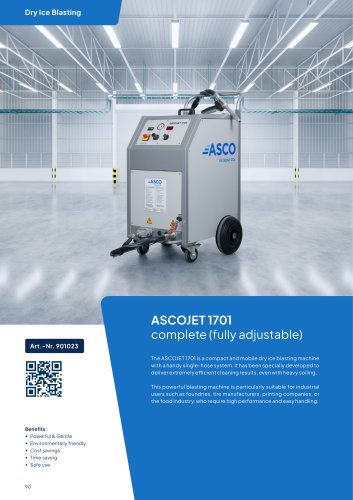 Dry Ice Blasting Unit 1701
8 Pages
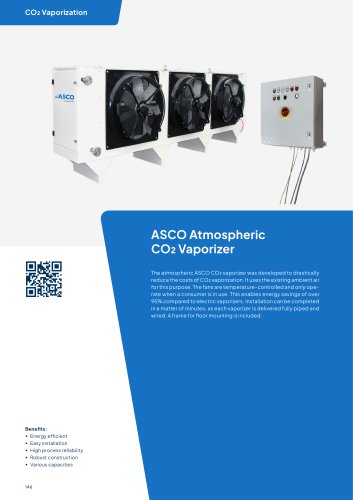 Atmospheric CO2 Vaporiser
8 Pages
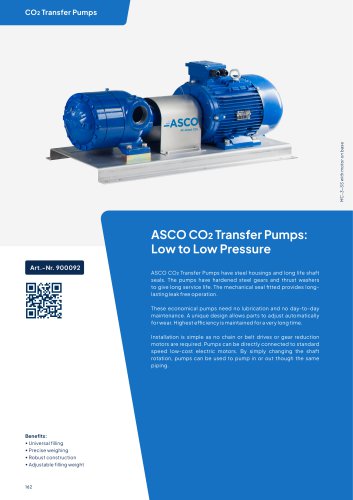 CO2 Transfer Pump
3 Pages
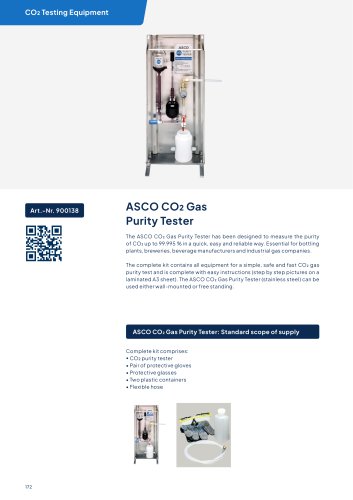 CO2 Gas Purity Tester
2 Pages
 CO2 Carbonation Tester
1 Page
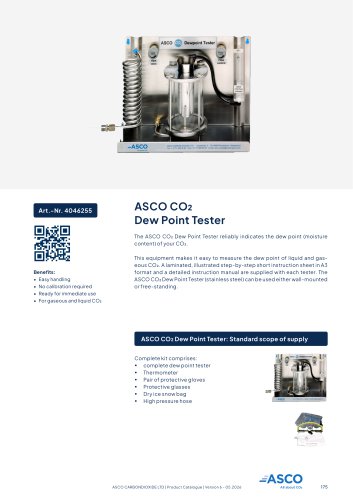 CO2 Dew Point Tester
1 Page
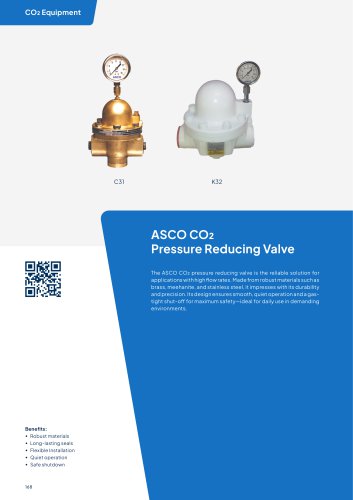 Pressure Reducing Valve
2 Pages
 CO2 Gas Detector
2 Pages
 Dry Ice Box AT126
1 Page
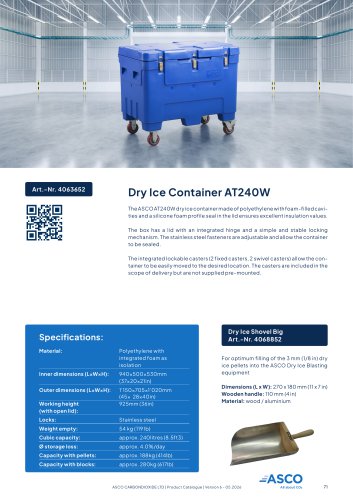 Dry Ice Container AT240W
1 Page
 Dry Ice Container AT440
1 Page
 CO2 Transfer Pumps
3 Pages
 Transportable CO2 Tank
2 Pages
 Dry Ice Reformer R70i
3 Pages
 Overview Dry Ice Production
3 Pages
 ASCO Carefree Rental Options
3 Pages